Home Blog Page 58

Investing for beginners: How to save millions for the future – I Will Teach You To Be Rich


0
Investing for beginners: How to save millions for the future – I Will Teach You To Be Rich

Investing is one of those things in life people know they should start doing — but never get around to actually doing it.

And … why? Especially since there are so many reasons to get started:

  • Retirement. The most obvious reason you should start investing. With retirement vehicles like 401ks and Roth IRAs giving you lucrative tax advantages, you can rest easy knowing you’ll be set up for your future.
  • Generate income. If you’re willing to get really into the weeds of investing, you can treat it like another source of income (but not your only source).
  • It’s easy to do. When you couple investing with automated systems, you won’t have to worry about manually investing money each month. This will save you time you can spend on ways to generate even more income.

That’s why I want to show you how you can get started investing for beginners. The best part is you don’t need that much money either. In fact, you can start investing today with just $50.

Let’s dive in and find out how.

Investing for beginners: The Ladder of Personal Finance

There are five steps you should take to invest.

Each step builds on the previous one, so when you finish the first, go on to the second. If you can’t get to the fifth step, don’t worry. You can still feel great since most people never even get to the first step.

Here’s how it works:

  • Rung #1: 401k. Each month you should be contributing as much as you need to in order to get the most out of your company’s 401k match. That means if your company offers a 5% match, you should be contributing AT LEAST 5% of your monthly income to your 401k each month.
  • Rung #2: Your debt. Once you’ve committed yourself to contributing at least the employer match for your 401k, you need to make sure you don’t have any debt. If you don’t, great! If you do, that’s okay. You can check out my system on eliminating debt fast to help you.
  • Rung #3: Roth IRA. Once you’ve started contributing to your 401k and eliminated your debt, you can start investing into a Roth IRA. Unlike your 401k, this investment account allows you to invest after-tax money and you collect no taxes on the earnings. As of writing this, you can contribute up to $5,500 / year.
  • Rung #4: Max out 401k. If you have money left over, go back to your 401k and contribute as much as possible to it (this is above and beyond the employer match). You can contribute up to $18,000/year on your 401k if you’re under 50. So you should have no issue continuing to invest in your 401k.
  • Rung #5: Non-retirement account. If you have money left, open a regular non-retirement account and put as much as possible there. Also pay extra on any mortgage debt you have, and consider investing in yourself — whether it’s starting a side hustle or getting an additional degree, there’s often no better investment than your own career.

The Ladder of Personal Finance is pretty handy when considering what to prioritize when it comes to your investments. For more, check out my less-than-3-minute video where I explain it.

This system shows you where you should be investing your money. Now I want to take a deeper look into a few of these rungs as well as show you a system to automate it all.

401k: Free money from your employer

A 401k is one of the most powerful investment vehicles at your disposal.

Here’s how it works: Each time you get your paycheck, a percentage of your pay is taken out and put into your 401k pre-tax. This means you’ll only pay taxes on it after you withdraw your contributions when you retire.

Often times, your employer will match your contributions up to a certain percentage.

For example, imagine you make $150,000 / year. Your company offers 3% matching with their 401k plan. If you invested 3% of your salary (around $5,000) into your 401k, your company would match your amount — effectively doubling your investment.

Here’s a graph showcasing this:
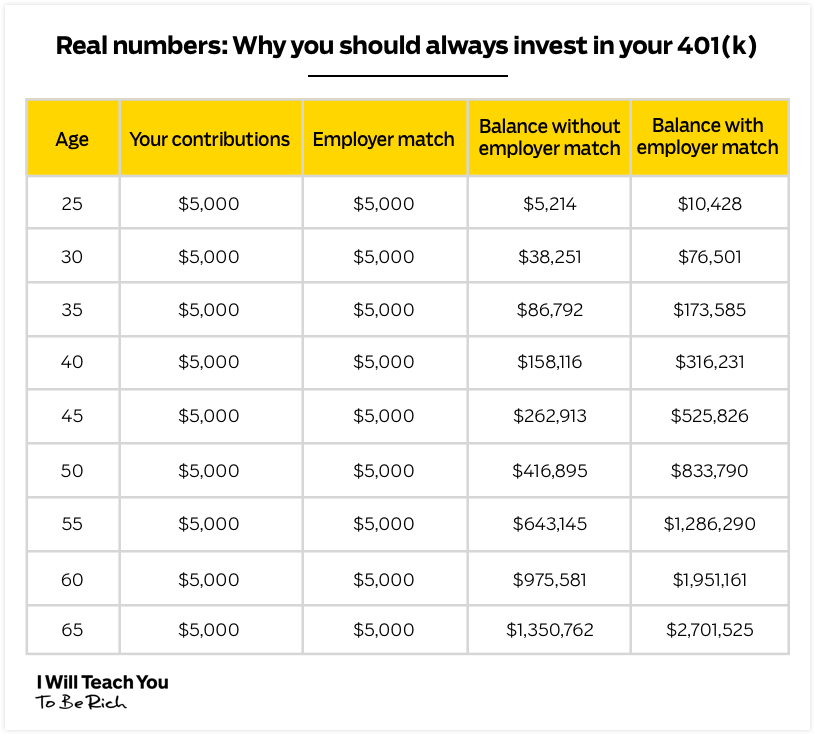
image00 4 4

This, my friends, is free money (aka the best kind of money).

Not all companies offer a matching plan — but it’s rare to find one that doesn’t. If your company offers a match you should at least invest enough to take full advantage of it.

Where’s my money going?

You have the option to choose your investments when you put money into a 401k. However, most companies also give you the option to entrust your money with a professional investing company. They’ll give you a variety of investment options to choose from and can help answer any questions you have about your 401k.

The other great thing about 401ks is how easy they are for you to set up. You just have to opt in when your company’s HR department offers it. They’ll withdraw only as much as you want them to invest from your paycheck.

When do I get my money?

You can take money out of your 401k when you turn 59 ½ years old. This is the beginning of the federally recognized retirement age.

Of course you CAN take money out earlier — but Uncle Sam is going to hit you with a 10% federal penalty on your funds along with the taxes you have to pay on the amount you withdraw.

That’s why it’s so important to keep your money in your 401k until you retire.

If you should ever decide to leave your company, your money comes with you! For more on 401ks, be sure to check out my article on how the account is the best way to grow your money.

Roth IRA: The best long-term investment

Further down the ladder is the Roth IRA. This is another vehicle for long-term investing.

Unlike a 401k, a Roth IRA leverages after-tax money to give you an even better deal. This means you put already taxed income into investments such as stocks or bonds and pay no money when you withdraw it.

When saving for retirement, your greatest advantage is time. You have time to weather the bumps in the market. And over years, those tax-free gains are an amazing deal.

Your employer won’t offer you a Roth IRA. To get one, you’ll have to go through a broker — of which there are a LOT.

There are a lot of elements that can determine your decision, including minimum investment fees and stock options.

A few brokers we suggest are Charles Schwab, Vanguard (this is the one I use), and E*TRADE.

NOTE: Most brokers require a minimum amount for opening a Roth IRA. However, they might waive the minimum if you set up a regular automatic investment plan.

As of 2018, the yearly maximum investment for a Roth IRA is $5,500. This amount changes often though so be sure to check out the IRS contribution limits page to keep updated.

Where’s my money going?

Once your account is set up, you’ll have to actually invest the money.

Let me say that again, once you set up the account and put money into it, you still need to invest your money. 

If you don’t purchase stocks, bonds, ETFs, or whatever else, your money will just be sitting in a glorified savings account not accruing any substantial amount of interest.

My suggestion for what you should invest in? An index fund that tracks the S&P 500. The S&P 500 averages a return of 10% and is managed with barely any fees.

For more, read our introductory articles on stocks and bonds to gain a better understanding of your options. I created a video that’ll show you exactly how to choose a Roth IRA.

When do I get my money?

Like your 401k, you’re expected to treat this as a long-term investment vehicle. You are penalized if you withdraw your earnings before you’re 59 ½ years old.

You can, however, withdraw your principal, or the amount you actually invested from your pocket, at any time, penalty-free (most people don’t know this).

There are also exceptions for down payments on a home, funding education for you/partner/children/grandchildren, and some other emergency reasons.

But it’s still a fantastic investment to make — especially when you do it early. After all, the sooner you can invest, the more money your investment will accrue.

Asset allocation: The most important thing in investing

401ks and Roth IRAs are the baseline investment vehicles you need to have.

If you want to start dipping your toes in building your own portfolio (collection of investment assets) beyond these investment vehicles, I want to introduce you to one key concept: Asset allocation.

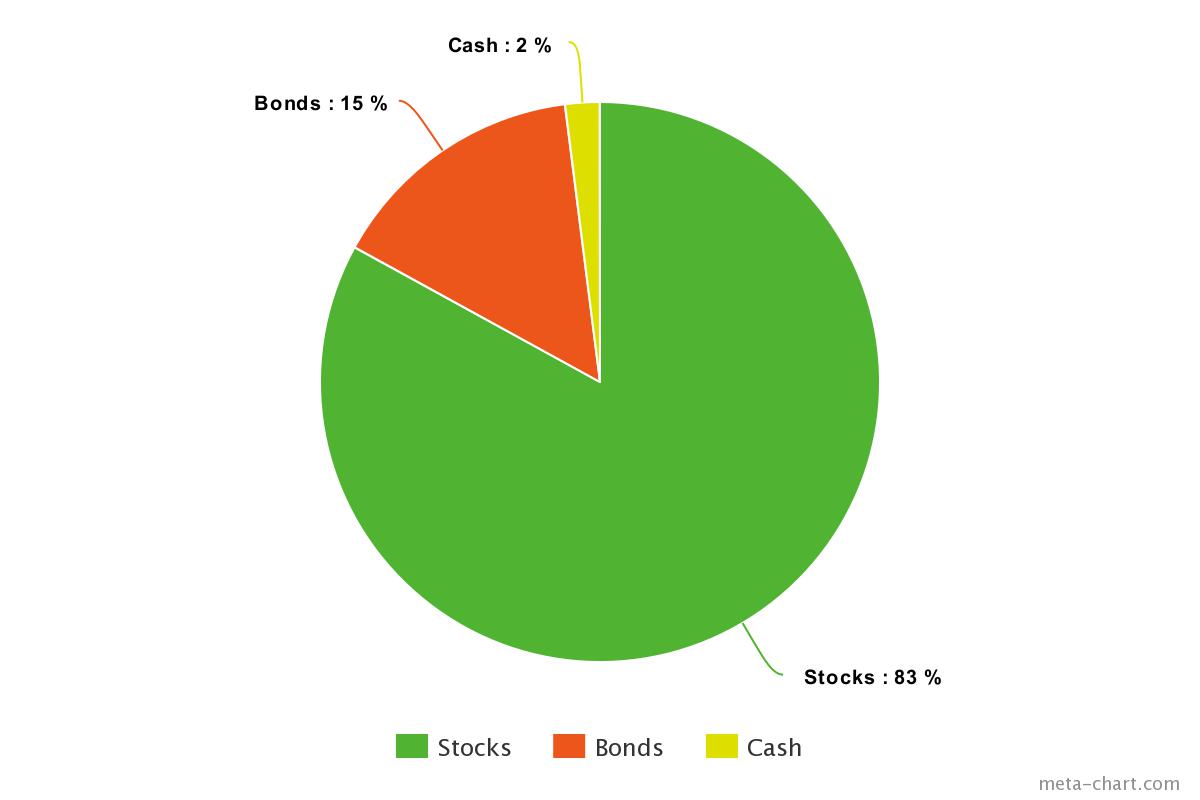
Here’s my portfolio:
meta chart 2 2

Inevitably, whenever I’m teaching someone about the basics of investing, someone will pipe up with a myriad questions, like these:

  • “What stocks should I buy?”
  • “Is X company a good investment?”
  • “Is $XX too much for this stock?”

Pump the breaks on that a bit.

Before you make an investment in any sort of stock or bond or whatever, you need to understand that’s not nearly as important as asset allocation (i.e., what your pie looks like).

When you invest, you can do so by allocating your money across different asset classes. Though there are many different kinds of asset classes, the three most common ones are:

  • Stocks and mutual funds (“equities”). When you own a company’s stock, you own part of that company. These are generally considered to be “riskier” because they can grow or shrink quickly. You can diversify that risk by owning mutual funds, which are essentially baskets of stocks.
  • Bonds. These are like IOUs that you get from banks. You’re lending them money in exchange for interest over a fixed amount of time. These are generally considered “safer” because they have a fixed (if modest) rate of return.
  • Cash. This includes liquid money and the money that you have in your checking and savings accounts.

Investing in only one category is dangerous over the long term. This is where the all-important concept of asset allocation comes into play.

Remember it like this: Diversification is D for going deep into a category (e.g., stocks have large-cap stocks, mid-cap stocks, small-cap stocks, and international stocks).

Asset allocation is A for going across all categories (e.g., stocks, bonds, and cash).

How much you allocate in each asset class depends completely on you and your risk tolerance. For example, if you’re young and have many years before you retire, you might want to invest more in things like stocks. But if you’re older and are close to retirement age, you want to hedge your bets as much as possible and go with safe investments like bonds.

You don’t want to keep all your investments in one basket. Keep your asset allocation in check by buying different types of stocks and funds to have a balanced portfolio — and then further diversifying in each of those asset classes.

A 1991 study discovered that 91.5% of the results from long-term portfolio performance came from how the investments were allocated. This means that asset allocation is CRUCIAL to how your portfolio performs.

If you want some more solid examples of portfolio mixes, check out my article on asset allocation and diversification.

Stocks and CDs and bonds — oh my!

If you want to start getting into the weeds, there are a ton of different asset classes you can choose from and even more variety in individual investments you can make.

If you want to learn more about some of these investment options, be sure to check out my resources below:

For now, I want to show you a system that’ll allow you to invest passively — saving you time and energy.

Automate your system

Automating your personal finances helps you control your finances by putting in place a system that works passively.

This means that instead of worrying about how much you have to spend each month or manually saving and investing, you can just set it all up once and only worry about it a few hours a year.

And it’s simple:

Step 1: Have your bills sent to you on the first of the month

Call up all the companies that bill you (e.g., credit card, electric, water, cable) and have them bill on the 1st. This lets you know exactly when you’re going to be billed so you’re never confused by a surprise gas bill again.

Of course, this is assuming you’re being paid on the first of the month. If not, you can adjust the day accordingly.

Step 2: Set up your 401k

You should have your 401k set up so that your money is being invested before it even arrives in your checking account.

Remember to contribute at least enough to collect on your employer match.

Step 3: Automate your checking account

Once your paycheck actually arrives into your checking account, the money will now go into four buckets:

  1. Roth IRA: Remember, you’re going to want to max it out as much as possible, so if you can contribute enough to hit $5,500 / year (or $458.33 / month), do so.
  2. Savings account: Here is where you save for mid- to long-term money goals like your wedding, vacation, or down payment on your house. Many banks provide the option to create smaller sub-accounts in your normal savings account — perfect for goal setting.
  3. Credit card: Make automatic payments for recurring services like Netflix, Blue Apron, and gym memberships using your credit card. Also, if you’re maxing out your 401k and Roth IRA, you’re going to have plenty of guilt-free spending money in here for things like the occasional night out or fun purchases you want to make.

    Log into your credit card’s website and set up automatic payments with your checking account so your credit card bill is paid off each month. You can rest assured that you will have enough money in your checking because you’ve already set up automatic payments with everything else.

  4. Misc. bills: These are for bills that can’t be paid off with a credit card such as rent, electric, water, and gas.

Set it up so that your checking account automatically sends funds to these four areas on your bank’s website — or you can just call your bank and have them do it for you. Or you could go to the bank in person, sort out your accounts, and make a new friend.

For a more detailed explanation, you can check out my 12-minute video on how to automate your finances here.

Master your personal finances today

If you want even more actionable tactics to help you manage AND make more money, you’re in luck. I wrote a FREE guide that goes into detail on how you can get started doing just that.

Join the hundreds of thousands of people who have read it and benefitted from it already by entering your information below to receive a PDF copy of the guide.

When you’re done, read it, apply the lessons, and shoot me an email with your successes — I read every email.


Yes, send me the Ultimate Guide to Personal Finance

Click here to see the full story

20 Rules of Personal Finance – A Wealth of Common Sense

0
20 Rules of Personal Finance – A Wealth of Common Sense

Meb Faber asked a bunch of us bloggers to give him our top 3-5 most read blog posts of the year. I looked back at my trusty Google Analytics for the first time in a while and discovered that two of my top three in terms of readership were personal finance-related posts. I’ve always said that personal finances are more important than portfolio management, but I still think there’s probably not enough people writing or providing education on the topic.

So I’m going to make a concerted effort to write more about personal finance in the coming year.

Here’s my list of 20 personal finance rules:

1. Salary is not the same as savings. Your net worth is more important than how much money you make. It’s amazing how many people don’t realize this simple truth. Having a high salary does not automatically make you rich; having a low salary does not automatically make you poor. All that matters is how much you save out of your salary.

2. Saving is more important than investing. Pay yourself first is such simple advice, but so few people do this. The best investment decision you can make is setting a high savings rate because it gives you a huge margin of safety in life.

3. Avoid credit card debt like the plague. Carrying credit card debt is a great way to negatively compound your net worth.

4. Live below your means, not within your means. The only way to get ahead financially is to stay behind your own earnings power.

5. But credit itself is important. Likely the biggest expense over your lifetime will be interest costs on your mortgage, car loans, student loans, etc. Having a solid credit score can save you tens of thousands of dollars by lowering your borrowing costs. So use credit cards, but always pay off the balance each month.

6. If you want to understand your priorities look at where you spend money each month. You have to understand your spending habits if you ever wish to gain control of your finances. The goal is to spend money on things that are important to you but cut back everywhere else. And if you pay yourself first you don’t have to worry about budgeting, you just spend whatever’s left over.

7. Automate everything. The best way to save more, avoid late fees, make your life easier and get out of your own way is to automate as much of your financial life as possible. It probably takes me one hour a month to keep track of everything because it’s all on autopilot.

8. Get the big purchases right. I know I shouldn’t be so judgmental but whenever I see $50-$70k SUVs on the road or enormous McMansions the first thing that pops into my head is, “I wonder how much they have saved for retirement?” Personal finance experts love to debate the minutia of brown bag lunches and lattes but the most important purchases in terms of keeping your finances in order will be the big ones — housing and transportation. Overextending yourself on these can be a killer.

9. Build up that savings account. I don’t even like calling it an emergency savings account anymore because most of the time these “emergencies” are things you should plan on happening periodically. You have to have liquid assets to take care of things when life inevitably gets in the way.

10. Cover your insurable needs. This is another huge personal finance margin of safety item. Just remember that insurance is about protecting wealth, not building it.

11. Always get the match. I can’t tell you how many times I’ve talked to people who aren’t saving enough in their 401(k) plan to get the employer match. That’s like turning down a tax-deferred portion of your salary each year. I’d like to see more people max out their retirement contributions, but at a minimum you should *always* save enough to get the match.

12. Save a little more each year. The trick is to increase your savings rates every time you get a raise so you’ll never even notice that you had more money to begin with. Avoiding lifestyle creep can be difficult, but that’s how you build wealth.

13. Choose your friends and neighborhood wisely. Robert Cialdini has written extensively on the concept of social proof and how we mirror the actions of others to gain acceptance. Trying to keep up with spendthrift friends or neighbors is a never-ending game with no true winners.

14. Talk about money. It takes all of 5 minutes before I hear about politics in almost any conversation these days, but somehow money is still a taboo subject. Talk to your spouse about money. Ask others for help. Don’t allow financial problems to linger and get worse.

15. Material purchases won’t make you happier in the long-run. There is something of a short-term dopamine hit we get through retail therapy but it always wears off. Buying stuff won’t make you happier or wealthier.

16. Read a book or ten. There are countless personal finance books out there. If it bores you to death then at least skim through a few and pick out the best pieces of advice from a few different sources to test out. This stuff should be taught in every high school and college, but we’re often on our own. That means you have to take the initiative.

17. Know where you stand. Everyone should have a back-of-the-envelope idea about where their net worth (assets – liabilities) stands. Before knowing where you want to go you have to know where you are.

18. Taxes matter. I think everyone should try to do their own taxes at least once just to understand how it all works (maybe with an assist from TurboTax). It can be maddeningly complicated, but it can help you save money over time if you know where to look. Take advantage of as many tax breaks as you can and always understand your personal tax situation.

19. Make more money. Saving and/or cutting back is a great way to get ahead, but it’s an incomplete strategy if you’re not trying to earn more by enhancing your career. Too many people are stuck in the mindset that there’s nothing they can do to get a better job, take on more responsibilities or earn a higher salary. That’s nonsense.

20. Don’t think about retirement, but financial independence. The goal shouldn’t be about making it to a certain age so you can ride off into the sunset, but rather getting to the point where you don’t have to worry about money anymore.

You make disagree with some of these but remember — personal finance is personal. Feel free to share any others I may have missed in the comments.

These are the two popular posts from this year that I referenced above:
10 Purchases That are Worth the Money
Money Revelations in my 30s

Now here’s what I’ve been reading this week:


Print Friendly, PDF & Email

Click here to see the full story

Danish bank launches world’s first negative interest rate mortgage

0
Danish bank launches world’s first negative interest rate mortgage


This article is more than 2 months old

Jyske Bank will effectively pay borrowers 0.5% a year to take out a loan


Jyske Bank is the first mortgage lender to offer a negative rate. Some banks are considering moving to negative rates on deposits.
Photograph: Alamy

A Danish bank has launched the world’s first negative interest rate mortgage – handing out loans to homeowners where the charge is minus 0.5% a year.

Negative interest rates effectively mean that a bank pays a borrower to take money off their hands, so they pay back less than they have been loaned.

Jyske Bank, Denmark’s third largest, has begun offering borrowers a 10-year deal at -0.5%, while another Danish bank, Nordea, says it will begin offering 20-year fixed-rate deals at 0% and a 30-year mortgage at 0.5%.

Under its negative mortgage, Jyske said borrowers will make a monthly repayment as usual – but the amount still outstanding will be reduced each month by more than the borrower has paid.

“We don’t give you money directly in your hand, but every month your debt is reduced by more than the amount you pay,” said Jyske’s housing economist, Mikkel Høegh.

In recognition of how puzzling the new mortgage is for customers, the bank’s FAQ is littered with questions and statements such as Hvordan kan det lade sig gøre? (How is that possible?) and Ja, du læste rigtigt (Yes, you read that right).

The mortgage is possible because Denmark, as well as Sweden and Switzerland, has seen rates in money markets drop to levels that turn banking upside-down.

Høegh said Jyske Bank is able to go into money markets and borrow from institutional investors at a negative rate, and is simply passing this on to its customers.

But the flipside is that savers will see nothing paid in interest on their deposits – and may also suffer as they go negative.

In Switzerland, the bank UBS last week told its wealthy clients that it would introduce a charge of 0.6% a year if they deposited more than €500,000.

In Denmark, interest rates on savings deposited in Jyske – a Danish equivalent to Halifax or Nationwide in the UK – have already fallen to zero. Now banks in Denmark are thinking of following Switzerland and moving to negative rates on deposits.

“Right now, for deposits we don’t have a negative interest rate. But discussions are ongoing at the very highest level. It’s just that no bank here wants to be the first mover into negative deposit rates,” said Høegh.

While the Bank of England’s base rate is 0.75%, and the European Central Bank’s main rate is zero, in Denmark (which is not in the eurozone) the equivalent rate is -0.4%.

In reality, the Jyske mortgage borrower in Denmark is likely to end up paying back a little more than they borrowed, as there are still fees and charges to pay to compensate the bank for arranging the deal, even when the nominal rate is negative.

Sign up to the daily Business Today email or follow Guardian Business on Twitter at @BusinessDesk

In the UK, although the Bank of England has not cut its base rate, the yields on bonds in money markets have, as in the rest of Europe, fallen heavily, with gilts trading at record lows. While no one is predicting negative interest rates on UK mortgages, banks have begun cutting rates on fixed-rate deals.

Barclays this week cut rates on 15 of its mortgages, leapfrogging its rival NatWest to the top of the best-buy tables on five-year deals.

Three years ago, when gilts yields in the UK were last at the levels common today, NatWest warned its business customers that it may have to charge for accepting deposits, although the charge was never actually introduced.

Click here to see the full story

Here’s Some Money Advice: Just Buy the Coffee

0
Here’s Some Money Advice: Just Buy the Coffee

Welcome to the Smarter Living newsletter! Every Monday, Tim Herrera emails readers with tips and advice for living a better, more fulfilling life. Sign up here to get it in your inbox.

I’m calling it right now: This is the summer of bad personal finance advice.

An industry of experts exists to advise us on how to spend our money. Some of those experts are truly on your side and sincerely want to help you be better with money. Some of those experts are … not exactly on your side, and are perhaps more interested in riling us up about our spending. It can be difficult to tell them apart, and it makes our already-fraught relationship with money even worse.

Earlier this month CNBC generated an outrage cycle about money advice by tweeting this story, in which the personal finance professional Suze Orman claimed that buying coffee means “you are peeing $1 million down the drain as you are drinking that coffee.” (Even the legendary writer Susan Orlean weighed in.) Earlier this summer, USA Today generated a similar negative buzz when it published an article from the money website The Motley Fool that claimed Americans waste an average of $18,000 a year on “nonessential items,” which they said included personal grooming, gym memberships, restaurants, coffee and lunch. These are all on top of similarly shaming articles that tell us we’re not rich because we sleep in and travel; because we buy shoes and jeans; and, of course, because we buy too much coffee.

While it is true that every one of us — including yours truly — can and should be smarter about spending, these small, sometimes necessary purchases are a just a sliver of a much wider story about our struggles with money that, in large part, can be traced back to the Great Recession, the debt load for younger Americans and broader trends about wage stagnation.

“For Americans under the age of 40, the 21st century has resembled one long recession,” the Times columnist David Leonhardt wrote earlier this year. “I realize that may sound like an exaggeration, given that the economy has now been growing for almost a decade. But the truth is that younger Americans have not benefited much.”

So, no, your coffee habit is not the reason you aren’t a millionaire, nor are the haircuts you get or the gym membership you have. But how can we improve our financial situation when we’re being shamed for enjoying a latte? Who can we trust? Is the advice we’re reading truly advice or is it meant to sell us something? It’s a mess!

To get some answers, I talked to an actual expert who is on our side: Tara Siegel Bernard, a personal finance reporter for The Times and one of the sharpest minds working in this space. Below is a conversation I had with her about the state of personal finance advice, along with what we can do to truly improve our financial well-being. (And let me know on Twitter what money-saving tips have worked for you.)

Tim Herrera: So I feel like we’re in this weird bubble where a lot of personal finance advice is centered around tiny expenses, like coffee, snacks, occasional lunches or other small indulges. I hate it! Those are usually the things that make life worth living! So I’ll start with the question we’re all wondering: Will skipping coffee make me a millionaire?

Tara Siegel Bernard: The short answer: no. It’s silly. It’s a superficial way to get at the “needs versus wants” question, but it’s not a particularly smart one. Or maybe it’s just easier to blame people for overspending on coffee because it’s a lot more difficult to give advice on the many things they cannot control: wages not keeping pace with the cost of living, the high cost of health insurance, housing, child care, paying for college, etc. But … coffee! You can control the coffee!

All of that said, we should try to be thoughtful about spending. We’re constantly making choices and trade-offs that affect our financial and emotional well-being. Should I pay more for housing so I can live closer to work and spend less time on the train and more time with family and friends? Or should I pay less for a home but increase my commuting stress? Those types of financial decisions — how much house to buy, for example, or buying a more economical car — will go a lot further than agonizing over lattes.

[Like what you’re reading? Sign up here for the Smarter Living newsletter to get stories like this (and much more!) delivered straight to your inbox every Monday morning.]

TH: Yes! And I feel that focusing on tiny purchases just ends up making people feel bad and shamed about their spending — like there’s something wrong with them because they lack the willpower not to buy a latte. We all have enough anxiety about money, why does this stuff keep coming up?

TSB: It seems like a quick fix, something we can easily control. But I’m willing to bet that the headlines that accompany these types of stories and tweets generate a lot of clicks.

TH: So while we’re doing a little myth-busting, are there any other especially bad pieces of money advice that have seeped into the public consciousness you’d like to shoot down?

TSB: There’s a myth, or at least a misunderstanding, that investing needs to be hard and complicated, or that you will do better with the more “sophisticated” investments that wealthy people have access to. It’s just not true. If anything, it’s often a marketing tool to push some newfangled mutual fund or investment that you just don’t need.

There is a learning curve, even with the most basic investments, for those just getting acquainted with saving and investing. But it can be boiled down to the following: Buy a collection of low-cost investments like index funds, which will track different certain segments of the stock and bond markets, that provide exposure to businesses around the world. The most important factor is coming up with the right mix of aggressive investments (stocks) and conservative ones (bonds) that you can stomach — and there are smart financial pros who can help you with that.

The quality of any advice you receive depends on who is providing it. Wall Street regulators just passed new rules that, advocates say, may make it even more difficult to distinguish between which financial pros are acting in your best interest. The onus remains on us to sort it all out.

TH: Clearing away all the clutter, very simply: What are a few things average people could do today or this week to improve their overall financial well-being?

TSB: It has become much easier to be an unconscious spender. Within a relatively short period of time, subscription-based businesses are everywhere, and they’re probably betting that most of us will forget to turn off these services when we don’t need them anymore. Unsubscribing to something is a quick little win. It’s not going to make you a millionaire, but you can comfortably buy a cup of coffee with the proceeds. You might also check out our 7-day Money Challenge, which helps you tackle one simple task each day to help improve your financial life.

Here’s another easy one: Do you know what sort of perks your employer provides? Do you commute to work? Do you plan on buying a new pair of glasses? Your employer might have programs that allow you to buy all of these things with money from your paycheck before it has been taxed. If you’re in the 24 percent tax bracket, that translates into a $24 discount on your $100 prescription sunglasses. You might also be able to set aside up to $5,000 pretax for child care expenses. Open enrollment for all of these things — commuter programs, flexible spending, dependent care accounts — tends to happen in the fall, so check with your employer if you haven’t already signed up.

Earning more money always helps, too. Keep a written record of your accomplishments at work and ask for raises when you can build a case. Research shows this can be particularly tricky for women, which is something I’ve written about over the years. (Here’s some advice on asking for a raise.)

It’s also worthwhile to take a deep dive into your finances once every three to five years to get a better grasp on where your money is going and how it’s working for you. I’m a fan of getting advice from a professional, even if it’s only occasionally, to help hold you accountable. (Just be sure the adviser promises to act as a fiduciary, which means your interests are always put first.)

TH: Last question: What’s one piece of financial advice you wish you had known at the start of your career?

TSB: I wish I would have been better at seeing how much more I could’ve saved and invested. I think I knew that I had to save enough to get a matching contribution from my employer, but I should’ve tried harder to see how much further I could’ve gone. It might not have been much, but it would’ve raised my consciousness on the whole “save early and often” idea, and how much that can help later in life. Just going through the exercise helps.

The Workplace Still Isn’t Equal for Women. Here’s Some Advice to Navigate It. A field guide for working women.

How to Keep Bedbugs From Coming Home With You Bedbugs peak in the summer, just in time for vacation. Here’s how to check your hotel bed for bloodsuckers — and what to do if you find them.

How to Organize Your Messy Contacts List The contacts list on your phone is probably less a list of people you talk to and more a list of everyone you’ve ever talked to. Here’s how to clean it up.

A Misfit’s Guide to Navigating the Office It’s possible to survive — and even thrive — as a misfit without forcing yourself into a round corporate hole. Here’s how to embrace your weird and successfully navigate the workplace.

How to Protect Your DNA Data Before and After Taking an at-Home Test Mail-in genetic tests offer a wealth of information about your ancestry and insight into medical risks — in exchange for a lot of data. Here’s where that data goes, and how to delete it.

4 Questions You Should Ask Before Buying a House With a Friend Friends and unmarried couples make up a growing segment of the housing market. If that’s you, here’s what you need to know before buying.

This week I’ve invited the writer Foram Mehta to give us a little lesson on the art of not butchering someone’s name.

During roll call, my teachers used to pause before sputtering out a chopped-liver version of my name. At appointments, interviews and coffee shops, it suffers a similar treatment. (That’s if people don’t freeze, waiting for me to break the painful silence.)

Butchering someone’s name is the ultimate of bad first impressions. So ensues a domino effect of uncomfortable social exchanges that at best sour someone’s day and at worst deem a relationship dead before it’s had a fair shot. “What’s in a name?” Shakespeare challenged. Well, easy for him to say. Try these tips next time the cat’s got your tongue over an unfamiliar moniker.

Don’t Assume

English class taught us to “sound it out,” but people’s names — especially those roughly transliterated from other languages — play by their own rules. Simply put: If you’re unsure if you know how to pronounce it correctly, you probably don’t.

Just Ask

The simplest solution of all is simply to ask, “How do you say your name?” Doing so is not only respectful, it saves about 10 minutes of correcting, joking and pretending the whole situation isn’t just awkward.

Spell It Out

If afforded the luxury (or if all else fails), there’s always the option of taking it letter by letter. Chances are the person whose name you handled with such tender care will make themselves known midway and, most important, be so grateful.

Click here to see the full story