Home Blog Page 61

Thinking about becoming an Angel Investor? Consider these three tips…

Thinking about becoming an Angel Investor? Consider these three tips…

In the past year or so, I’ve sat down with dozens of CEOs and senior executives from enterprise cloud companies that have had successful exits, whether via IPO or acquisition.

My conversations with these folks have almost always included a similar topic: They tell me they are inundated with requests for funding and/or consultation from today’s new wave of enterprise cloud startups, but they aren’t exactly sure how to answer these requests.

Being an angel investor can be a gamble for sure, and sometimes that gamble can yield huge payoffs. When former Oracle executive Marc Benioff decided to venture off on his own in 1999 to realize his vision of an enterprise cloud company, he couldn’t find any VCs to pony up for his fledgling, apartment-based startup. But, angel investors like Oracle co-founder Larry Ellison, Dropbox’s Bobby Yazdani and CNET founder Halsey Minor took a chance, and Salesforce was born.

Obviously, not every angel investment is going to generate such amazing returns, and the executives I speak to usually have many of the same questions. Should they only say yes to people they already know? Should they gamble and put money into any and every promising startup? Should they say no to everyone?

It makes perfect sense that startups would want to connect with these proven cloud veterans. After all, with their experience they make ideal angel investors. But, do they even want to be angels? And, if so, what should their strategy be?

Here are three important tips for cloud veterans who are seriously considering angel investing.

1. Limit the number of investments.

A spray and pray approach to investing is always a bad idea. And it’s especially bad for angel investors, who don’t have the bandwidth to monitor dozens of different startup investments. The truth is that angel opportunities require a considerable amount of your time, resources and energy. And that’s a lot to ask, especially if you’re a cloud executive who’s still running a company.

Many active cloud executives simply don’t have enough time to be answering questions from startup founders and worrying about their investments while trying to juggle a demanding day job. So, only focus on a small number of startups that you truly believe in. For instance, look for cloud startups that are solving an important problem — a problem large enough to justify an actual company, not just a product or feature. After all, it’s quality not quantity that matters most.

2. Don’t underestimate the capital requirements.

Angel investments in the cloud can be a risky proposition because new cloud companies tend to need more money than a typical angel round can provide. That doesn’t stop the investments from being made, of course, but from my perspective, angel and seed round investors today are not providing the kind of financial support that enterprise cloud startups need.

According to a recent study by Pitchbook and Deloitte, the median seed round size in 2018 was about $2 million, but that’s simply not enough. From what I’ve experienced, cloud startups really need $5 million to get to the next level.

Enterprise cloud companies need to hire highly qualified engineers that can design mission-critical solutions. Pair this with the high level of executive experience required to deliver world-class, enterprise-grade products, and you can see how the required funds to get a startup off the ground can quickly add up.

I’ve actually talked to a number of angel investors who have come to this same conclusion — but only after it was too late. They realized after the fact that they didn’t put enough capital in the seed round and, as a result, other investors came in and their positions were quickly diluted.

3. Seek out the right partners.

I’ve talked with numerous cloud executives who are interested in angel investing but aren’t sure they have the time or energy to do the proper analysis on a startup or go through all the required meetings with the entrepreneurs.

That’s where partnering with a venture firm makes good sense. Successful cloud executives tend to have great instincts, so most venture firms will be happy to do the due diligence and let you know what they think. If the venture firm does decide to move ahead with the investment, the angel investors get the benefit of more capital in the round, as well as the advantages of working with an institutional firm that can increase the chances of the company succeeding in the long run.

The value proposition for a venture firm is obvious. Not only do they get high-quality deal flow, they get to partner with the best minds and the best operators in the cloud market. If a proven cloud executive thinks an opportunity is interesting, there’s a pretty good chance that it really does have potential.

It truly takes a village to build a great startup. Personally, I find that pairing a motivated, experienced angel investor with an emerging and promising cloud company can be the ultimate win-win. In fact, it can be heaven.

Warren Buffett Says This 1 Simple Habit Separates Successful People From Everyone Else

0
Warren Buffett Says This 1 Simple Habit Separates Successful People From Everyone Else

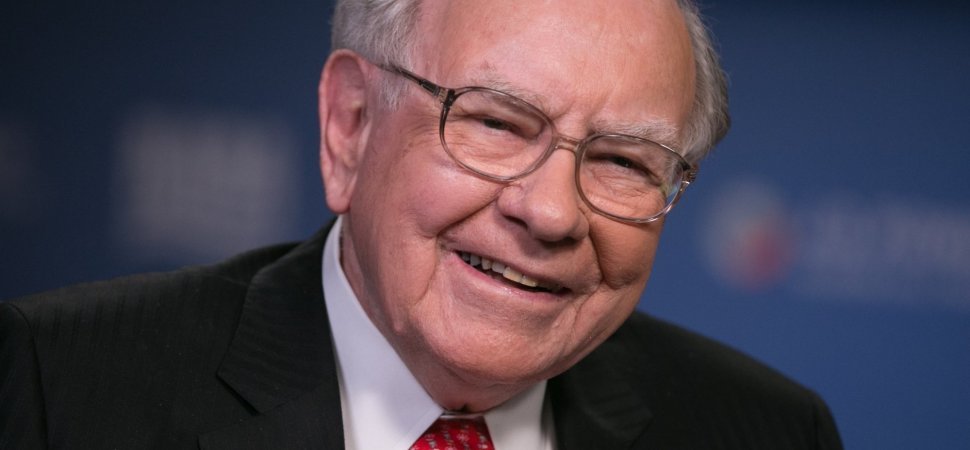
Warren Buffett. Photo from Getty Images.

Billionaire Warren Buffett, the chairman and CEO of Berkshire Hathaway, is in his late eighties and still capturing the world’s attention as the second richest person on the planet (as of this writing).

So, how has he done it? Actually, it’s not so much about what he has done as it is what he hasn’t done. With all the demands on him every day, Buffett learned a long time ago that the greatest commodity of all is time. He simply mastered the art and practice of setting boundaries for himself.

That’s why this Buffett quote remains a powerful life lesson. The mega-mogul said:

“The difference between successful people and really successful people is that really successful people say no to almost everything.”

The Powerful Meaning Behind Buffett’s Statement

Whether he meant saying no in the investment sense is not so important; what is important is that his advice, in whatever context, can apply to anyone arriving at the crossroads of daily decision-making.

For most ambitious people, we want to accomplish things. We are driven for results, doing more, learning things, getting promoted, and starting new ventures. But we also have our personal lives we can’t ignore for optimum balance and happiness. Ambition in this sense can mean taking care of family priorities, expanding our social circles, and pursuing hobbies and other interests.

That’s when Buffett’s advice is a bull’s-eye to our conscience. We have to know what to shoot for to simplify our lives. It means saying no over and over again to the unimportant things flying in our direction every day and remaining focused on saying yes to the few things that truly matter.

Steve Jobs Agreed. It’s About Focus.

Jobs prophetically supported this notion of saying no at an Apple Worldwide Developers Conference in 1997. Here’s what he said:

“People think focus means saying yes to the thing you’ve got to focus on. But that’s not what it means at all. It means saying no to the hundred other good ideas that there are. You have to pick carefully. I’m actually as proud of the things we haven’t done as the things I have done. Innovation is saying no to 1,000 things.”

Like Jobs and Buffett, it’s hushing that loud voice in your head when it tempts you with yet another sexy proposition that might steer you off course. You say a resounding NO! when it asks, “Should I take this opportunity? It may never come around again.” Sometimes, the best course of action is not taking any action.

Seven Things Successful People Say No To Every Day

Jim Collins, famous author of the mega-bestseller Good to Great, once suggested that instead of to-do lists, we should make “stop-doing” lists. Because in obsessing over to-do lists full of things that don’t really matter, we spend less time saying yes to the things that do.

Here are seven things the most successful people say no to on a regular basis. Perhaps you should too?

1. They say no to opportunities and things that don’t excite them, speak to their values, or further their mission in life.

2. They say no to superficial networking events in which people swap business cards and never hear from one another. Why? Because successful people don’t network. They build relationships.

3. They say no to spending time with uninspiring, critical, or negative people who drag them down. Time is precious — choose a small circle of people who will energize you and challenge you to be better.

4. They say no to overworking. While it’s true some successful people and many entrepreneurs put in 60 to 80 hours per week, very successful people aren’t workaholics who neglect self-care and family. They recognize that if they can’t take care of themselves, everything else suffers.

5. They say no to doing all the work. This comes down to one word:

D-E-L-E-G-A-T-I-O-N.

6. They say no to giving the steering wheel of life to anyone else. Another Buffett quote affirms this: “You’ve gotta keep control of your time and you can’t unless you say no. You can’t let people set your agenda in life.”

7. They say no to people-pleasing. Successful people don’t neglect their deepest wishes and desires to accommodate and yield to others’ wishes and desires.

Buffett’s Three-Step Rule of Focus for Success

To set you on the right course, take a coaching lesson from Buffett himself. He once walked his personal pilot through a life-changing exercise in goal-setting that’s since become popular in productivity and career circles. It’s a simple, three-step process to set boundaries, say no to distractions, and home in on success. It goes like this:

1. Write down a list of your top 25 career goals.

2. Circle the five most important goals that truly speak to you. These are your most urgent goals.

Now here’s the real kicker.

3. Completely eliminate the other 20 goals you have listed. Just cross them off, despite if they hold weight or some level of importance.

Buffett says those 20 goals are lower and not urgent priorities, therefore, any effort invested in them steals away dedicated focus and energy from your five highest-priority goals.

The point is to say no to everything on that list except for what you have declared, in your heart-of-hearts, to be the five most important things. These are what you should put all your effort and focus into achieving. The rest are merely distractions that will get in the way of your reaching your ultimate success.

Marcel Schwantes is the founder and chief human officer of Leadership From the Core.

Click here to see the full story

Lockheed’s Boring Earnings Look Like a Buying Opportunity

Lockheed’s Boring Earnings Look Like a Buying Opportunity

Exciting earnings they’re not.

Lockheed Martin (LMTGet Report) is getting attention this afternoon following the firm’s second-quarter earnings release. Lockheed earned $5 per share for the quarter, just edging out the $4.78 that Wall Street analysts were expecting, on average. Shares have spent most of Tuesday’s trading session ever-so-slightly lower on the heels of the relatively unsurprising results.

But lest you think that Lockheed’s Q2 earnings are a complete snooze-fest, there’s good reason to pay attention to the price action in this defense sector giant.

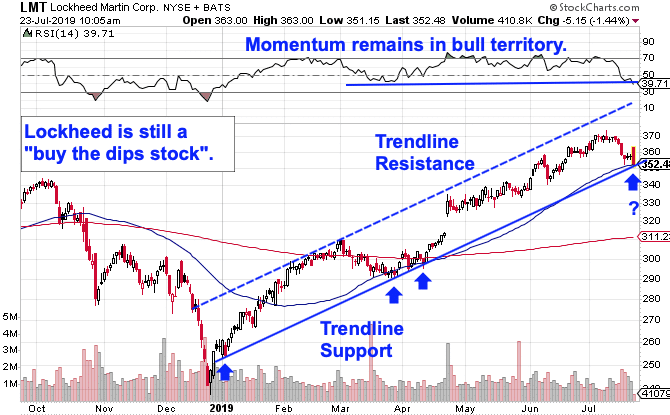
Lockheed looks like a solid buying opportunity in the wake of its earnings results. To figure out how to trade it from here, we’re turning to the chart for a technical look.

At a glance, you don’t need to be an expert technical trader to figure out what’s happening in shares of Lockheed Martin. Instead, the price action in this big defense name is about as straightforward as it gets.

Since the calendar flipped to 2019, Lockheed Martin has been bouncing its way higher in a well-defined trading channel, catching a bid on every test of trendline support on the way up. Now, as shares cool off in July, market participants are staring down a buying opportunity as Lockheed tests trendline support for the fourth time this year.

Put simply, the next bounce off of support is the signal that it’s time to pull the trigger on this trade before the next leg higher.

That bullish trajectory is confirmed by momentum, measured by 14-day RSI up at the top of Lockheed’s chart. As Lockheed Martin’s shares have corrected this month, momentum has retraced back to around the same level it hit during the last big buying opportunity this past spring. That’s confirmation that buyers remain in control despite what might appear to be recent weakness.

Risk management is important to consider here, if you’re thinking about going long LMT this summer. The 50-day moving average has been acting like a solid proxy for trendline support since all the way back in late March – that makes it a logical place to park a protective stop below. If Lockheed materially violates its 50-day, then the uptrend is over and you don’t want to own it anymore.

Meanwhile, with earnings risk in the rear-view mirror, shares of Lockheed look primed for higher ground in the near term.

Deere Looks Ready for a Breakout

Deere Looks Ready for a Breakout

To say the least, 2019 has been an interesting year for Deere & Co. (DEGet Report) .

Back in early May, shares of the agriculture and construction equipment giant went tumbling on trade-war concerns, only to finally catch a bid and reverse course heading into June. All told, Deere has lived through about a 45% round-trip move between the start of May and today, July 23 – some pretty massive volatility during a stretch when the S&P 500 has enjoyed comparably calm seas.

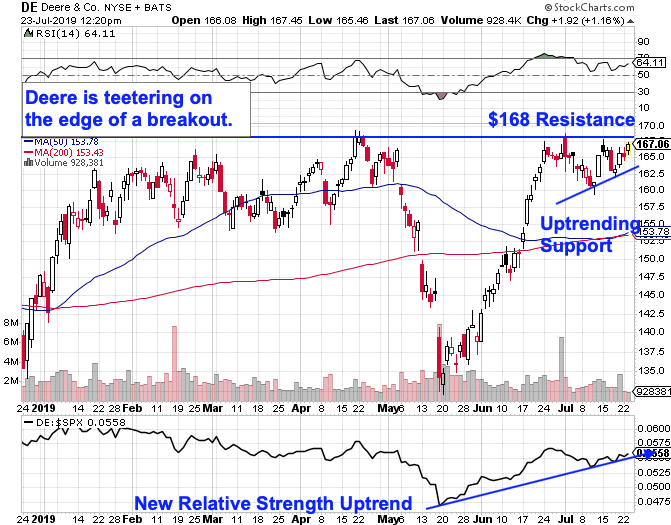
But that tumultuous trading is actually setting the stage for a potential breakout to new all-time highs for shares of Deere. To figure out what’s happening here, we’re turning to the chart for a technical look:

It’s hard to miss the abrupt about-face in shares of Deere this summer.

After surging higher starting in the second half of May, this stock has spent all of July cooling off from a momentum standpoint with some sideways price action. And that sideways consolidation is what’s actually setting the stage for a breakout.

Deere is currently forming a pretty textbook example of an ascending triangle pattern, a bullish continuation setup that’s formed by long-term resistance above shares at $168, with uptrending support to the downside. If Deere can muster the buying pressure to materially break out through $168, we’ve got a clear signal that buyers are still in control this summer – and that it makes sense to join them.

Relative strength, the side indicator down at the bottom of Deere’s chart, has been in an uptrend of its own since the one-two punch of trade war fears and earnings guidance disappointment scuttled shares in May. That’s an indication that Deere is making up for lost time by systematically outperforming the broad market, even now during this sideways cool-off.

While it might feel a little nerve wracking to go long a stock like Deere on the tail-end of such a big rally, context is key.

The fact that June’s buying pressure came after a violent selloff means that buyers likely still have gas in the tank for continued upside. Seeing a breakout through $168 here serves as confirmation of that.

From a risk-management standpoint, it makes sense to pay attention to what might invalidate the bullish setup that’s been forming in Deere this July. If shares trade below the $155 level that acted like support earlier this year, consider the buy setup dead and cut your losses.

From a risk-reward standpoint, Deere looks attractive here with shares sitting just shy of record highs.

The Capital Wave Behind the Coming IPO Flood

The Capital Wave Behind the Coming IPO Flood

As private capital continues to pour into these companies, they have four possible destinies. Here’s what you need to know to ride the wave…

As the public cannabis markets endure a short-term swoon in concert with world equities, investors should be aware that in the background a private capital wave continues to boom.

Cannabis companies in Canada, the United States, and around the world are receiving funding at an incredible rate. CBD companies are also receiving massive funding to meet the coming boom in demand for CBD products.

I’ve previously written about some of this wave, including the emergence of the “Private Offices” of billionaires getting into the game.

But with private capital being raised at a record rate, it’s time for an update.

So far this year, 50 private cannabis companies have raised over $1.2 billion in equity. That’s nearly double the pace of last year. The money has been raised in just about every sector of the cannabis industry.

All of that money is going to lead to a flood of IPOs.

I want to make sure you know why this will happen – and how you can play this opportunity to secure a retirement fortune…

The Four Destinies of Private Companies

Some smart person realized that those private offices want to invest in cannabis but don’t know how. So now there is an exclusive set of conferences set up solely for the private offices of rich people to learn about cannabis investing.

Those 50 private companies, and the 173 that raised private money last year, have one of four destinies.

  • They could fail. Some will, but the truth is that in the cannabis industry most will not fail – at least not initially.
  • They could sell to a competitor. I’m sure some of those companies have looked at the massive cash hordes of Canopy Growth (NYSE: CGC) and Cronos (Nasdaq: CRON) and asked themselves how to build a company that would be attractive to one of those.
  • They could remain private and independent, raising more private capital as needed.
  • And they could go public – I believe that will be the destiny of many of these companies.

In fact, many of those private equity raises were specifically marketed to investors as a pre-IPO raise. The company is explicitly promising to go public. So this summer and fall will prove to have many interesting IPOs.

Banks are pressuring issuers to forget their long-term plans and raise as much money as they can as soon as they can, so it will be important to do the work to separate great companies at bargain prices from mediocre companies charging too much for their shares.

But the best opportunities will be outstanding – better than the best IPOs of last year.

Taking Advantage of Big Money

And fortunately, there will be more money to absorb all of those IPOs, too. As I shared yesterday, big money is finally starting to enter the cannabis market in a serious way. So far, that institutional money is mostly staying in fully federally legal companies – Canadian and international operators and U.S. companies that do not “touch the leaf.”

But there are exceptions.

It turns out that a big hedge fund has amassed more than 3% of Acreage Holdings (CSE: ACRG, OTC: ACRGF). We only know that because the fund is objecting to the Canopy takeover, so we can infer that that fund and others that don’t have to report their holdings very often are also in U.S. cannabis companies.

It is inevitable that institutions will start to invest in U.S. stocks as federal regulations make it safer for them to do so. The top Canadian firms have seen their disclosed institutional ownership increase from under 2% to over 10% within the past 18 months or so. Big U.S. operators generally have disclosed institutional ownership of under 1%. And every institution knows that the U.S. opportunity is many times greater than the Canadian opportunity and that U.S. companies are underpriced relative to their Canadian counterparts.

Even Bigger Things in Store

Looking to the future, what seems like a flood now will feel like a trickle in just a short time. In fact, in one sense, that future is already here.

A single public investment – Altria’s (NYSE: MO) investment in Cronos – was larger than the total amount of private equity invested in the cannabis industry so far this year. Now that Canopy has created a pipeline from non-cannabis companies to U.S.-based cannabis companies through the “option merger” it has with Acreage, expect more strategic investors in Canadian companies, followed by partnerships with or acquisitions of U.S. multi-state operators.

That, in turn, will draw even more private equity into the sector – those private offices aren’t going to those conferences just to get away from the desk for a few days. Strategic investors, private investors, and institutional investors will start to leapfrog each other to put more money into the cannabis sector.

We’ve been talking about this trend for a while and reinforcing that you, as an individual investor, want to get in front of this wave of capital, not behind it.

The only thing that’s changed is the speed at which that wave is coming. What we used to think was a year or two off is starting to happen right now.

Don’t miss out.