Home Blog Page 62

Be Ready Now to Profit from These Bigger, Faster Markets

Be Ready Now to Profit from These Bigger, Faster Markets

The legal marijuana market will be far bigger than anyone dares predict, and it’ll get there sooner than anyone thinks.

Last year, total marijuana sales in the U.S. topped $86 billion.

In 2018, all across the country, nearly 49 million people spent an average of $1,755 each on marijuana.

Now, the majority of those sales were illegal, but of that number, about $18 billion was legal.

And it’s this large, established market of marijuana sales that makes the opportunity to profit from cannabis stock investing so rare.

Bringing these sales into the legal light doesn’t require convincing new customers to try something new. No new consumption habits need to be formed. It’s a well-established market just waiting to be sold to.

As the legal market overtakes the illegal market, trillions of dollars in value will be created, and investors that get in now will capture the lion’s share of those profits. It’s a millionaire-minting machine, and the incredible opportunity for normal, everyday investors to participate in these riches is what spurred us to build out community.

We want to put you in the position to reap those gains. And the quicker that legal gap closes, the sooner investors who own cannabis stocks now can pocket the rewards.

Just how big those rewards can be depends a lot on the ultimate size of the legal marijuana market.

And once you see these projections, you’ll know exactly why the opportunity is far bigger than anyone dares to predict…

Mind the Gap

Just how quickly can legal sales fill that gap?

I think that in five years, given the pace of legalization, legal sales could fill most of that gap. After all, Canopy Growth Corporation (NSYE: CGC) would not have agreed to acquire Acreage Holdings (CSE: ACRG, OTC: ACRGF) in the future if it felt that federal legalization was several years away. Similarly, Acreage would not have agreed to sell if it thought that future was very far off. Such a deal would entail too much risk for Canopy and give away too much opportunity for Acreage.

Canopy plunked down $300 million to secure the right to acquire Acreage. That’s far too much money, even for a company like Canopy with billions in cash, to leave sitting around for a year or two.

Closing the gap with illegal sales would put the legal marijuana market at around $100 billion by 2025, once you factor in population growth.

Phase 2 of cannabis investing has the potential to make average Americans millions. You still have time to get in before big business does – but first, you need to click here to watch this landmark announcement that could change your life.

But that $100 billion in revenues only counts current users of traditional marijuana products converting to legal sales. It does nothing to account for totally new users who switch after legalization or the development of new markets.

Nor does it count the creation of new marijuana markets. Once we add those in, the revenue growth that the right cannabis companies enjoy will push their valuations through the stratosphere.

Entirely New Markets

For starters, we need to account for medical marijuana. This market will expand rapidly as knowledge about its superiority over Big Pharma drugs – especially opioids – spreads.

To that, we can add the proliferation of new methods of consumption such as vape pens, gummies, and THC-infused beverages. These products will rope in an entirely new set of recreational users. So between growing medical use and new recreational consumers, that could easily add another $30 billion in sales.

But so far we’re just counting final retail sales only. To all this, you have to add the revenues of the entire cannabis ecosystem. For example, cultivators sell cannabis to product manufacturers. Manufacturers pay extractors. Distributors move the product and sell to retailers. Yet others, like KushCo Holdings Inc. (OTC: KSHB), sell packaging.

Between the growth of new markets and the ecosystem that rises up around it, revenues could easily exceed $250 billion in the U.S. alone.

And we better not forget the big one – cannabinoid-based pharmaceutical drugs.

Big Pharma Gets In on the Act

Frankly, I find accurately estimating the maximum size of the cannabis pharmaceuticals segment an impossible task. The potential for breakthrough discovery treatments is too significant, but let’s add another $100 billion in sales in the U.S. as a ballpark, conservative estimate.

By that count, in five years, total sales across the legal marijuana ecosystem could exceed $350 billion per year. And from a base of $20 billion, revenues have to grow nearly 80% per year to get there. It’s stocks in companies with that incredible level of growth for which institutional investors will pay a very high price. Big money wants in, and once federal regulations are lifted, institutional money is going to rush in.

Revenues growing at 80% annually on its way to $350 billion per year could easily launch the value of cannabis stocks well north of $3 trillion.

And when the bidding starts, you’ll be there to sell your market-leading cannabis stocks to them for a fortune.

You Too Can Be an Angel Investor – If You Have What it Takes

You Too Can Be an Angel Investor – If You Have What it Takes

Private investing was once only for the wealthiest of investors, but that has changed, and here’s how you can stake your claim in the next private cannabis venture.

In the past, to invest in the type of startups that ultimately define the future of an industry, you needed a few things that the typical investor didn’t have.

For starters, you needed access to deal flow. That’s just private investing talk that means you had to know how to find ventures that needed funding.

Not an easy task.

You also needed a lot of financial expertise. It takes highly specialized knowledge to determine if a deal is structured in a way that allows you to get rich right alongside the founders.

And having the business acumen to identify whether the company has a strategy with any chance of success is another must have. The lack of this skillset rightfully builds a barrier to all but the most knowledgeable investors.

Now, besides all of this, you still had to earn hundreds of thousands of dollars per year or have millions of dollars in net worth to legally invest in private companies.

Yet, even meeting that threshold wasn’t enough. The practical reality was that only the mega wealthy could afford the advisors who had access to deals and the expertise to evaluate if those deals were worth investing in.

It stood that way for decades.

It’s true that public markets have created tremendous amounts of wealth, but far more wealth is created in a company long before it goes public.

And as we mentioned, access to this wealth was once reserved for only the most well-heeled investors.

But this has all changed.

The pieces have fallen into place, and you too can rake in returns just like the investing elite…

The Government Actually Made Investing Easier

Nowadays, the rules have evolved to open private deal access to all Americans.

The SEC has upgraded securities regulations. It has made sweeping changes to Reg D, Reg A, and has also created an entirely new set of regulations called Reg CF. And these regulations have had a big impact on how companies raise money.

Anyone, regardless of income or wealth, can provide startup executives with the vital seed capital they need to grow. Everyone with money to invest can champion a cause by putting their money behind it, and share in the same profits once reserved for the top 1%.

And the timing couldn’t be better for capital-hungry cannabis startups looking to claim a piece of a market set to create a $1 trillion in value over the coming years.

Know that the path the cannabis industry takes to $1 trillion will mint an entirely new class of marijuana millionaires, especially for those who get in early on the private deals that fund these ventures long before they go public.

But even new regulations opening this ground-level opportunity up to everyone still doesn’t change one other fundamental requirement of private investing.

Fortunately, it’s something that you can control.

The CBD market is on fire. Our experts have identified two companies that could deliver 1,000% gains… and both are trading for under $4. Go here for more information.

You’re in Control of Your Financial Future

You can’t buy and sell private investments like regular stocks and bonds. In fact, years can pass before you can sell a privately held security, and that often comes after the company goes public.

Now, as we mentioned, the barriers have been removed to help retail investors own a piece of private companies.

However, the average investor still doesn’t have the foresight that it takes to see a private company all the way through. The lack of liquidity makes them feel as though their hands are tied. As such, they limit themselves to public market returns.

But that’s good for those who see the end game.

A smaller pool of investors that have what it takes means fewer buyers of private investments. With fewer buyers, you can also get in at a lower price. Over time, continuously buying investments at a lower price adds up to a pile of much higher returns.

We call it the “Patience Premium,” because that lies at the heart of what it takes. The beautiful part is that this is a source of returns that’s completely under your control. You determine whether you earn it.

And, over time, this Patience Premium can double what you earn in public markets – and many multiples of even that when you invest in the right private cannabis deals.

So the pieces have come together to get you in on the ground floor. The rules have changed for the better, and you know what you bring to the table.

The only thing left is how to access and evaluate these deals, and we know just how to help with that.

The Final Piece of the Private Investing Puzzle

We set out to make it easier for investors like you to invest in private deals.

What investors needed was someone to field the calls from companies looking for capital. Someone to evaluate the pitch deck, run the financial projections, and grill management. Greg wanted to provide you with a pipeline of private cannabis deals that my research team and I have personally vetted.

That’s why he created the American Angel Investors Community. It was designed not only for those investors looking to profit from the cannabis boom, but also for those with the patience to see a great venture through – and reap the rewards.

Syndicate members have already seeded one promising cannabis startup, and you can now get in on the same deal. Members will also soon have another deal into which they can sink their private capital. So pull up a chair right beside the founders of the next great cannabis company, put the Patience Premium to work, and make the most of what the Syndicate can provide.

To your investing success,

Wall Street Probe

P.S. Historically, private investing has only been an option for 0.1% of investors – but it’s time to change that. We’ve partnered with one of the world’s top venture capital experts to show you how to become a private cannabis investor… and put the potential for massive profits directly in your hands. Private deals offer a different type of investment, but it’s one that could pay off with double-, triple-, or even quadruple- digit gains. So if you’re ready to take the first steps towards becoming a private investor, check out our presentation right here.

The Three Tools You Need to Privately Invest in the Cannabis Sector

The Three Tools You Need to Privately Invest in the Cannabis Sector

Venture Capital Expert Michael A. Robinson shares his insights on the three tools every private investor needs before approaching the cannabis sector. Take a look…

As a 35-year Silicon Valley veteran, I’ve worked closely with a lot of promising startups.

I’ve served as a consultant, senior advisor, and board member for various venture capital firms, and I’ve loved having the opportunity to work with pioneering CEOs.

I was involved with early meetings right before the cloud computing phenomenon took off, and I’ve seen firsthand the disruptive power of the robotics revolution.

It’s helped me develop a keen eye for identifying the “next big thing,” and it’s also helped me uncover who will be the early winners in a fast-moving, emerging market. In fact, spotting those future big-name players in an emerging industry is what makes private investing so lucrative.

That’s why, today, I wanted to share what I’ve learned over the last 30 years and apply it to private investing in the one of the most exciting sectors in the market today: cannabis.

Thanks to changes in the law, private investing is no longer reserved for just insiders and the super wealthy. You now have the chance to grab a piece of this potential $1 trillion industry – before the average retail investor.

See, from my home state of California, I get a firsthand look at how this industry is unfolding, and let me tell you: Now is the best time to make your move.

With that in mind, today I wanted to share with you three of the most important tips I’ve learned for identifying the best private investing opportunities…

Private Funding Tool No. 1: Seek Expansive Markets

There’s a very good reason why this tops the list of venture capital (VC) tools.

Fact is, VC firms look at hundreds of potential deals a year. Few get funded, in no small measure because the sector they seek to disrupt is just too small or growing too slowly to justify the risk.

Focusing on a large potential market serves as a quick filter to determine if it’s even worth reading the rest of the pitch. The smaller the sector, the harder it is to get other investors interested as well.

Please don’t gloss over that last item. We are, after all, looking for a successful exit in the form of an IPO or a corporate takeover.

It’s a lot easier to get others involved in the deal if the market is worth north of $10 billion and is growing by double digits every year. Ideally, we want to know that the addressable market will double in a decade or less.

Here’s how it works out mathematically: Let’s assume our startup is looking at only a $10 billion segment of the cannabis industry that is growing by 15%, with a 20% market share in mind.

That gives us potential annual revenue of $400 million five years out.

All other things being equal, this is definitely worth pursuing – there are plenty of publicly traded small-cap growth firms that have yet to hit that sales threshold.

In the next three years alone, sales in this sector of the cannabis market are predicted to grow 3,622%. To find out how you can best profit from this, go here now.

Private Funding Tool No. 2: Focus on Scale

Investing in a startup is a bit like buying a yacht – it has the potential to suck gobs of cash down the drain for many years.

Growth firms require massive investments in personnel, marketing, distribution, technology, and sales. It adds up quickly, which is why so many startups need millions in several funding rounds before ever going public.

Scale is important because it means that once the company has built out its franchise, its costs fall sharply and profits start to really take off.

A classic example of this comes outside of cannabis. Facebook Inc. was able to turn a profit about five years after its founding. Today, it has massive scale, with two billion average monthly users.

It’s unlikely we’ll see anything of that scale in cannabis. But we still need to keep this principle firmly in mind.

Let’s say a well-run dispensary is seeking VC money to fund its expansion. If the firm only wants to remain a niche regional player, it’s not likely to pay off.

There’s just not enough upside buying a niche player in a cannabis market that will be worth roughly $150 billion by 2025.

On the other hand, a startup that offered cloud-based supply-chain management software would be onto something.

Just facilitating 10% of that segment gives us a $15 billion target, with the kind of high profit margins that the cloud almost guarantees.

Private Funding Tool No. 3: Hire Visionary Leaders

When you’re funding a firm, you’re basically hiring its leaders to execute its business plans and give you a profitable exit.

By definition, evaluating leaders is the hardest thing to actually quantify. There’s no real formula for measuring those skills.

But they’re vital. A startup needs to work along many parallel tracks at the same time, like marketing, product development, and sales.

At the top of the list, of course, is hiring skilled personnel, without which no startup can grow. The “soft skills” required to succeed here means our execs need to know three main things:

  • How to spot talent.
  • The resources to hire great workers.
  • The personality and incentives to keep them on board and fully engaged in the mission.

Those are really just what I call the “mechanics” of dealing with personnel. And to some extent, they can be learned.

What’s difficult to teach, however, is the most important soft skill of all – the “Big Vision.” We’re looking for leaders who have a messianic view of the company’s role in the cannabis industry.

We want executives who get out of bed every day looking to disrupt the status quo and change the world around them.

These kinds of leaders inspire great loyalty that can make the difference between a mediocre firm and one so successful it’s like they’re actually printing cash for shareholders.

If you are looking to become one of those investors, the best place to start is with the Angels and Entrepreneurs Network.

This service was created to lead people like you who are interested in the world of cannabis angel investing to the best private placement deals out there.

Big Money Can’t Get In – But You Can

Big Money Can’t Get In – But You Can

Major institutional investors see the incredible potential within the cannabis markets. But there’s one thing holding them back – and clearing the way for you…

PayPal Inc. has thrown its weight behind the Secure and Fair Enforcement (SAFE) Banking Act of 2019.

We’ve been following this legislation closely, because its passage will turn the flow of capital into the cannabis sector into an absolute torrent.

The SAFE Banking Act has support on both sides of the aisle – including from key Trump administration officials – and it looks increasingly likely that we’ll see the bill pass on to the Senate in short order.

Now Rep. Ed Perlmutter (D-CO), who introduced the bill, has shared that PayPal is offering its support, too. “The company, which more typically lobbies on issues like mobile banking, transaction fees, and international trade,” Perlmutter said, “added pot banking in its first quarter 2019 lobbying report.”

The purpose of the act is “to increase public safety by expanding financial services to cannabis-related legitimate businesses and service providers and reducing the amount of cash at such businesses.” And while it’s true that PayPal may wish well for the safety of individuals in the cannabis industry, that’s not why PayPal is putting its money behind the bill.

This lobbying is a clear sign that mainstream financial services companies are clamoring to enter the cannabis game.

As you’ll see, PayPal isn’t alone in this effort…

Big Money Wants In

There’s another big company Cannabis Profits Daily readers will be very familiar with by this point: Constellation Brands (NYSE: STZ), an international producer and marketer of beer, wine, and spirits.

This Fortune 500 company began its own foray into cannabis in August of 2018 when it injected a $4 billion investment into Canopy Growth Corp. (NYSE: CGC).

Constellation is 74.34% owned by institutions, while institutional investors only hold 10.93% of Canadian giant Canopy.

Going even further down the chain, institutional ownership of Acreage Holdings (CSE: ACRG, OTC: ACRGF), the company in the process of being acquired by Canopy, comes in at less than 5%.

What the support of these major players proves is that big money is desperate to make its way into the cannabis space. Federal regulations are simply stifling them from doing more.

Huge financial institutions like Merrill LynchBank of America, and Jefferies have all begun covering cannabis stocks, but they’re limited to either Canadian companies or those that don’t “touch the leaf.” And that creates a monumental gap.

Even security firms dealing with cash like Brinks want in. CEO Doug Pertzmade his eagerness to access the broader American cannabis markets clear, saying, “I’d love to see something happen in the U.S. to be able to duplicate what we’re doing in Canada.”

You, on the other hand, face no such restrictions with your capital. We’re in a unique window where cannabis companies are going public and making a ton of money, and Main Street investors like you are the ones who stand to gain the most.

Once those federal regulations are lifted, institutional money is going to rush into this sector – making anyone who invests today profits like nothing we’ve ever seen.

Make sure you’re there for it.

Twitter Is Primed to Keep Leading Markets Higher in 2019

Twitter Is Primed to Keep Leading Markets Higher in 2019

The year 2019 is turning into a spectacular one for social media heavyweight Twitter (TWTRGet Report) .

Year to date, shares of Twitter have surged 44.5%, besting the S&P 500’s momentous run this year by a factor of two. Better still, shares aren’t showing any signs of a slowdown this summer.

Quite the contrary.

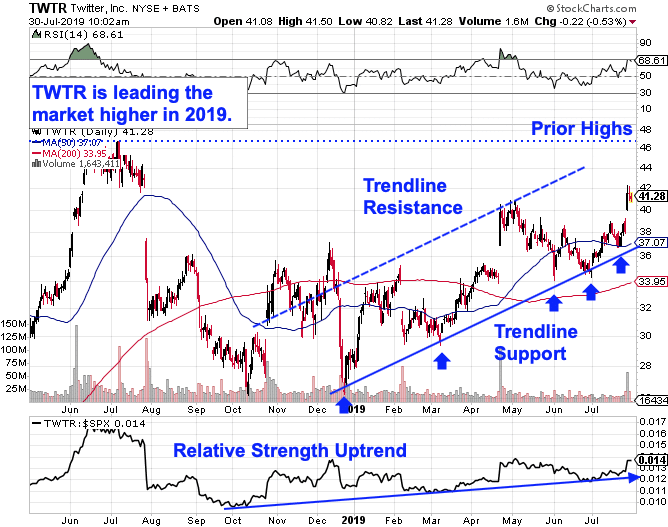
As Mr. Market rounds the corner to August this week, shares of Twitter look primed to keep on leading stocks higher. That’s thanks in part to a solid earnings beat last week that propelled shares almost 9% higher. But earnings only tell part of the story. Longer term, Twitter’s technical trajectory has been as straightforward as it’s been bullish.

To figure out how to trade Twitter from here, we’re turning to the chart for a technical look.

Like a lot of prominent names right now, it doesn’t take a technical trading whiz to figure out what’s been going on in shares of Twitter so far this year. Instead, the price action is about as simple as it gets.

Since the calendar flipped to January, Twitter has been bouncing higher in a well-defined uptrend. So far, every test of trendline support down at the bottom of Twitter’s price range has resulted in a bounce higher. As Twitter bounces off support for a fifth time on the heels of earnings, we’re seeing a clear buy signal this summer.

That’s confirmed in part by relative strength, down at the bottom of Twitter’s chart. Twitter’s relative-strength line has been in an uptrend of its own since last fall, indicating that shares continue to systematically outperform the rest of the broad market right now. As long as relative strength keeps pointing up and to the right, Twitter remains predisposed to continue to outperform the S&P.

As always, risk management is key in shares of Twitter right now. Prior lows are around $35. The other side of that looks like a reasonable place to park a protective stop; if Twitter violates that $35 line in the sand, then the uptrend is over and you don’t want to own it anymore.

In the meantime, buyers are still clearly in control of the price action, and Twitter continues to be a “buy the dips stock” this summer.