Home Blog Page 63

Public Storage Is a Buy After Earnings
Public Storage Is a Buy After Earnings

REITs are rallying.

Real estate investment trusts, or REITs, have been participating in the broad stock market rally in 2019, the popular Dow Jones REIT Total Return Index is charging more than 22% higher since the calendar flipped to January.

It’s not hard to see why REITs are appealing in this market environment. With investors pricing in a rate cut on the heels of this afternoon’s FOMC meeting, the high yields paid by REITs continue to look enticing to income investors.

Case in point: Public Storage  (PSAGet Report) .

Public Storage has been one of the stronger names in the sector this year, all while paying out a 3.26% dividend yield.

Yesterday, the firm reported earnings of $2.57 per share for the second quarter, ever-so-slightly edging out analysts’ average estimates. With earnings in the rearview mirror, now looks like a great time to be a buyer in Public Storage.

To figure out why – and how to trade it from here – we’re turning to the chart for a technical look.

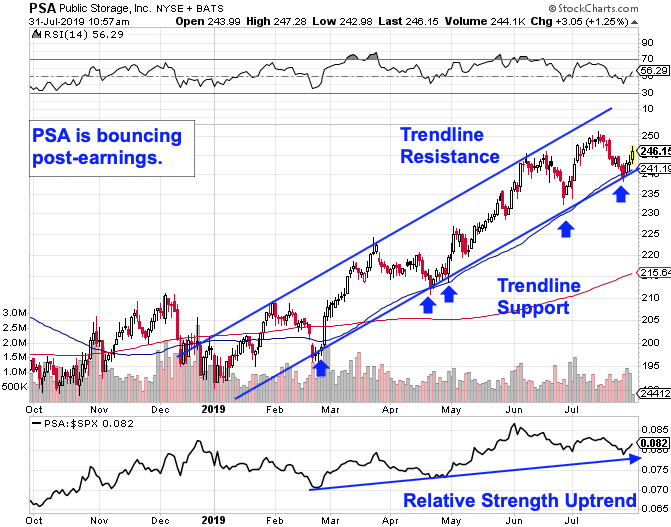
Public Storage is catching a bid this afternoon, but the tiny earnings beat that the company posted Tuesday isn’t the main driver. Instead, Public Storage is charging higher thanks to a textbook bullish technical price setup.

Shares have been in an extremely well-defined uptrending channel all year long. Year-to-date, every test of trendline support has been followed up by a bounce higher within that price channel. Now, as shares catch a bid at support for the fifth time in 2019, we’re staring down another solid buying opportunity in shares.

Relative strength, the indicator down at the bottom of the stock chart, adds some extra confidence to the buying pressure we’re seeing today. With relative strength holding onto an uptrend of its own here, we’ve got a clear signal that Public Storage continues to systematically outperform the rest of the broad market in this environment.

Despite the bullish trajectory, risk management is key here. With the 50-day acting like a near-perfect proxy for trendline support since the end of February, it makes sense to park a protective stop on the other side of the 50-day. Simply put, if Public Storage violates that line in the sand, then the uptrend is over and it doesn’t make sense to own it anymore.

Meanwhile, Public Storage looks strong here. With earnings risk off the table, now looks like as good a time as any to add it to your portfolio.


The Angels & Entrepreneurs Summit

0
The Angels & Entrepreneurs Summit

I’m excited to announce that I’ve teamed up with my close friend Robert Herjavec for a truly historic summit. This is something you are not going to want to miss.

Robert and I revealed the greatest driver of wealth creation the world has ever seen.

The Federal Reserve has determined that for every $20 you make from the old-fashioned stock market, you could make $33,000 through this private market.

Long story short, this is a radical new way to make money. And it could exponentially grow your net worth.

Robert and I have been very fortunate in life and business. And we owe much of our success to the deals we’ve struck in this private market. Now, we want to pay it forward.

Take a few moments to watch this video (remember, it’s free). 

Get ready – because Robert’s words could transform your life!

When to Buy Apple: After the Selloff

When to Buy Apple: After the Selloff

As the dust settles following the worst day for stocks in 2019, investors are rightly wondering whether this is the time to batten down the hatches – or if it’s an opportunity to pick up some of the pieces.

Case in point: Apple (AAPLGet Report)

Apple was one of the biggest decliners in Monday’s trade-war fueled selloff, shedding more than 5.2% of its value on the session by the time the closing bell rang. That’s a colossal drop for a $900 billion company.

And with shares only clawing back 1% and change in Tuesday’s trading session, it’s not clear whether buyers or sellers are driving the ship here. To figure out what’s happening in Apple – and how to trade it from here – we’re turning to the charts for a technical look.

Apple is a holding in Jim Cramer’s Action Alerts PLUS member club. Want to be alerted before Jim Cramer buys or sells AAPL? Learn more now.

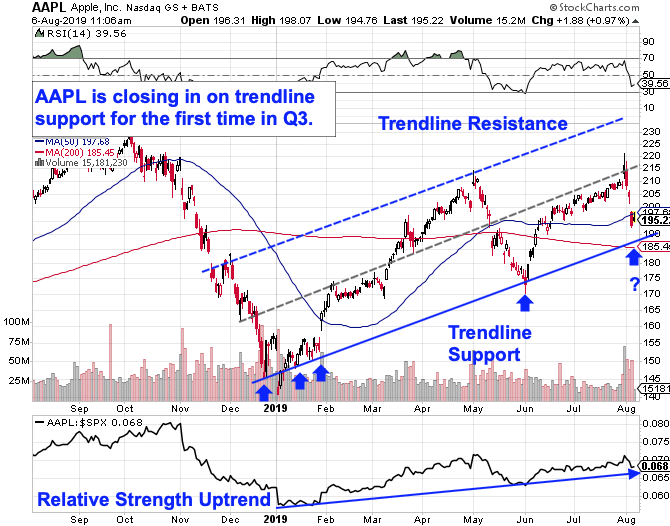
At a glance, it doesn’t take a trading expert to figure out Apple’s price trajectory this year. In fact, the price action is about as straightforward as it gets. Apple has been bouncing its way higher since the calendar flipped to January, catching a bid on every successive test of trendline support.

In other words, it’s a “buy the dips” stock.

Now, as shares fall back into correction-mode this August, they’re closing in on the first test of trendline support since the start of June. It’s worth noting that the prior move in June propelled shares some 26% higher.

To figure out whether Apple can do it again, it’s key to keep a close eye on how shares react to support. Rather than anticipating a bounce higher, it’s a better move to wait for the bounce to happen before jumping on shares of Apple. While that will come with some opportunity cost, waiting to pull the trigger greatly reduces the risk of the trade by waiting for buyers to affirm that they’re still in control of shares first.

Relative strength, the indicator down at the bottom of Apple’s chart, adds some extra confidence to the upside breakout here. Apple has been systematically outperforming the rest of the broad market since the start of the calendar year, and with that uptrend still intact, Apple remains predisposed to outperform.

The bottom line is that if Apple manages to bounce off of trendline support (currently right above $185) then we’ve got a clear signal that this tech behemoth is likely to keep on rallying in the second half of 2019.

In the meantime, it makes sense to sit on the sidelines for the next few sessions and see how this correction plays out.

Microsoft Is (Still) a Buy-the-Dips Stock This Summer

Microsoft Is (Still) a Buy-the-Dips Stock This Summer

No question, 2019 is turning into a fantastic year for shareholders of tech giant Microsoft (MSFTGet Report) .

Year-to-date shares of Microsoft are up approximately 35%. That’s basically double the price performance of the rest of the S&P 500. Better still, Microsoft’s rally isn’t showing any signs of slowing down this summer, despite an influx of volatility that’s left investors generally rattled this week.

So far, Microsoft has been a “buy the dips” stock all year long — and shares look as if they’re showing investors another buyable dip right now. To figure out how to trade it, we’re turning to the chart for a technical look.


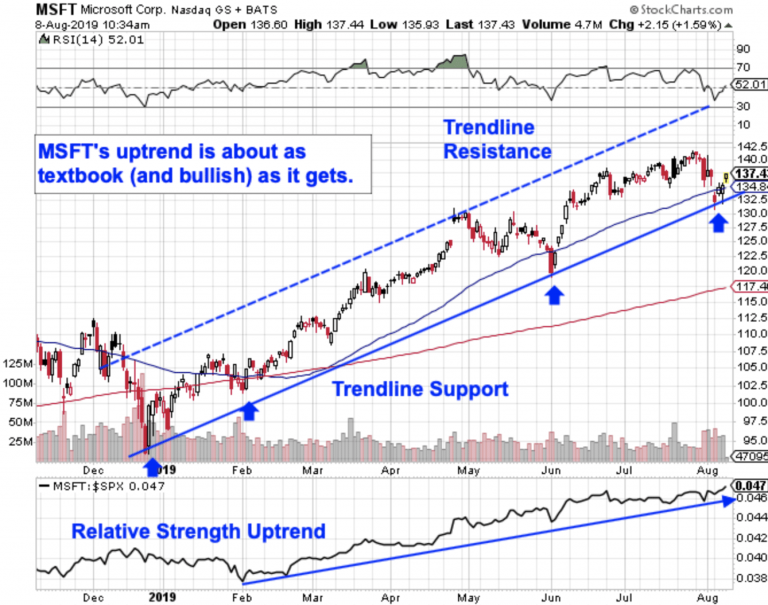
At a glance, you don’t need to be an expert trader to figure out what’s going on in shares of Microsoft. The uptrend in this big stock is about as textbook – and bullish, for that matter – as they get.

Microsoft’s uptrend kicked off at the start of the calendar year, on the heels of the deep broad market correction that stocks endured last fall. That’s not completely unique. Many stocks initiated similarly well-defined uptrends in early January, as correlations with the S&P remained strong.

But Microsoft’s different in the scale of the move higher. For every dollar the S&P has generated for investors’ portfolios this year, Microsoft has generated two dollars, on average, all while keeping the risk-reward tradeoff incredibly well defined.

Now, exact same long-term momentum setup that presented its last buying opportunity at the start of the summer is showing off what looks like another low-risk entry opportunity in shares.

The test of trendline support we saw in Microsoft at the beginning of August is getting confirmed by a bounce higher in the last few sessions. That’s an indication that buyers are stepping in once again at the bottom of Microsoft’s price range.

Relative strength, the indicator down at the bottom of Microsoft’s chart, adds some extra confirmation that this is still a name you want to own in the second half of 2019. Relative strength has been in an uptrend of its own all year long, and it continues to post higher lows this summer. That shows us that Microsoft has systematically outperformed the broader market, even now.

Of course, risk management is crucial – even for a solid setup like Microsoft. Prior lows around the $130 level look to be a logical place to park a protective stop underneath. Simply put, if Microsoft meaningfully violates that $130 level in the near term, its long-standing uptrend is broken, and you don’t want to own it anymore.

Meanwhile, the Microsoft trade still looks as if the wind is at its back. For investors who don’t own Microsoft in their portfolio (or want to buy more), now looks like as good a time as any from a risk/reward standpoint.

AMD Breakout: Key Level to Watch

AMD Breakout: Key Level to Watch

The companies on the front lines of the trade war are getting a bit of a reprieve to start the week, following the announcement from Commerce Secretary Wilbur Ross that Chinese device maker Huawei will get another 90 days to buy from American suppliers.

That’s proving to be a good thing for the tech sector, as investors hope that the dialog might spill over more broadly to the trade discussions ongoing with China.

One big U.S. tech name that counts Huawei as a customer is Advanced Micro Devices (AMDGet Report) – shares are getting a boost from the news cycle Monday, up 2.6% just before noon.

That’s putting shares of AMD in a positive price trajectory for the first time in the last couple months. To figure out how to trade shares from here, we’re turning to the chart for a technical look.

AMD’s price action has been choppy lately. While shares spent most of 2019 in a well-defined uptrend – one that sent a clear-cut buy signal in mid-June that was followed almost immediately by a push to new highs – things have changed as trade war developments and recession fears entered the market.

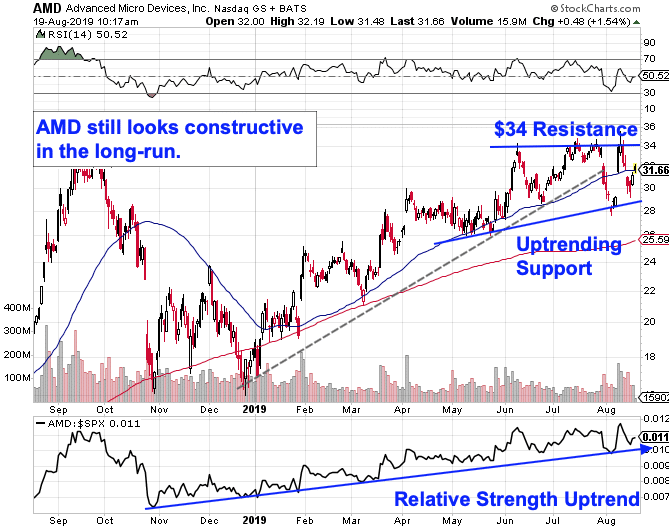
That prior uptrend (the gray dashed line on the chart above) got violated at the start of this month, and shares have been stuck in a choppy range ever since.

But while AMD’s picture-perfect rally may be over, it’s still far too early to count out this momentum tech name. That’s because shares actually still look constructive in the long term, thanks to a bullish continuation pattern that’s setting up in the long term.

AMD is currently forming an ascending triangle pattern, a bullish continuation setup that’s formed by horizontal resistance up above shares at $34, with uptrending support to the downside. Simply put, as AMD bounces in between those two technically significant price levels, shares have been getting squeezed closer and closer to a breakout through the $34 level.

Once that happens, we’ve got a brand new buy signal in AMD.

Shares aren’t quite there yet, but they’re close.

Meanwhile, relative strength continues to look extremely bullish in shares of AMD right now. That gauge, down at the bottom of the AMD chart above, indicates that this stock continues to systematically outperform the broad market in 2019, even during this recent bout of volatility. As long as that relative strength uptrend remains intact, AMD continues to be a stock that you should own.

Investors should keep a close eye on the $34 level in the sessions ahead. If shares can muster the strength to catch a bid up above that level, AMD opens the door to considerably more upside in the second half of 2019.