Home Blog Page 64

Another Lousy Week for the S&P 500: How to Trade It
Another Lousy Week for the S&P 500: How to Trade It

Markets are reeling Friday, the big S&P 500 index selling off more than 2% in this afternoon’s session following another round of trade war escalation with China.

President Trump tweeted that he would order American companies to start looking for an alternative to China for manufacturing, a rebuttal to China’s State Council’s Customs Tariff Commission announcing that it would levy two batches of new tariffs effective next weekend and Dec. 15, respectively.

The trade war drama is surely far from over at this point.

As a consequence, it’s set to be another lousy week for the stock market – the fourth straight decline for the S&P, in fact.

But that only tells part of the story. Often, when volatility gets injected into the broad market, the technical picture can provide some crucial context. Namely, is the selling we’re experiencing here a good opportunity to be a buyer?

Or is the market looking ready to throw in the towel and point lower for the rest of 2019?

To figure out the most likely trajectory for the S&P from here, we’re turning to the charts for a technical look.

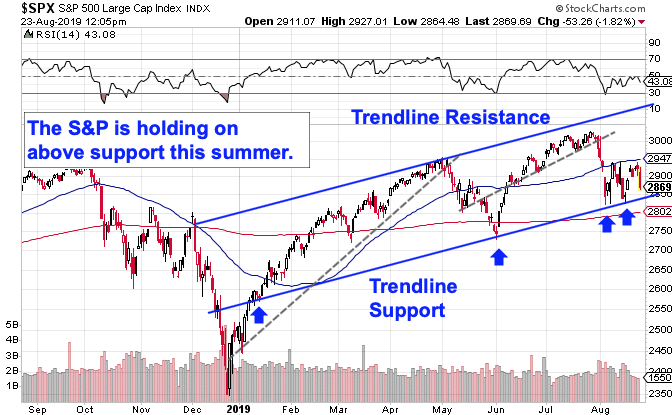
First, the good news. It doesn’t take a technical trading whiz to see that the S&P 500’s price trajectory continues to look extremely constructive here.

While there have been a couple of revisions to the S&P 500’s uptrend in the shorter-term, the longer-term trend from January remains intact here with a series of higher highs and lows.

In other words, we’re still very much in a “buy the dips market”.

Just as importantly, that uptrend gives us a clear do-not-cross line that would signal an end to the trend if violated. Right now, that level comes in right around 2,825 for the S&P 500. A material breach of that level means that downside risk in the market just ramped higher.

Until then, the trend is your friend.

That’s true in the much longer-term, too:

The chart above shows the weekly price action of the S&P 500 reaching all the way back to early 2013. The S&P’s price action has been near-linear over that stretch, with clearly-defined support connecting major lows of 2012, 2016, and 2018, and a return line at higher levels currently in play.

If the 2,825 level in the S&P were to get broken through, a test of primary support at around 2,550 becomes likely.

That’s more than 10% additional downside from here before the S&P 500’s long-term uptrend even gets tested.

Despite the trade war, recession fears, and headline risk galore, the stock market isn’t on the verge of collapse this summer – in fact, it’s not even waving a caution flag yet.

This may be another lousy week for the market, but the technical evidence points to more upside ahead for the broad market.


International Stocks Are Starting to Look Bullish Again

International Stocks Are Starting to Look Bullish Again

Buy American” has been good investment advice for quite a while now. But some international stocks are finally starting to show signs of life again. 

U.S. equity markets have overwhelmingly outperformed the rest of the world for years. Over the last five years, the MSCI All Country Ex-U.S. Index has produced total returns of 11.05%. By comparison, the U.S.-focused S&P 500 has surged more than 69.5% over the same period.

Along the way, foreign stocks – namely emerging markets – have been a colossal value trap. While international markets have looked cheap by many valuation metrics relative to American stocks, they still manage to keep on getting cheaper.

That could be about to change – at least in one particular pocket of the ex-U.S. market.

To figure out what’s happening (and how to trade it) we’re turning to the chart for a technical look.

For starters, it’s important to bear in mind that while international stocks have been a quagmire for long-term investors, they’ve presented some tactical upside opportunities – especially in recent months.

We looked at a buyable opportunity in Brazil back in October 2018, when U.S. stocks were flagging. And again, at a broader group of emerging markets earlier this year. Both led to double-digit rallies in the short-run.

Now, a similar tactical play is shaping up in the iShares Core MSCI EAFE ETF IEFA, an exchange-traded fund that tracks stocks in Europe, Australasia, and the Far East.

IEFA has been in correction-mode lately, rolling over in early July and more recently consolidating sideways in a range just below $60. It’s that range that’s setting up the potential for a buy signal in this ETF right now.

IEFA is currently forming an inverse head-and-shoulders pattern, a bullish reversal setup that’s formed by a pair of swing lows that are separated by a deeper low. The buy signal comes on a breakout above the resistance level that identifies the top-side of the price range. For IEFA, that breakout level is currently right at $59.

That’s a significant level for another reason – it’s also the price level that defines the bottom of the uptrend that IEFA had been trading within for most of 2019. A breakout through that level also puts IEFA back in its uptrend, with plenty of upside room.

At a glance, IEFA’s price action looks particularly “gappy”. Those gaps are suspension gaps caused by off-hours trading on non-U.S. exchanges. They make IEFA look more volatile than it really is – but you can ignore them.

Finally, momentum, measured by 14-day RSI up at the top of IEFA’s price chart, adds some extra confidence to the potential for a reversal here – our momentum gauge managed to put in a higher low on each of the price swings in the pattern.

For IEFA, the buy signal comes on a meaningful breakout above $59. Wait for shares to catch a bid above that line in the sand before you jump into this trade. After that, it makes sense to keep a tight stop in place; if shares violate $57, then the pattern is broken and you don’t want to own it anymore.

Labor Day Sale: Join Jim Cramer’s Club for Investors and Save

This Secret Angel Investment Tax Credit Could Save You Millions

This Secret Angel Investment Tax Credit Could Save You Millions

Section 1202 tax exclusion provides angel investors and entrepreneurs with a 100% tax break of up to $10 million.

Over the past few months I’ve been surprised to find that very few angel investors and entrepreneurs are aware of one of the most important developments for startups in a long time.

It goes to show that almost anyone with a bank account and $50 could become an Angel Investor… (paraphrasing Robert Herjavec at the Angels and Entrepreneurs Summit.)

If you are at all thinking about becoming an angel investor or a founder make sure you read this article carefully as it could save you millions.

Recently Congress extended Section 1202 of the Internal Revenue Code, providing significant tax benefits to angel investors and entrepreneurs. The Section 1202 tax exclusion provides tax-free gains on 100% of gains related to startup investments, up to $10 million per investment. This provision enables entrepreneurs to exclude up to $10 million of gains as well. A version of this provision has been around for years but previously it was not a permanent exemption, the exemption was less than 100% during certain years and it was generally less straightforward.

The 1202 tax exclusion should make angel investing more attractive than ever before and also provides a major benefit to entrepreneurs. Just make sure you understand the details:

Section 1202 Basics

  • 100% tax break for gains made on investments in qualified small business stock (startups or small businesses).
  • Maximum exclusion equals the greater of $10 million or ten times the initial investment (technically the adjusted tax basis).
  • Alternative Minimum Tax does not apply.
  • Companies must be properly incorporated in adherence with Section 1202.
  • Founders, employees, angel investors, fund general partners and taxable limited partners are all eligible to the tax break.

Example of Impact on Angel Investors

We’ll use the Federal Reserve’s data and say that you, as an angel investor, could’ve made $1650 from backing startups.

For every dollar you could’ve made in the stock market…

And let’s be more realistic and say you as an angel investor put $500 into a start up.

You would’ve been sitting on over $165,000, in just over the first 10 years of the Fed’s study. 

Completely tax free.

Another company gets acquired for $500 million and an angel investor who invested $100,000 early on now owns 2.5% of the company at exit. The angel investor would receive $12.5 million at exit and would have a $12.4 million gain ($12.5 million of proceeds less original investment of $100,000).

As long as the company took advantage of the 1202 tax exclusion, the angel investor could exclude $10 million from taxes and would just get taxed on the remaining $2.4 million.

If you want to read more about Angel Investing or have any questions, please sign up in the side bar (here), or watch this rebroadcast of the Angels and Entrepreneurs Summit.

This Stock Just Broke Out. Buy It Now!

This Stock Just Broke Out. Buy It Now!

The bank holding company based in Memphis, Tennessee, First Horizon National Corp (NYSE: FHN) seems to be poised for a price surge according to its charts.

Bullish Indications

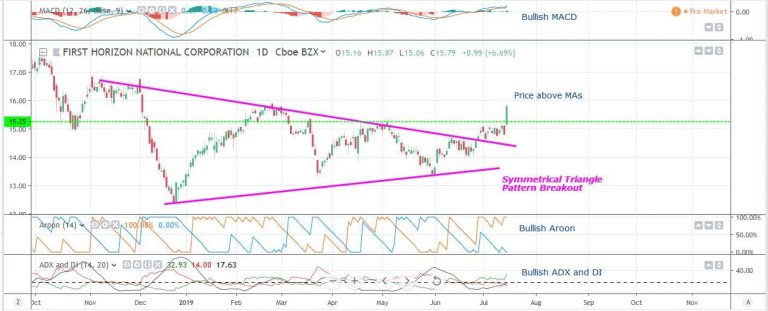
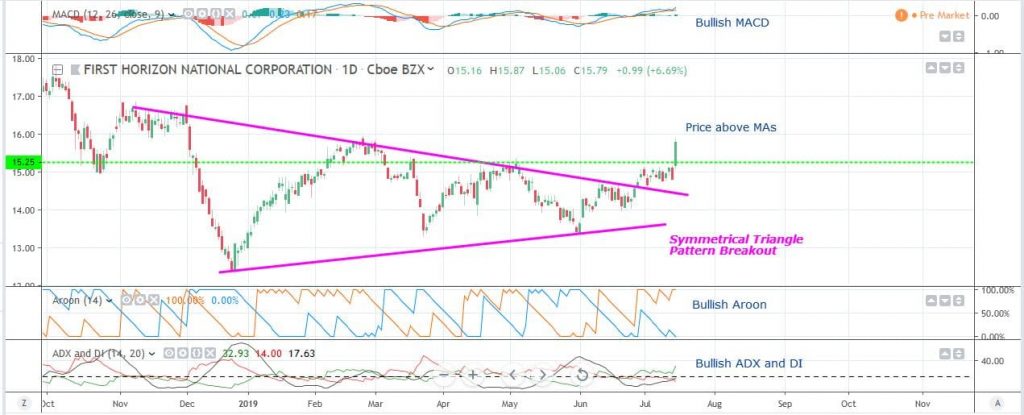
#1 Symmetrical Triangle Pattern breakout: The daily charts shows that a symmetrical triangle pattern has been formed for the stock. This is marked in pink color lines. A symmetrical triangle pattern represents a period of consolidation before the price breaks out.

This is typically formed when there is indecision in the price movements and uncertainty among the buyers and sellers. Once a breakout from the upper trend line occurs, it usually signifies the start of a new bullish trend. Currently, the stock has broken out of the symmetrical triangle pattern. This is a possible bullish sign.

Daily Chart – FHN

#2 MACD Above Signal Line…: 

In the daily chart, the MACD line (light blue color) is currently above the MACD signal line (orange color) which is typically considered bullish.

#3 Trading Above MAs: The stock is currently trading above both its 50-day and 200-day SMA, which implies that the bulls are currently in control.

#4 Bullish AroonThe value of Aroon Up (orange line) is above 70 while Aroon Down (blue line) is below 30 in the daily chart.

This indicates possible bullishness.

#5 Bullish ADXThe ADX line is starting to move up from below –DI and +DI lines.

The +DI line is also currently above –DI line. This indicates possible bullishness.

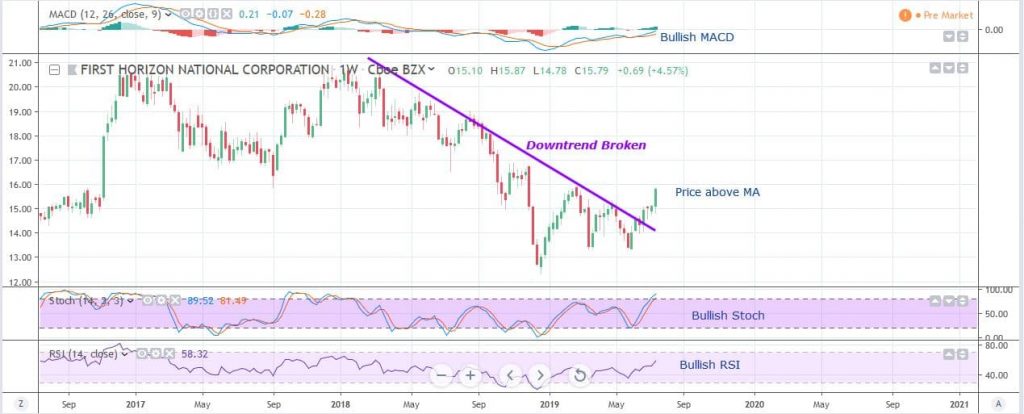
#6 Downtrend Broken: The weekly chart shows that the stock has currently broken out of a downtrend line. This line is shown in purple color in the chart below. This is a possible bullish sign.

Weekly Chart – FHN

#7 Bullish MACD: In the weekly chart as well, the MACD (light blue color) is currently above the MACD signal line (orange color). This indicates a possible bullish setup.

#8 Bullish RSI: The RSI is currently above 50 and moving up in the weekly chart, indicating possible bullishness.

#9 Bullish Stochastic: The %K (blue) line of stochastic is currently above the %D (Orange) line in the weekly chart. This is a possible bullish indication.

Recommended Trade (based on the charts)

Buy Price: If you want to get in on this trade, you can buy the shares of FHN at the current price of $15.79.

But for those with a lower risk appetite, you can purchase half the intended quantity of shares of FHN at the current price and the rest if the stock corrects to around $15.

TP: Our target prices are $21 and $27 in the next 4-6 months.

SL: To limit risk, place a stop loss at $13.70. Note that this stop loss is on a closing basis.

Our target potential upside is almost 33% to 71% in the next 4-6 months.

For a risk of $2.09, our target rewards are $5.21 and $11.21. This is a nearly 1:3 and 1:5 risk-reward trade.

In other words, this trade offers nearly 3x to 5x more potential upside than downside.

Risks to ConsiderThe stock may reverse its overall trend if it breaks down with high volume from the symmetrical triangle pattern. The sell-off of the stock could also be triggered in case of any negative news, overall weakness in the market, or any regulatory changes in the sector.

Happy Trading!

Rich @ Wall Street Probe

Hello world!

0
Hello world!

Welcome to WordPress. This is your first post. Edit or delete it, then start writing!