Home Blog Page 65

Coke Is Still a ‘Buy the Dips Stock’ This Fall
Coke Is Still a ‘Buy the Dips Stock’ This Fall

2019 has been a year of high flyers.

With the S&P 500 up more than 22% on a total returns basis year-to-date, all of the focus has been on this year’s biggest momentum names. But investors might want to take a closer look at big, lower-volatility stocks that have been delivering strong (if not earth-shattering) performance.

Case in point: The Coca-Cola Company (KOGet Report) .

Coke has “only” shown investors total returns of 17.5% so far this year. But while shares haven’t climbed quite as far or as fast as the S&P, they’ve still managed to pull off an unmitigated rally since the end of February – one that’s still in full effect this September.

As investors grow increasingly wary of the market’s ability to continue to push up and to the right in 2019, that looks like a very attractive combination.

To figure out how to trade it, we’re turning to the chart for a technical look.

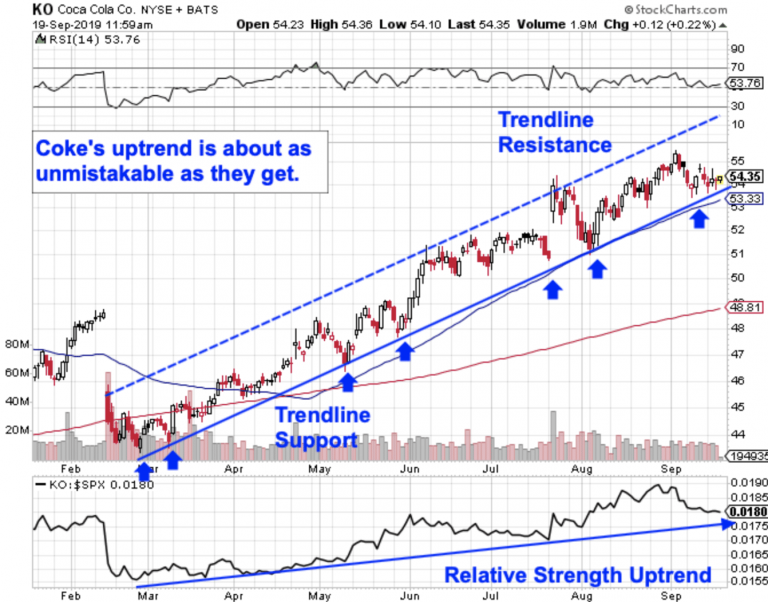
When I say Coke’s been enjoying an unmitigated rally for much of this year, it’s not hard to see what I’m talking about based on the chart. Coca-Cola’s price action has been extremely well-defined by a tight trend channel since late February, as shares have bounced on the last six tests of trendline support.

This week, as Coke tests that support line for a seventh time, there’s reason to expect it to resolve in the same way: Higher.

Relative strength turns out to be a crucial piece of the puzzle for Coke. Our relative strength line has been in an uptrend of its own since March, signaling that this stock’s underperformance this year isn’t simply a case of lower beta – it’s all due to the earnings-driven correction shares experienced back in the middle of February. While Coke has generally been lower-volatility than the broad market, it’s also been gaining ground on the S&P.

That makes it a logical name to own in your portfolio in the final stretch of the year.

As always, risk management remains key here. The 50-day moving average has been acting like a solid proxy for support since early on in Coca-Cola’s uptrend. That makes it a logical place to park a protective stop below in order to limit downside risk, if and when the uptrend in Coke fizzles out.

Meanwhile, Coke’s rally remains alive and well this fall. Buy the dips.
Oil and Gas Stocks Are in Breakout Mode This Month

Oil and Gas Stocks Are in Breakout Mode This Month

It’s been a tough year for shares of oil and gas producers.

While oil prices have been strong in 2019, up about 21% since the calendar flipped to January, and on-pace with the stock market this year, natural gas has been a major drag for energy companies. Natural gas has shed about 10% of its cost year-to-date, pulling prices for exploration and production stocks with heavy exposure to natgas down along with them.

As a result, the average E&P stock entered September down almost 19%, based on an index that tracks the industry.

But oil and gas producers are starting to look energized this month – and they could be kicking off a major change in trend that leads to higher prices for these stocks in the long run.

To figure out how to trade the trend, we’re turning to the charts for a technical look.

For our purposes of looking at the whole industry in one shot, the instrument we’re focusing on here is the SPDR S&P Oil & Gas Exploration & Production ETF (XOPGet Report) , a $1.73 billion exchange-traded fund that owns a basket of 63 exploration and production stocks.

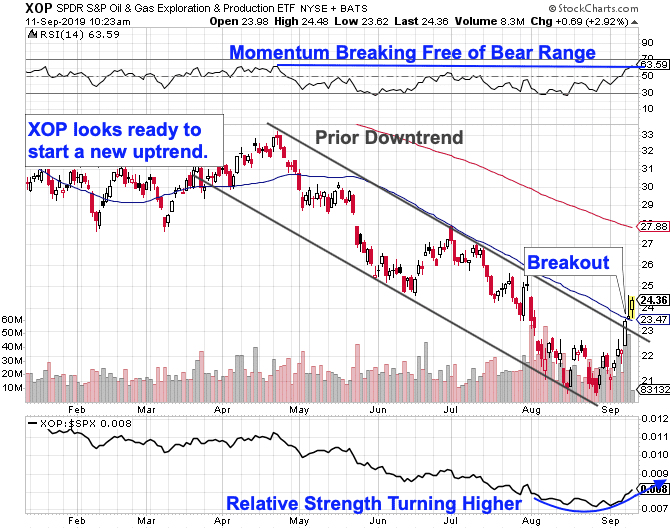
At a glance, you don’t need to be a technical trading expert to figure out that XOP has been stuck in a pretty ugly downtrend since the beginning of April. In that four-month stretch, this ETF has actually shed about 30% of its market value, precipitated by a steepening decline in natgas prices.

But it looks like that selloff was overdone – and as shares break out of that well-defined downtrend range this week, they’re clearing the way for buyers to make up for lost time.

That’s confirmed by relative strength down at the bottom of the chart, which broke out of its own downtrend at the start of this month. That signals that XOP is starting to systematically outperform the rest of the broad market in September. Likewise, momentum, measured by 14-day RSI up at the top of the XOP chart, just broke out of its own bear market range, indicating that buyers are back in control of things.

Context matters a lot in this market. The fact that XOP has underperformed so materially at the same time that the S&P 500 has charged more than 21% higher on a total returns basis in 2019 means that E&P stocks could find considerably more buying power as investors searching for some semblance of value in a rich market rotate into industries that haven’t participated in that upside yet.

As always, risk management is crucial here. If XOP violates prior lows at $21, then the bullish trend reversal is off, and XOP opens the door to more downside. Meanwhile, shares look primed for a move higher in the intermediate-term.

Bed Bath & Beyond’s Breakout Points to More Upside in September

Bed Bath & Beyond’s Breakout Points to More Upside in September

Retail is dead. Long live retail!

While most investors continue to be fed the same old song and dance about ecommerce giant Amazon’s (AMZNGet Report) ongoing disruption of the retail sector in 2019, something interesting has been quietly happening…

Retail stocks have started working again.

Retail stocks have been ripping higher in the last few weeks, with the big S&P 500 Retail Index surging more than 7.4% higher since the middle of August – about double the upside of the rest of the S&P over that same stretch.

And right now, the poster child for the return of retail is housewares retailer Bed Bath & Beyond  (BBBYGet Report) .

In the last month, shares of Bed Bath & Beyond have been surging, up more than 22%. Better yet, it looks like there’s still more where that came from. To figure out how to trade it from here, we’re turning to the chart for a technical look.

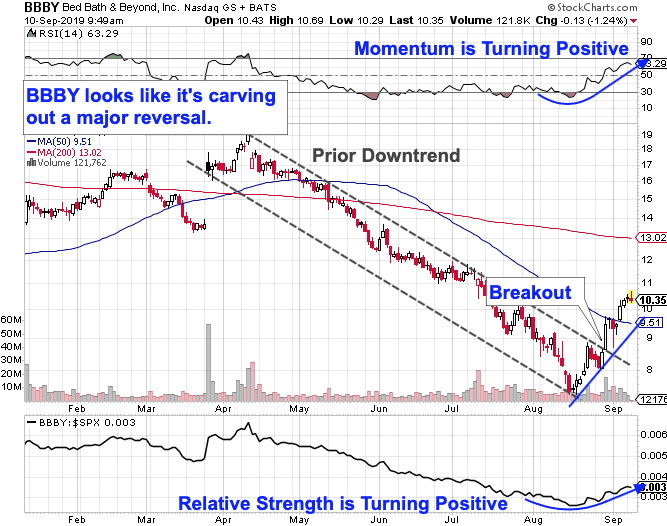
At a glance, it’s not hard to spot the prevailing trend that’s been in play in Bed Bath & Beyond year-to-date – and it hasn’t been a bullish one. Even with the return to rally-mode that shares have enjoyed in the last month, this big retail name is still down more than 8% on a price basis since the calendar flipped to January, underperforming the rest of the broad market in a big way.

That’s important context when it comes to understanding the staying power behind Bed Bath & Beyond’s rally. While the 22% climb shares have undertaken in the last four weeks might sound like too far, too fast on an absolute basis, relative to the correction shares have endured this year, it’s actually pretty reasonable.

And shares look primed to continue to make up for lost time.

Bed Bath & Beyond broke out of an extremely well-defined downtrend back at the end of August, and they’ve been setting higher highs ever since. Right now, it looks like we’re seeing the establishment of a new uptrend that could undo more of the corrective price action from this spring.

That’s confirmed in part by relative strength, the indicator down at the bottom of the price chart. Relative strength just turned positive for the first time in 2019 for Bed Bath & Beyond, signaling that shares are finally systematically outperforming the broad market as we head deeper into September.

Following the surge higher Bed Bath & Beyond has undertaken in recent weeks, it wouldn’t be out of character to see a modest correction in the next few sessions back down to newfound trendline support, currently right around the $9.50 level. Look for dips of that scale as a buying opportunity in BBBY on the way up.

Meanwhile, risk management remains key for this trade. If shares materially violate $8, then the new uptrend is over and you don’t want to own it anymore. Until then, this retailer looks primed to keep climbing in September.

Microsoft Looks Ready to Break Out in September

Microsoft Looks Ready to Break Out in September

Tech giant Microsoft  (MSFTGet Report) is enjoying a stellar run in 2019. Year-to-date, shares have surged more than 34% higher, leaving the S&P 500’s otherwise impressive rally in the dust.

And there’s more where that came from.

While many investors are looking at high-performers with skepticism, on watch for signs of the next leg lower, the fact of the matter is that stock market leadership continues to be rewarded as we head into September. So, while volatility has been ticking higher in August, Microsoft has managed to hold up relatively unscathed.

More importantly, shares look like they’re setting the stage for another substantive leg higher, thanks to a bullish price setup that’s taking shape. To figure out how to trade it, we’re turning to the chart for a technical look.

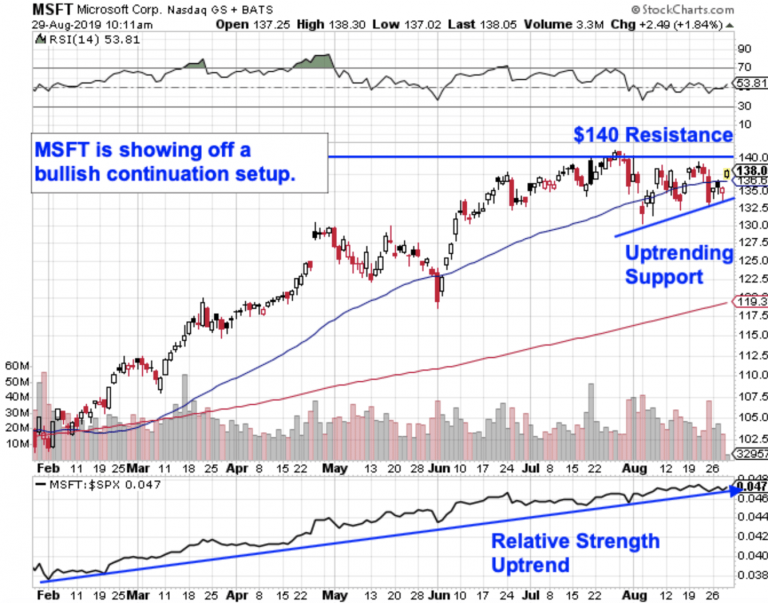
There’s nothing subtle about the nonstop rally that shares of Microsoft have been enjoying this year. In fact, for much of 2019, the price action has been about as straightforward as it gets: Microsoft has marched higher in a well-defined uptrending channel that’s provided clear-cut buying opportunities on every test of support.

More recently, though, shares have taken on a more sideways trajectory. And it’s that consolidation that’s setting the stage for the next up-move in Microsoft as we head into September.

Microsoft is currently forming an ascending triangle pattern, a bullish continuation pattern that’s formed by horizontal resistance up above shares (at the $140 level in this case), with uptrending support to the downside. A breakout materially above the $140 level signals that it’s time to buy again.

Why all of that significance at that $140 level? It all comes down to buyers and sellers.

The $140 resistance level is a price where there has been an excess of supply of shares; in other words, it’s a spot where sellers have been more eager to step in and take gains than buyers have been to buy in August. That’s what makes a breakout above $140 so significant – the move means that buyers are finally strong enough to absorb all of the excess supply above that price level.

The price setup in Microsoft is being confirmed right now by relative strength, the indicator down at the bottom of the chart. Relative strength has been holding onto an uptrend of its own all year long in Microsoft, signaling that this big tech name continues to systematically outperform the rest of the market, even now.

As always, risk management is key in this trade. If shares violate their pattern lows around $130, then the setup is broken and you don’t want to own it anymore.

In the meantime, Microsoft remains a stock to keep a close eye on in the sessions ahead.

Labor Day Sale: Join Jim Cramer’s Club for Investors and Save. Get 57% off on your membership to Jim’s Action Alerts PLUS club for investors.

International Stocks Are Starting to Look Bullish Again

International Stocks Are Starting to Look Bullish Again

Buy American” has been good investment advice for quite a while now. But some international stocks are finally starting to show signs of life again. 

U.S. equity markets have overwhelmingly outperformed the rest of the world for years. Over the last five years, the MSCI All Country Ex-U.S. Index has produced total returns of 11.05%. By comparison, the U.S.-focused S&P 500 has surged more than 69.5% over the same period.

Along the way, foreign stocks – namely emerging markets – have been a colossal value trap. While international markets have looked cheap by many valuation metrics relative to American stocks, they still manage to keep on getting cheaper.

That could be about to change – at least in one particular pocket of the ex-U.S. market.

To figure out what’s happening (and how to trade it) we’re turning to the chart for a technical look.

For starters, it’s important to bear in mind that while international stocks have been a quagmire for long-term investors, they’ve presented some tactical upside opportunities – especially in recent months.

We looked at a buyable opportunity in Brazil back in October 2018, when U.S. stocks were flagging. And again, at a broader group of emerging markets earlier this year. Both led to double-digit rallies in the short-run.

Now, a similar tactical play is shaping up in the iShares Core MSCI EAFE ETF IEFA, an exchange-traded fund that tracks stocks in Europe, Australasia, and the Far East.

IEFA has been in correction-mode lately, rolling over in early July and more recently consolidating sideways in a range just below $60. It’s that range that’s setting up the potential for a buy signal in this ETF right now.

IEFA is currently forming an inverse head-and-shoulders pattern, a bullish reversal setup that’s formed by a pair of swing lows that are separated by a deeper low. The buy signal comes on a breakout above the resistance level that identifies the top-side of the price range. For IEFA, that breakout level is currently right at $59.

That’s a significant level for another reason – it’s also the price level that defines the bottom of the uptrend that IEFA had been trading within for most of 2019. A breakout through that level also puts IEFA back in its uptrend, with plenty of upside room.

At a glance, IEFA’s price action looks particularly “gappy”. Those gaps are suspension gaps caused by off-hours trading on non-U.S. exchanges. They make IEFA look more volatile than it really is – but you can ignore them.

Finally, momentum, measured by 14-day RSI up at the top of IEFA’s price chart, adds some extra confidence to the potential for a reversal here – our momentum gauge managed to put in a higher low on each of the price swings in the pattern.

For IEFA, the buy signal comes on a meaningful breakout above $59. Wait for shares to catch a bid above that line in the sand before you jump into this trade. After that, it makes sense to keep a tight stop in place; if shares violate $57, then the pattern is broken and you don’t want to own it anymore.

Labor Day Sale: Join Jim Cramer’s Club for Investors and Save