Home Blog Page 66

Another Lousy Week for the S&P 500: How to Trade It
Another Lousy Week for the S&P 500: How to Trade It

Markets are reeling Friday, the big S&P 500 index selling off more than 2% in this afternoon’s session following another round of trade war escalation with China.

President Trump tweeted that he would order American companies to start looking for an alternative to China for manufacturing, a rebuttal to China’s State Council’s Customs Tariff Commission announcing that it would levy two batches of new tariffs effective next weekend and Dec. 15, respectively.

The trade war drama is surely far from over at this point.

As a consequence, it’s set to be another lousy week for the stock market – the fourth straight decline for the S&P, in fact.

But that only tells part of the story. Often, when volatility gets injected into the broad market, the technical picture can provide some crucial context. Namely, is the selling we’re experiencing here a good opportunity to be a buyer?

Or is the market looking ready to throw in the towel and point lower for the rest of 2019?

To figure out the most likely trajectory for the S&P from here, we’re turning to the charts for a technical look.

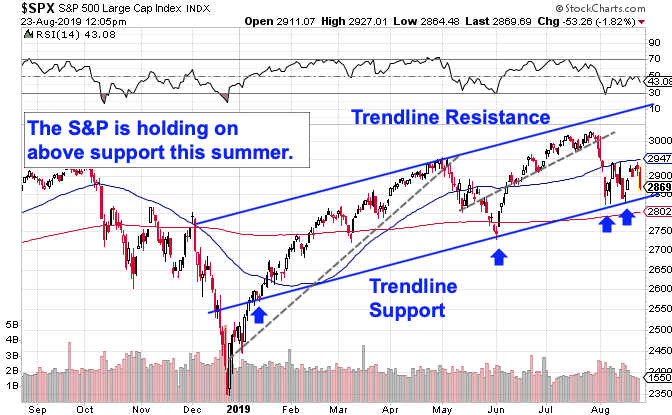
First, the good news. It doesn’t take a technical trading whiz to see that the S&P 500’s price trajectory continues to look extremely constructive here.

While there have been a couple of revisions to the S&P 500’s uptrend in the shorter-term, the longer-term trend from January remains intact here with a series of higher highs and lows.

In other words, we’re still very much in a “buy the dips market”.

Just as importantly, that uptrend gives us a clear do-not-cross line that would signal an end to the trend if violated. Right now, that level comes in right around 2,825 for the S&P 500. A material breach of that level means that downside risk in the market just ramped higher.

Until then, the trend is your friend.

That’s true in the much longer-term, too:

The chart above shows the weekly price action of the S&P 500 reaching all the way back to early 2013. The S&P’s price action has been near-linear over that stretch, with clearly-defined support connecting major lows of 2012, 2016, and 2018, and a return line at higher levels currently in play.

If the 2,825 level in the S&P were to get broken through, a test of primary support at around 2,550 becomes likely.

That’s more than 10% additional downside from here before the S&P 500’s long-term uptrend even gets tested.

Despite the trade war, recession fears, and headline risk galore, the stock market isn’t on the verge of collapse this summer – in fact, it’s not even waving a caution flag yet.

This may be another lousy week for the market, but the technical evidence points to more upside ahead for the broad market.
AMD Breakout: Key Level to Watch

AMD Breakout: Key Level to Watch

The companies on the front lines of the trade war are getting a bit of a reprieve to start the week, following the announcement from Commerce Secretary Wilbur Ross that Chinese device maker Huawei will get another 90 days to buy from American suppliers.

That’s proving to be a good thing for the tech sector, as investors hope that the dialog might spill over more broadly to the trade discussions ongoing with China.

One big U.S. tech name that counts Huawei as a customer is Advanced Micro Devices (AMDGet Report) – shares are getting a boost from the news cycle Monday, up 2.6% just before noon.

That’s putting shares of AMD in a positive price trajectory for the first time in the last couple months. To figure out how to trade shares from here, we’re turning to the chart for a technical look.

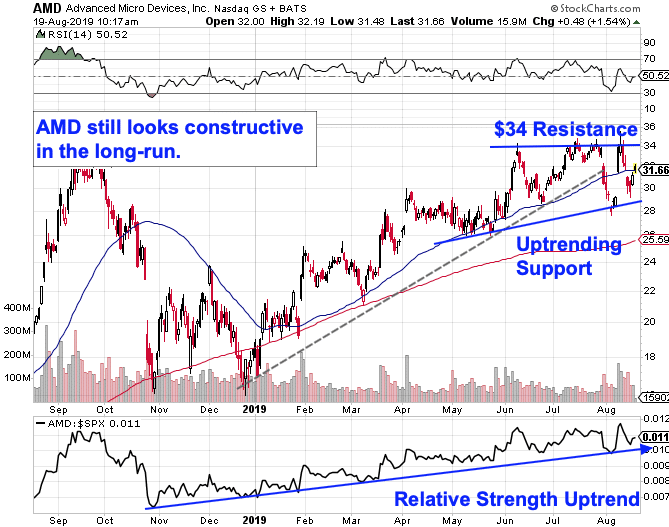
AMD’s price action has been choppy lately. While shares spent most of 2019 in a well-defined uptrend – one that sent a clear-cut buy signal in mid-June that was followed almost immediately by a push to new highs – things have changed as trade war developments and recession fears entered the market.

That prior uptrend (the gray dashed line on the chart above) got violated at the start of this month, and shares have been stuck in a choppy range ever since.

But while AMD’s picture-perfect rally may be over, it’s still far too early to count out this momentum tech name. That’s because shares actually still look constructive in the long term, thanks to a bullish continuation pattern that’s setting up in the long term.

AMD is currently forming an ascending triangle pattern, a bullish continuation setup that’s formed by horizontal resistance up above shares at $34, with uptrending support to the downside. Simply put, as AMD bounces in between those two technically significant price levels, shares have been getting squeezed closer and closer to a breakout through the $34 level.

Once that happens, we’ve got a brand new buy signal in AMD.

Shares aren’t quite there yet, but they’re close.

Meanwhile, relative strength continues to look extremely bullish in shares of AMD right now. That gauge, down at the bottom of the AMD chart above, indicates that this stock continues to systematically outperform the broad market in 2019, even during this recent bout of volatility. As long as that relative strength uptrend remains intact, AMD continues to be a stock that you should own.

Investors should keep a close eye on the $34 level in the sessions ahead. If shares can muster the strength to catch a bid up above that level, AMD opens the door to considerably more upside in the second half of 2019.

Microsoft Is (Still) a Buy-the-Dips Stock This Summer

Microsoft Is (Still) a Buy-the-Dips Stock This Summer

No question, 2019 is turning into a fantastic year for shareholders of tech giant Microsoft (MSFTGet Report) .

Year-to-date shares of Microsoft are up approximately 35%. That’s basically double the price performance of the rest of the S&P 500. Better still, Microsoft’s rally isn’t showing any signs of slowing down this summer, despite an influx of volatility that’s left investors generally rattled this week.

So far, Microsoft has been a “buy the dips” stock all year long — and shares look as if they’re showing investors another buyable dip right now. To figure out how to trade it, we’re turning to the chart for a technical look.


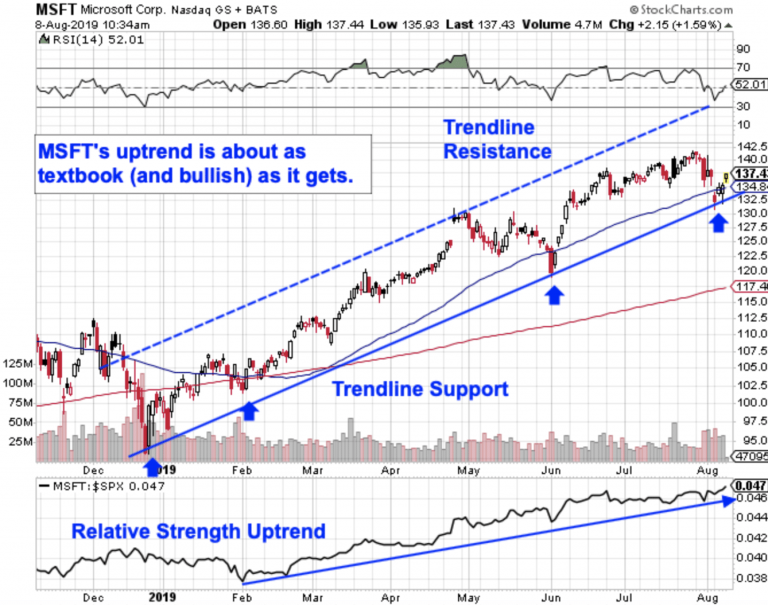
At a glance, you don’t need to be an expert trader to figure out what’s going on in shares of Microsoft. The uptrend in this big stock is about as textbook – and bullish, for that matter – as they get.

Microsoft’s uptrend kicked off at the start of the calendar year, on the heels of the deep broad market correction that stocks endured last fall. That’s not completely unique. Many stocks initiated similarly well-defined uptrends in early January, as correlations with the S&P remained strong.

But Microsoft’s different in the scale of the move higher. For every dollar the S&P has generated for investors’ portfolios this year, Microsoft has generated two dollars, on average, all while keeping the risk-reward tradeoff incredibly well defined.

Now, exact same long-term momentum setup that presented its last buying opportunity at the start of the summer is showing off what looks like another low-risk entry opportunity in shares.

The test of trendline support we saw in Microsoft at the beginning of August is getting confirmed by a bounce higher in the last few sessions. That’s an indication that buyers are stepping in once again at the bottom of Microsoft’s price range.

Relative strength, the indicator down at the bottom of Microsoft’s chart, adds some extra confirmation that this is still a name you want to own in the second half of 2019. Relative strength has been in an uptrend of its own all year long, and it continues to post higher lows this summer. That shows us that Microsoft has systematically outperformed the broader market, even now.

Of course, risk management is crucial – even for a solid setup like Microsoft. Prior lows around the $130 level look to be a logical place to park a protective stop underneath. Simply put, if Microsoft meaningfully violates that $130 level in the near term, its long-standing uptrend is broken, and you don’t want to own it anymore.

Meanwhile, the Microsoft trade still looks as if the wind is at its back. For investors who don’t own Microsoft in their portfolio (or want to buy more), now looks like as good a time as any from a risk/reward standpoint.

Thinking about becoming an Angel Investor? Consider these three tips…

Thinking about becoming an Angel Investor? Consider these three tips…

In the past year or so, I’ve sat down with dozens of CEOs and senior executives from enterprise cloud companies that have had successful exits, whether via IPO or acquisition.

My conversations with these folks have almost always included a similar topic: They tell me they are inundated with requests for funding and/or consultation from today’s new wave of enterprise cloud startups, but they aren’t exactly sure how to answer these requests.

Being an angel investor can be a gamble for sure, and sometimes that gamble can yield huge payoffs. When former Oracle executive Marc Benioff decided to venture off on his own in 1999 to realize his vision of an enterprise cloud company, he couldn’t find any VCs to pony up for his fledgling, apartment-based startup. But, angel investors like Oracle co-founder Larry Ellison, Dropbox’s Bobby Yazdani and CNET founder Halsey Minor took a chance, and Salesforce was born.

Obviously, not every angel investment is going to generate such amazing returns, and the executives I speak to usually have many of the same questions. Should they only say yes to people they already know? Should they gamble and put money into any and every promising startup? Should they say no to everyone?

It makes perfect sense that startups would want to connect with these proven cloud veterans. After all, with their experience they make ideal angel investors. But, do they even want to be angels? And, if so, what should their strategy be?

Here are three important tips for cloud veterans who are seriously considering angel investing.

1. Limit the number of investments.

A spray and pray approach to investing is always a bad idea. And it’s especially bad for angel investors, who don’t have the bandwidth to monitor dozens of different startup investments. The truth is that angel opportunities require a considerable amount of your time, resources and energy. And that’s a lot to ask, especially if you’re a cloud executive who’s still running a company.

Many active cloud executives simply don’t have enough time to be answering questions from startup founders and worrying about their investments while trying to juggle a demanding day job. So, only focus on a small number of startups that you truly believe in. For instance, look for cloud startups that are solving an important problem — a problem large enough to justify an actual company, not just a product or feature. After all, it’s quality not quantity that matters most.

2. Don’t underestimate the capital requirements.

Angel investments in the cloud can be a risky proposition because new cloud companies tend to need more money than a typical angel round can provide. That doesn’t stop the investments from being made, of course, but from my perspective, angel and seed round investors today are not providing the kind of financial support that enterprise cloud startups need.

According to a recent study by Pitchbook and Deloitte, the median seed round size in 2018 was about $2 million, but that’s simply not enough. From what I’ve experienced, cloud startups really need $5 million to get to the next level.

Enterprise cloud companies need to hire highly qualified engineers that can design mission-critical solutions. Pair this with the high level of executive experience required to deliver world-class, enterprise-grade products, and you can see how the required funds to get a startup off the ground can quickly add up.

I’ve actually talked to a number of angel investors who have come to this same conclusion — but only after it was too late. They realized after the fact that they didn’t put enough capital in the seed round and, as a result, other investors came in and their positions were quickly diluted.

3. Seek out the right partners.

I’ve talked with numerous cloud executives who are interested in angel investing but aren’t sure they have the time or energy to do the proper analysis on a startup or go through all the required meetings with the entrepreneurs.

That’s where partnering with a venture firm makes good sense. Successful cloud executives tend to have great instincts, so most venture firms will be happy to do the due diligence and let you know what they think. If the venture firm does decide to move ahead with the investment, the angel investors get the benefit of more capital in the round, as well as the advantages of working with an institutional firm that can increase the chances of the company succeeding in the long run.

The value proposition for a venture firm is obvious. Not only do they get high-quality deal flow, they get to partner with the best minds and the best operators in the cloud market. If a proven cloud executive thinks an opportunity is interesting, there’s a pretty good chance that it really does have potential.

It truly takes a village to build a great startup. Personally, I find that pairing a motivated, experienced angel investor with an emerging and promising cloud company can be the ultimate win-win. In fact, it can be heaven.


When to Buy Apple: After the Selloff

When to Buy Apple: After the Selloff

As the dust settles following the worst day for stocks in 2019, investors are rightly wondering whether this is the time to batten down the hatches – or if it’s an opportunity to pick up some of the pieces.

Case in point: Apple (AAPLGet Report)

Apple was one of the biggest decliners in Monday’s trade-war fueled selloff, shedding more than 5.2% of its value on the session by the time the closing bell rang. That’s a colossal drop for a $900 billion company.

And with shares only clawing back 1% and change in Tuesday’s trading session, it’s not clear whether buyers or sellers are driving the ship here. To figure out what’s happening in Apple – and how to trade it from here – we’re turning to the charts for a technical look.

Apple is a holding in Jim Cramer’s Action Alerts PLUS member club. Want to be alerted before Jim Cramer buys or sells AAPL? Learn more now.

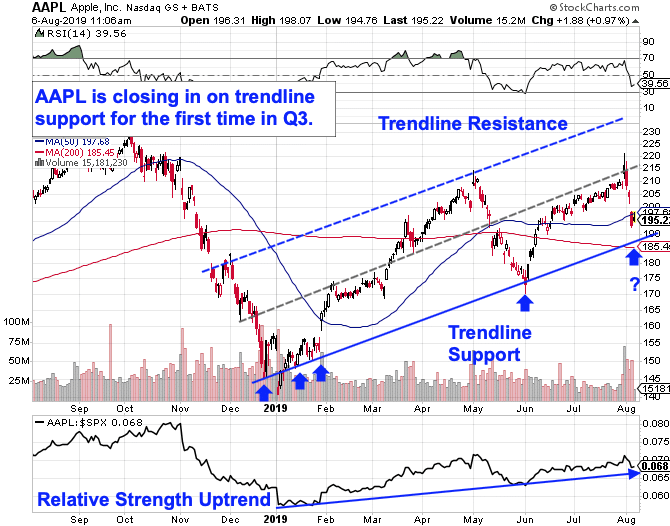
At a glance, it doesn’t take a trading expert to figure out Apple’s price trajectory this year. In fact, the price action is about as straightforward as it gets. Apple has been bouncing its way higher since the calendar flipped to January, catching a bid on every successive test of trendline support.

In other words, it’s a “buy the dips” stock.

Now, as shares fall back into correction-mode this August, they’re closing in on the first test of trendline support since the start of June. It’s worth noting that the prior move in June propelled shares some 26% higher.

To figure out whether Apple can do it again, it’s key to keep a close eye on how shares react to support. Rather than anticipating a bounce higher, it’s a better move to wait for the bounce to happen before jumping on shares of Apple. While that will come with some opportunity cost, waiting to pull the trigger greatly reduces the risk of the trade by waiting for buyers to affirm that they’re still in control of shares first.

Relative strength, the indicator down at the bottom of Apple’s chart, adds some extra confidence to the upside breakout here. Apple has been systematically outperforming the rest of the broad market since the start of the calendar year, and with that uptrend still intact, Apple remains predisposed to outperform.

The bottom line is that if Apple manages to bounce off of trendline support (currently right above $185) then we’ve got a clear signal that this tech behemoth is likely to keep on rallying in the second half of 2019.

In the meantime, it makes sense to sit on the sidelines for the next few sessions and see how this correction plays out.