Home Blog Page 68

The Capital Wave Behind the Coming IPO Flood

The Capital Wave Behind the Coming IPO Flood

As private capital continues to pour into these companies, they have four possible destinies. Here’s what you need to know to ride the wave…

As the public cannabis markets endure a short-term swoon in concert with world equities, investors should be aware that in the background a private capital wave continues to boom.

Cannabis companies in Canada, the United States, and around the world are receiving funding at an incredible rate. CBD companies are also receiving massive funding to meet the coming boom in demand for CBD products.

I’ve previously written about some of this wave, including the emergence of the “Private Offices” of billionaires getting into the game.

But with private capital being raised at a record rate, it’s time for an update.

So far this year, 50 private cannabis companies have raised over $1.2 billion in equity. That’s nearly double the pace of last year. The money has been raised in just about every sector of the cannabis industry.

All of that money is going to lead to a flood of IPOs.

I want to make sure you know why this will happen – and how you can play this opportunity to secure a retirement fortune…

The Four Destinies of Private Companies

Some smart person realized that those private offices want to invest in cannabis but don’t know how. So now there is an exclusive set of conferences set up solely for the private offices of rich people to learn about cannabis investing.

Those 50 private companies, and the 173 that raised private money last year, have one of four destinies.

  • They could fail. Some will, but the truth is that in the cannabis industry most will not fail – at least not initially.
  • They could sell to a competitor. I’m sure some of those companies have looked at the massive cash hordes of Canopy Growth (NYSE: CGC) and Cronos (Nasdaq: CRON) and asked themselves how to build a company that would be attractive to one of those.
  • They could remain private and independent, raising more private capital as needed.
  • And they could go public – I believe that will be the destiny of many of these companies.

In fact, many of those private equity raises were specifically marketed to investors as a pre-IPO raise. The company is explicitly promising to go public. So this summer and fall will prove to have many interesting IPOs.

Banks are pressuring issuers to forget their long-term plans and raise as much money as they can as soon as they can, so it will be important to do the work to separate great companies at bargain prices from mediocre companies charging too much for their shares.

But the best opportunities will be outstanding – better than the best IPOs of last year.

Taking Advantage of Big Money

And fortunately, there will be more money to absorb all of those IPOs, too. As I shared yesterday, big money is finally starting to enter the cannabis market in a serious way. So far, that institutional money is mostly staying in fully federally legal companies – Canadian and international operators and U.S. companies that do not “touch the leaf.”

But there are exceptions.

It turns out that a big hedge fund has amassed more than 3% of Acreage Holdings (CSE: ACRG, OTC: ACRGF). We only know that because the fund is objecting to the Canopy takeover, so we can infer that that fund and others that don’t have to report their holdings very often are also in U.S. cannabis companies.

It is inevitable that institutions will start to invest in U.S. stocks as federal regulations make it safer for them to do so. The top Canadian firms have seen their disclosed institutional ownership increase from under 2% to over 10% within the past 18 months or so. Big U.S. operators generally have disclosed institutional ownership of under 1%. And every institution knows that the U.S. opportunity is many times greater than the Canadian opportunity and that U.S. companies are underpriced relative to their Canadian counterparts.

Even Bigger Things in Store

Looking to the future, what seems like a flood now will feel like a trickle in just a short time. In fact, in one sense, that future is already here.

A single public investment – Altria’s (NYSE: MO) investment in Cronos – was larger than the total amount of private equity invested in the cannabis industry so far this year. Now that Canopy has created a pipeline from non-cannabis companies to U.S.-based cannabis companies through the “option merger” it has with Acreage, expect more strategic investors in Canadian companies, followed by partnerships with or acquisitions of U.S. multi-state operators.

That, in turn, will draw even more private equity into the sector – those private offices aren’t going to those conferences just to get away from the desk for a few days. Strategic investors, private investors, and institutional investors will start to leapfrog each other to put more money into the cannabis sector.

We’ve been talking about this trend for a while and reinforcing that you, as an individual investor, want to get in front of this wave of capital, not behind it.

The only thing that’s changed is the speed at which that wave is coming. What we used to think was a year or two off is starting to happen right now.


Don’t miss out.

Be Ready Now to Profit from These Bigger, Faster Markets

Be Ready Now to Profit from These Bigger, Faster Markets

The legal marijuana market will be far bigger than anyone dares predict, and it’ll get there sooner than anyone thinks.

Last year, total marijuana sales in the U.S. topped $86 billion.

In 2018, all across the country, nearly 49 million people spent an average of $1,755 each on marijuana.

Now, the majority of those sales were illegal, but of that number, about $18 billion was legal.

And it’s this large, established market of marijuana sales that makes the opportunity to profit from cannabis stock investing so rare.

Bringing these sales into the legal light doesn’t require convincing new customers to try something new. No new consumption habits need to be formed. It’s a well-established market just waiting to be sold to.

As the legal market overtakes the illegal market, trillions of dollars in value will be created, and investors that get in now will capture the lion’s share of those profits. It’s a millionaire-minting machine, and the incredible opportunity for normal, everyday investors to participate in these riches is what spurred us to build out community.

We want to put you in the position to reap those gains. And the quicker that legal gap closes, the sooner investors who own cannabis stocks now can pocket the rewards.

Just how big those rewards can be depends a lot on the ultimate size of the legal marijuana market.

And once you see these projections, you’ll know exactly why the opportunity is far bigger than anyone dares to predict…

Mind the Gap

Just how quickly can legal sales fill that gap?

I think that in five years, given the pace of legalization, legal sales could fill most of that gap. After all, Canopy Growth Corporation (NSYE: CGC) would not have agreed to acquire Acreage Holdings (CSE: ACRG, OTC: ACRGF) in the future if it felt that federal legalization was several years away. Similarly, Acreage would not have agreed to sell if it thought that future was very far off. Such a deal would entail too much risk for Canopy and give away too much opportunity for Acreage.

Canopy plunked down $300 million to secure the right to acquire Acreage. That’s far too much money, even for a company like Canopy with billions in cash, to leave sitting around for a year or two.

Closing the gap with illegal sales would put the legal marijuana market at around $100 billion by 2025, once you factor in population growth.

Phase 2 of cannabis investing has the potential to make average Americans millions. You still have time to get in before big business does – but first, you need to click here to watch this landmark announcement that could change your life.

But that $100 billion in revenues only counts current users of traditional marijuana products converting to legal sales. It does nothing to account for totally new users who switch after legalization or the development of new markets.

Nor does it count the creation of new marijuana markets. Once we add those in, the revenue growth that the right cannabis companies enjoy will push their valuations through the stratosphere.

Entirely New Markets

For starters, we need to account for medical marijuana. This market will expand rapidly as knowledge about its superiority over Big Pharma drugs – especially opioids – spreads.

To that, we can add the proliferation of new methods of consumption such as vape pens, gummies, and THC-infused beverages. These products will rope in an entirely new set of recreational users. So between growing medical use and new recreational consumers, that could easily add another $30 billion in sales.

But so far we’re just counting final retail sales only. To all this, you have to add the revenues of the entire cannabis ecosystem. For example, cultivators sell cannabis to product manufacturers. Manufacturers pay extractors. Distributors move the product and sell to retailers. Yet others, like KushCo Holdings Inc. (OTC: KSHB), sell packaging.

Between the growth of new markets and the ecosystem that rises up around it, revenues could easily exceed $250 billion in the U.S. alone.

And we better not forget the big one – cannabinoid-based pharmaceutical drugs.

Big Pharma Gets In on the Act

Frankly, I find accurately estimating the maximum size of the cannabis pharmaceuticals segment an impossible task. The potential for breakthrough discovery treatments is too significant, but let’s add another $100 billion in sales in the U.S. as a ballpark, conservative estimate.

By that count, in five years, total sales across the legal marijuana ecosystem could exceed $350 billion per year. And from a base of $20 billion, revenues have to grow nearly 80% per year to get there. It’s stocks in companies with that incredible level of growth for which institutional investors will pay a very high price. Big money wants in, and once federal regulations are lifted, institutional money is going to rush in.

Revenues growing at 80% annually on its way to $350 billion per year could easily launch the value of cannabis stocks well north of $3 trillion.

And when the bidding starts, you’ll be there to sell your market-leading cannabis stocks to them for a fortune.

You Too Can Be an Angel Investor – If You Have What it Takes

You Too Can Be an Angel Investor – If You Have What it Takes

Private investing was once only for the wealthiest of investors, but that has changed, and here’s how you can stake your claim in the next private cannabis venture.

In the past, to invest in the type of startups that ultimately define the future of an industry, you needed a few things that the typical investor didn’t have.

For starters, you needed access to deal flow. That’s just private investing talk that means you had to know how to find ventures that needed funding.

Not an easy task.

You also needed a lot of financial expertise. It takes highly specialized knowledge to determine if a deal is structured in a way that allows you to get rich right alongside the founders.

And having the business acumen to identify whether the company has a strategy with any chance of success is another must have. The lack of this skillset rightfully builds a barrier to all but the most knowledgeable investors.

Now, besides all of this, you still had to earn hundreds of thousands of dollars per year or have millions of dollars in net worth to legally invest in private companies.

Yet, even meeting that threshold wasn’t enough. The practical reality was that only the mega wealthy could afford the advisors who had access to deals and the expertise to evaluate if those deals were worth investing in.

It stood that way for decades.

It’s true that public markets have created tremendous amounts of wealth, but far more wealth is created in a company long before it goes public.

And as we mentioned, access to this wealth was once reserved for only the most well-heeled investors.

But this has all changed.

The pieces have fallen into place, and you too can rake in returns just like the investing elite…

The Government Actually Made Investing Easier

Nowadays, the rules have evolved to open private deal access to all Americans.

The SEC has upgraded securities regulations. It has made sweeping changes to Reg D, Reg A, and has also created an entirely new set of regulations called Reg CF. And these regulations have had a big impact on how companies raise money.

Anyone, regardless of income or wealth, can provide startup executives with the vital seed capital they need to grow. Everyone with money to invest can champion a cause by putting their money behind it, and share in the same profits once reserved for the top 1%.

And the timing couldn’t be better for capital-hungry cannabis startups looking to claim a piece of a market set to create a $1 trillion in value over the coming years.

Know that the path the cannabis industry takes to $1 trillion will mint an entirely new class of marijuana millionaires, especially for those who get in early on the private deals that fund these ventures long before they go public.

But even new regulations opening this ground-level opportunity up to everyone still doesn’t change one other fundamental requirement of private investing.

Fortunately, it’s something that you can control.

The CBD market is on fire. Our experts have identified two companies that could deliver 1,000% gains… and both are trading for under $4. Go here for more information.

You’re in Control of Your Financial Future

You can’t buy and sell private investments like regular stocks and bonds. In fact, years can pass before you can sell a privately held security, and that often comes after the company goes public.

Now, as we mentioned, the barriers have been removed to help retail investors own a piece of private companies.

However, the average investor still doesn’t have the foresight that it takes to see a private company all the way through. The lack of liquidity makes them feel as though their hands are tied. As such, they limit themselves to public market returns.

But that’s good for those who see the end game.

A smaller pool of investors that have what it takes means fewer buyers of private investments. With fewer buyers, you can also get in at a lower price. Over time, continuously buying investments at a lower price adds up to a pile of much higher returns.

We call it the “Patience Premium,” because that lies at the heart of what it takes. The beautiful part is that this is a source of returns that’s completely under your control. You determine whether you earn it.

And, over time, this Patience Premium can double what you earn in public markets – and many multiples of even that when you invest in the right private cannabis deals.

So the pieces have come together to get you in on the ground floor. The rules have changed for the better, and you know what you bring to the table.

The only thing left is how to access and evaluate these deals, and we know just how to help with that.

The Final Piece of the Private Investing Puzzle

We set out to make it easier for investors like you to invest in private deals.

What investors needed was someone to field the calls from companies looking for capital. Someone to evaluate the pitch deck, run the financial projections, and grill management. Greg wanted to provide you with a pipeline of private cannabis deals that my research team and I have personally vetted.

That’s why he created the American Angel Investors Community. It was designed not only for those investors looking to profit from the cannabis boom, but also for those with the patience to see a great venture through – and reap the rewards.

Syndicate members have already seeded one promising cannabis startup, and you can now get in on the same deal. Members will also soon have another deal into which they can sink their private capital. So pull up a chair right beside the founders of the next great cannabis company, put the Patience Premium to work, and make the most of what the Syndicate can provide.

To your investing success,

Wall Street Probe

P.S. Historically, private investing has only been an option for 0.1% of investors – but it’s time to change that. We’ve partnered with one of the world’s top venture capital experts to show you how to become a private cannabis investor… and put the potential for massive profits directly in your hands. Private deals offer a different type of investment, but it’s one that could pay off with double-, triple-, or even quadruple- digit gains. So if you’re ready to take the first steps towards becoming a private investor, check out our presentation right here.

Deere Looks Ready for a Breakout

Deere Looks Ready for a Breakout

To say the least, 2019 has been an interesting year for Deere & Co. (DEGet Report) .

Back in early May, shares of the agriculture and construction equipment giant went tumbling on trade-war concerns, only to finally catch a bid and reverse course heading into June. All told, Deere has lived through about a 45% round-trip move between the start of May and today, July 23 – some pretty massive volatility during a stretch when the S&P 500 has enjoyed comparably calm seas.

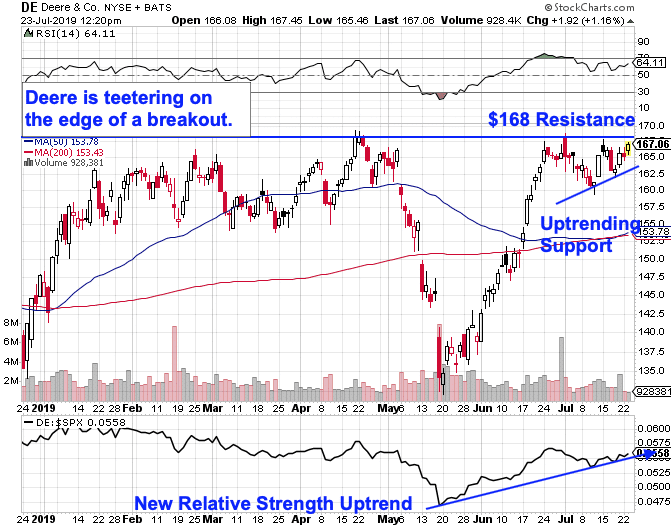
But that tumultuous trading is actually setting the stage for a potential breakout to new all-time highs for shares of Deere. To figure out what’s happening here, we’re turning to the chart for a technical look:

It’s hard to miss the abrupt about-face in shares of Deere this summer.

After surging higher starting in the second half of May, this stock has spent all of July cooling off from a momentum standpoint with some sideways price action. And that sideways consolidation is what’s actually setting the stage for a breakout.

Deere is currently forming a pretty textbook example of an ascending triangle pattern, a bullish continuation setup that’s formed by long-term resistance above shares at $168, with uptrending support to the downside. If Deere can muster the buying pressure to materially break out through $168, we’ve got a clear signal that buyers are still in control this summer – and that it makes sense to join them.

Relative strength, the side indicator down at the bottom of Deere’s chart, has been in an uptrend of its own since the one-two punch of trade war fears and earnings guidance disappointment scuttled shares in May. That’s an indication that Deere is making up for lost time by systematically outperforming the broad market, even now during this sideways cool-off.

While it might feel a little nerve wracking to go long a stock like Deere on the tail-end of such a big rally, context is key.

The fact that June’s buying pressure came after a violent selloff means that buyers likely still have gas in the tank for continued upside. Seeing a breakout through $168 here serves as confirmation of that.

From a risk-management standpoint, it makes sense to pay attention to what might invalidate the bullish setup that’s been forming in Deere this July. If shares trade below the $155 level that acted like support earlier this year, consider the buy setup dead and cut your losses.

From a risk-reward standpoint, Deere looks attractive here with shares sitting just shy of record highs.

Lockheed’s Boring Earnings Look Like a Buying Opportunity

Lockheed’s Boring Earnings Look Like a Buying Opportunity

Exciting earnings they’re not.

Lockheed Martin (LMTGet Report) is getting attention this afternoon following the firm’s second-quarter earnings release. Lockheed earned $5 per share for the quarter, just edging out the $4.78 that Wall Street analysts were expecting, on average. Shares have spent most of Tuesday’s trading session ever-so-slightly lower on the heels of the relatively unsurprising results.

But lest you think that Lockheed’s Q2 earnings are a complete snooze-fest, there’s good reason to pay attention to the price action in this defense sector giant.

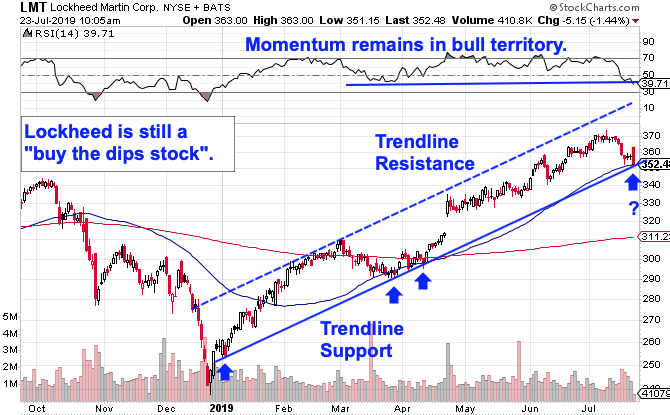
Lockheed looks like a solid buying opportunity in the wake of its earnings results. To figure out how to trade it from here, we’re turning to the chart for a technical look.

At a glance, you don’t need to be an expert technical trader to figure out what’s happening in shares of Lockheed Martin. Instead, the price action in this big defense name is about as straightforward as it gets.

Since the calendar flipped to 2019, Lockheed Martin has been bouncing its way higher in a well-defined trading channel, catching a bid on every test of trendline support on the way up. Now, as shares cool off in July, market participants are staring down a buying opportunity as Lockheed tests trendline support for the fourth time this year.

Put simply, the next bounce off of support is the signal that it’s time to pull the trigger on this trade before the next leg higher.

That bullish trajectory is confirmed by momentum, measured by 14-day RSI up at the top of Lockheed’s chart. As Lockheed Martin’s shares have corrected this month, momentum has retraced back to around the same level it hit during the last big buying opportunity this past spring. That’s confirmation that buyers remain in control despite what might appear to be recent weakness.

Risk management is important to consider here, if you’re thinking about going long LMT this summer. The 50-day moving average has been acting like a solid proxy for trendline support since all the way back in late March – that makes it a logical place to park a protective stop below. If Lockheed materially violates its 50-day, then the uptrend is over and you don’t want to own it anymore.

Meanwhile, with earnings risk in the rear-view mirror, shares of Lockheed look primed for higher ground in the near term.