Home Blog Page 69

This Secret Angel Investment Tax Credit Could Save You Millions

This Secret Angel Investment Tax Credit Could Save You Millions

Section 1202 tax exclusion provides angel investors and entrepreneurs with a 100% tax break of up to $10 million.

Over the past few months I’ve been surprised to find that very few angel investors and entrepreneurs are aware of one of the most important developments for startups in a long time.

It goes to show that almost anyone with a bank account and $50 could become an Angel Investor… (paraphrasing Robert Herjavec at the Angels and Entrepreneurs Summit.)

If you are at all thinking about becoming an angel investor or a founder make sure you read this article carefully as it could save you millions.

Recently Congress extended Section 1202 of the Internal Revenue Code, providing significant tax benefits to angel investors and entrepreneurs. The Section 1202 tax exclusion provides tax-free gains on 100% of gains related to startup investments, up to $10 million per investment. This provision enables entrepreneurs to exclude up to $10 million of gains as well. A version of this provision has been around for years but previously it was not a permanent exemption, the exemption was less than 100% during certain years and it was generally less straightforward.

The 1202 tax exclusion should make angel investing more attractive than ever before and also provides a major benefit to entrepreneurs. Just make sure you understand the details:

Section 1202 Basics

  • 100% tax break for gains made on investments in qualified small business stock (startups or small businesses).
  • Maximum exclusion equals the greater of $10 million or ten times the initial investment (technically the adjusted tax basis).
  • Alternative Minimum Tax does not apply.
  • Companies must be properly incorporated in adherence with Section 1202.
  • Founders, employees, angel investors, fund general partners and taxable limited partners are all eligible to the tax break.

Example of Impact on Angel Investors

We’ll use the Federal Reserve’s data and say that you, as an angel investor, could’ve made $1650 from backing startups.

For every dollar you could’ve made in the stock market…

And let’s be more realistic and say you as an angel investor put $500 into a start up.

You would’ve been sitting on over $165,000, in just over the first 10 years of the Fed’s study. 

Completely tax free.

Another company gets acquired for $500 million and an angel investor who invested $100,000 early on now owns 2.5% of the company at exit. The angel investor would receive $12.5 million at exit and would have a $12.4 million gain ($12.5 million of proceeds less original investment of $100,000).

As long as the company took advantage of the 1202 tax exclusion, the angel investor could exclude $10 million from taxes and would just get taxed on the remaining $2.4 million.

If you want to read more about Angel Investing or have any questions, please sign up in the side bar (here), or watch this rebroadcast of the Angels and Entrepreneurs Summit.

Warren Buffett Says This 1 Simple Habit Separates Successful People From Everyone Else

0
Warren Buffett Says This 1 Simple Habit Separates Successful People From Everyone Else

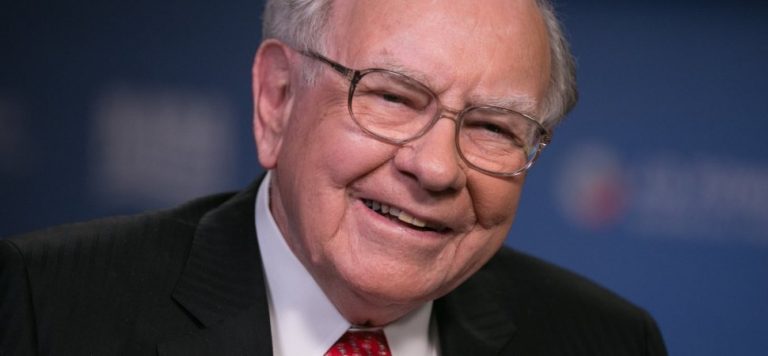
Warren Buffett. Photo from Getty Images.

Billionaire Warren Buffett, the chairman and CEO of Berkshire Hathaway, is in his late eighties and still capturing the world’s attention as the second richest person on the planet (as of this writing).

So, how has he done it? Actually, it’s not so much about what he has done as it is what he hasn’t done. With all the demands on him every day, Buffett learned a long time ago that the greatest commodity of all is time. He simply mastered the art and practice of setting boundaries for himself.

That’s why this Buffett quote remains a powerful life lesson. The mega-mogul said:

“The difference between successful people and really successful people is that really successful people say no to almost everything.”

The Powerful Meaning Behind Buffett’s Statement

Whether he meant saying no in the investment sense is not so important; what is important is that his advice, in whatever context, can apply to anyone arriving at the crossroads of daily decision-making.

For most ambitious people, we want to accomplish things. We are driven for results, doing more, learning things, getting promoted, and starting new ventures. But we also have our personal lives we can’t ignore for optimum balance and happiness. Ambition in this sense can mean taking care of family priorities, expanding our social circles, and pursuing hobbies and other interests.

That’s when Buffett’s advice is a bull’s-eye to our conscience. We have to know what to shoot for to simplify our lives. It means saying no over and over again to the unimportant things flying in our direction every day and remaining focused on saying yes to the few things that truly matter.

Steve Jobs Agreed. It’s About Focus.

Jobs prophetically supported this notion of saying no at an Apple Worldwide Developers Conference in 1997. Here’s what he said:

“People think focus means saying yes to the thing you’ve got to focus on. But that’s not what it means at all. It means saying no to the hundred other good ideas that there are. You have to pick carefully. I’m actually as proud of the things we haven’t done as the things I have done. Innovation is saying no to 1,000 things.”

Like Jobs and Buffett, it’s hushing that loud voice in your head when it tempts you with yet another sexy proposition that might steer you off course. You say a resounding NO! when it asks, “Should I take this opportunity? It may never come around again.” Sometimes, the best course of action is not taking any action.

Seven Things Successful People Say No To Every Day

Jim Collins, famous author of the mega-bestseller Good to Great, once suggested that instead of to-do lists, we should make “stop-doing” lists. Because in obsessing over to-do lists full of things that don’t really matter, we spend less time saying yes to the things that do.

Here are seven things the most successful people say no to on a regular basis. Perhaps you should too?

1. They say no to opportunities and things that don’t excite them, speak to their values, or further their mission in life.

2. They say no to superficial networking events in which people swap business cards and never hear from one another. Why? Because successful people don’t network. They build relationships.

3. They say no to spending time with uninspiring, critical, or negative people who drag them down. Time is precious — choose a small circle of people who will energize you and challenge you to be better.

4. They say no to overworking. While it’s true some successful people and many entrepreneurs put in 60 to 80 hours per week, very successful people aren’t workaholics who neglect self-care and family. They recognize that if they can’t take care of themselves, everything else suffers.

5. They say no to doing all the work. This comes down to one word:

D-E-L-E-G-A-T-I-O-N.

6. They say no to giving the steering wheel of life to anyone else. Another Buffett quote affirms this: “You’ve gotta keep control of your time and you can’t unless you say no. You can’t let people set your agenda in life.”

7. They say no to people-pleasing. Successful people don’t neglect their deepest wishes and desires to accommodate and yield to others’ wishes and desires.

Buffett’s Three-Step Rule of Focus for Success

To set you on the right course, take a coaching lesson from Buffett himself. He once walked his personal pilot through a life-changing exercise in goal-setting that’s since become popular in productivity and career circles. It’s a simple, three-step process to set boundaries, say no to distractions, and home in on success. It goes like this:

1. Write down a list of your top 25 career goals.

2. Circle the five most important goals that truly speak to you. These are your most urgent goals.

Now here’s the real kicker.

3. Completely eliminate the other 20 goals you have listed. Just cross them off, despite if they hold weight or some level of importance.

Buffett says those 20 goals are lower and not urgent priorities, therefore, any effort invested in them steals away dedicated focus and energy from your five highest-priority goals.

The point is to say no to everything on that list except for what you have declared, in your heart-of-hearts, to be the five most important things. These are what you should put all your effort and focus into achieving. The rest are merely distractions that will get in the way of your reaching your ultimate success.

Marcel Schwantes is the founder and chief human officer of Leadership From the Core.

Click here to see the full story

This Stock Just Broke Out. Buy It Now!

This Stock Just Broke Out. Buy It Now!

The bank holding company based in Memphis, Tennessee, First Horizon National Corp (NYSE: FHN) seems to be poised for a price surge according to its charts.

Bullish Indications

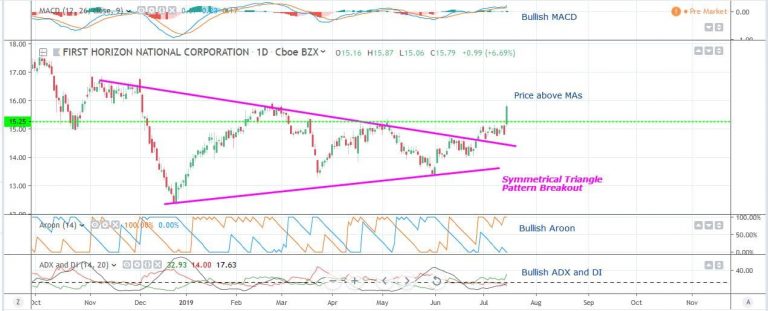
#1 Symmetrical Triangle Pattern breakout: The daily charts shows that a symmetrical triangle pattern has been formed for the stock. This is marked in pink color lines. A symmetrical triangle pattern represents a period of consolidation before the price breaks out.

This is typically formed when there is indecision in the price movements and uncertainty among the buyers and sellers. Once a breakout from the upper trend line occurs, it usually signifies the start of a new bullish trend. Currently, the stock has broken out of the symmetrical triangle pattern. This is a possible bullish sign.

Daily Chart – FHN

#2 MACD Above Signal Line…: 

In the daily chart, the MACD line (light blue color) is currently above the MACD signal line (orange color) which is typically considered bullish.

#3 Trading Above MAs: The stock is currently trading above both its 50-day and 200-day SMA, which implies that the bulls are currently in control.

#4 Bullish AroonThe value of Aroon Up (orange line) is above 70 while Aroon Down (blue line) is below 30 in the daily chart.

This indicates possible bullishness.

#5 Bullish ADXThe ADX line is starting to move up from below –DI and +DI lines.

The +DI line is also currently above –DI line. This indicates possible bullishness.

#6 Downtrend Broken: The weekly chart shows that the stock has currently broken out of a downtrend line. This line is shown in purple color in the chart below. This is a possible bullish sign.

Weekly Chart – FHN

#7 Bullish MACD: In the weekly chart as well, the MACD (light blue color) is currently above the MACD signal line (orange color). This indicates a possible bullish setup.

#8 Bullish RSI: The RSI is currently above 50 and moving up in the weekly chart, indicating possible bullishness.

#9 Bullish Stochastic: The %K (blue) line of stochastic is currently above the %D (Orange) line in the weekly chart. This is a possible bullish indication.

Recommended Trade (based on the charts)

Buy Price: If you want to get in on this trade, you can buy the shares of FHN at the current price of $15.79.

But for those with a lower risk appetite, you can purchase half the intended quantity of shares of FHN at the current price and the rest if the stock corrects to around $15.

TP: Our target prices are $21 and $27 in the next 4-6 months.

SL: To limit risk, place a stop loss at $13.70. Note that this stop loss is on a closing basis.

Our target potential upside is almost 33% to 71% in the next 4-6 months.

For a risk of $2.09, our target rewards are $5.21 and $11.21. This is a nearly 1:3 and 1:5 risk-reward trade.

In other words, this trade offers nearly 3x to 5x more potential upside than downside.

Risks to ConsiderThe stock may reverse its overall trend if it breaks down with high volume from the symmetrical triangle pattern. The sell-off of the stock could also be triggered in case of any negative news, overall weakness in the market, or any regulatory changes in the sector.

Happy Trading!

Rich @ Wall Street Probe

The 4 factors angels use when investing in startups

The 4 factors angels use when investing in startups

Pitching to angel investors can be difficult at the best of times. Not only can it be nerve-wracking to talk about the ins and outs of your startup, but most of the time you’re just not sure what they want to hear.

There are lots of different types of angel investors – they aren’t all ‘high-net-worth’ individuals like you see on Shark Tank. Because they are so diverse, they have different preferences – they are looking for different things in a company and favour different criterion. However, based on my research talking to angel investors, there are four factors they all have in common when choosing which startup to invest in.

Personal experience

An angel investor’s personal experience guides them when deciding whether to invest in your startup, so you have to approach them in the right way.

One of the most important aspects for angel investors is their personal experience with the person who tells them about your startup. This means that you need to deliberately build relationships with people who may know angel investors (accountants are a good place to start, but also suppliers and some clients). What it also means is that direct approaches to angel investors or angel networks are unlikely to yield results.

Personal experience also applies to how they approach due diligence and evaluation. Research shows that there is a lot of inconsistency in the types of financial indicators investors use. However, every investor I’ve spoken to agreed founders need to know the important aspects: your cashflow, how you’re optimising your business model, and how you will realise the return on their investment. So, emphasise these factors when presenting your business to a potential investor.

Trust

Trust is made up of two components: trust in someone’s competence, and trust in their integrity.

The first thing angels look for is whether the entrepreneur is still an owner of the business. This is one common way of dealing with trust issues, though it isn’t a particularly good one because it relies on avoiding mutually assured destruction and does nothing to develop trust. The best approach is to build trust through your behaviour and you will be more likely to receive an offer from an investor:

Be honest and open (if there is something you don’t know, acknowledge it);

Be upfront about how you will use their capital (remember, capital is long term, so you shouldn’t use it to buy office furniture!);

Be willing to accept advice (be coachable); and…

Be a reliable communicator (talk to people, don’t rely on email).

The need to contribute

A need to contribute is what sets angel investors apart, and it is the most valuable aspect of angel finance. An angel’s post-investment involvement opens up new opportunities and provides access to skills, knowledge and contacts that would otherwise be unavailable. In short, they add value beyond money. The right angel investor gets a sense of achievement and fulfilment from being involved in a new venture.

The best angel for you will have relevant industry knowledge and experience. This is why I encourage entrepreneurs to develop industry networks to seek out angel investors in a targeted way rather than going to angel networks or incubators. And watch out for ‘diversifying’ angels. If your company is just one in a portfolio, they are likely to be spread too thinly to add much value to your firm.

Developing a good working relationship with your angel investor from the beginning is the key to tapping into the value they can add to your business beyond funding.

Realistic expectations

It’s important for both the angel and you to be honest, upfront and realistic. An angel investor will expect an equity stake in your firm. Don’t be too worried, a good angel investor also wants you to have equity.

You need to be realistic about the value of your firm. You must have something that is inherently valuable: existing customers is one thing that angel investors look for.

Entrepreneurs are often optimistic, but you need to have a realistic view of the potential of your business, particularly for scaling into markets, level of competition, and market size. Be realistic about the financial value of your business and how it will grow, and how an investor will realise their returns. Most often it’s a trade sale, so think about how that might play out.

You can still be optimistic, in fact, optimistic entrepreneurs are better at obtaining finance, often at a lower cost.

Finding angels isn’t simple, unfortunately. You can’t just present your plan and hope for the best. You need to find the right angel, one who can bring human and social capital along with their financial investment.

In Australia, at least, the best way of finding the right business angel is to develop your personal networks. Talk to people and keep in contact with them on a more meaningful level than just social media.

Finally, remember that everything takes three times longer than you think it will – especially the money part!


Buy Pre-IPO Shares before a Company goes Public…

0
Buy Pre-IPO Shares before a Company goes Public…

Many fast-growing private companies have been resorting to IPO (Initial Public Offering) for raising capital to accelerate their growth. An IPO is basically the first sale of shares to the public. As a result, this company becomes publicly traded.

There are certain benefits that come with going public. It allows a company to quickly raise capital by attracting a vast number of investors. It also allows the company to get into the public eye, gain status, attract more attention, and potentially, also new talent.

Those who choose to invest in IPOs can benefit as well. They can raise profits by selling their shares at a higher price or gain passive income from dividends over time.

Yet, what can be even more beneficial is investing in pre-IPO shares.


What Are Pre-IPO Shares?

An IPO refers to the time when a company goes public for the first time and sells shares from its stock in an open market. It is the initial sale of stock that a company issues to the public.

Pre-IPO, however, shares are basically those shares of a company that are held by its employees and other investors before they are offered to the public in an IPO. They are important, as only a few companies are able to thrive in the presence of public-eye.

Pre-IPO Placement

A major section of pre-IPO shares is pre-IPO placement which occurs when a portion of an IPO is given to private investors just in time before the IPO is made public and is about to hit the market.

Normally, the private investors engaged with a Pre-IPO placement have large hedge funds or private equity which allows them to invest in a large stake in a company. Given the substantial investment done by these private investors, the price paid for Pre-IPO shares is often lesser than the prospective price of the IPO.

A pre-IPO-placement typically occurs when the demand for a pending IPO is very high. This often happens as a result of the IPO placements price per share whose risk basically depends on the company going public with its shares.

A pre-IPO placement mainly makes up for that risk by offering a per share price that is lower than what is expected for the IPO to offer. The risk generally arises as a result low post-IPO demand which decreases the share price.

Why Buying Pre-IPO Shares Is Beneficial?

While there are several risks attached to pre-IPO shares because of too many factors that can possibly prevent a company from going IPO, there are also numerous benefits that make them valuable.

When pre-IPO shares do end up being lucrative, they can lead to staggering returns. For instance, in a recent market float, a few pre-IPO investors bought shares at $0.10 per share which was exactly 4 months before the Initial Public Offering. The company then floated to $0.20 within a span of 6 months that led to a significant increase in the share price to $0.60. This basically amounts to six times the initial money that was invested within a period of 6 months.

Investors can also benefit from a unique and valuable opportunity that comes with buying pre-IPO shares in the form of crowdfunding, and PIPE investing, primarily for those private companies that are looking to go public.

How to Invest in Pre-IPO Shares?

Investing in pre-IPO shares isn’t always easy. In most cases, the ability to purchase them will largely depend on whom you know.

However, it’s not impossible. There are several ways and methods one can invest in pre-IPO shares with a company that intends to go public.

One of the most common ways is to speak to your stock broker or find an advisory firm that specializes in pre-IPO shares and capital raisings. They can give you directions as to how to invest in these shares with a company before it goes public.

You can also monitor news and alerts about startups or companies that intend to go public. You can also inquire about companies that are looking for investment by contacting local bankers and accountants.

Building business connections can be advantageous too. For instance, you can seek these connections in events such as venture forums and business incubators. Establishing relationships in the angel investor communities can prove to be beneficial as well.

Considering the fact that pre-IPO investments have a limited access for most investors and even for those who can easily access it, there is a high liquidity risk attached to it. However, there is a way to still invest in pre-IPO shares which ensures access to all the investors that are interested in private equity.

This method is called Stock Tokenization which basically refers to the conversion of traditional company shares into cryptocurrencies that also allow for liquidity in the IPO markets.

What Risks Are Involved When Investing in Pre-IPO Shares?

Investing in itself is risky. It requires knowledge in business and investment, ability to analyze, and foresight to predict the development of the company. Investing into a company that has been public for some time can be easier as you can access stock charts and see the trajectory of its growth.

With pre-IPO shares, however, more risks are involved. It is much harder to evaluate the future of the company. This happens due to the risk of information asymmetry.

Directors and managers who are selling their shares know more about the company and its business situation than people buying into it. They are also not required to disclose any information to the public while the company is private. This limits the amount of information available on it.

Even though companies that are going through the IPO process have to meet disclosure requirements and prepare a PPM (Private Placement Memorandum), the information provided often is not enough to give investors an accurate picture of the business’ performance.

In addition to that, the underwriters who intermediate the share sale have the incentive of maximizing the price they are able to secure in the secondary market.

Can You Sell Pre-IPO Shares Right Away?

For the majority of the pre-IPO companies, the only way to sell shares is through a secondary market that facilitates the transaction of private investments.

However, regulators have gradually tightened the rules that govern the buying and selling of pre-IPO shares. Many companies have also been found to delay their IPOs during a wave of eager private capital which has created increased demand between both buyers and sellers.

In Conclusion

Regardless of what route you choose to take, make sure you do not make any rash decisions. Investing in pre-IPO shares can be beneficial and lucrative, but also rather risky. Not each company succeeds, and you run a run a risk of losing your money if you do not invest wisely.

To avoid this, make sure you familiarize yourself with the topics of finance, investment, and business analysis. It will allow you to more accurately assess the potential of companies and become a successful investor.

And last, but not least, never invest without legal protection. Choose only companies that utilize a PPM. That will ensure that they are transparent and comply with ant-fraud laws. Alternatively, you can have a lawyer or attorney prepare and investment contract and a term sheet for you.

\