Home Blog Page 70

Ford’s Revving Its Engine This Summer

Ford’s Revving Its Engine This Summer

It’s been a challenging couple of years for shareholders of Ford Motor Co. (FGet Report) .

In the trailing 24 months, Ford has primarily ground sideways, failing to capture the 23% price move that’s propelled the rest of the S&P 500 higher over the same time frame. But Ford’s fortunes look like they’re changing in 2019.

After underperforming for the last couple of years, Ford’s price action has been making up for lost time, surging more than 33% higher on a price basis year-to-date, vs. a 19% charge higher in the broad market.

Thing is, this could just be the beginning – even despite weakness in China sales numbers just out, Ford’s rebound rally isn’t showing any signs of fatiguing this summer.

To figure out how to trade it, we’re turning to the charts for a technical look.

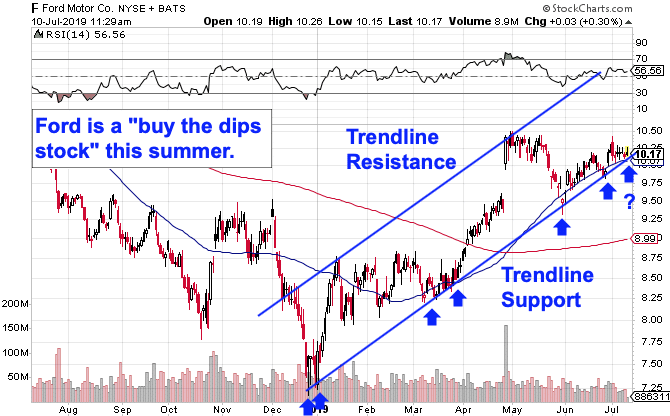
You don’t need to be an expert technical trader to figure out what’s happening in Ford’s price chart right now. In fact, the bullish setup in this automaker is about as basic as they get.

That’s a stark contrast to how Ford’s technicals looked last fall, when shares were selling off in a downtrend that was just as well-defined. Now, with that downtrend invalidated, and a new uptrend in play since January, it makes sense to “buy the dips” in Ford.

Longer term, the poor price performance that Ford has experienced over the last couple of years adds some confidence to this stock’s continued rebound potential. While Ford’s uptrend has been going strong for half a year, shares could continue on their current trajectory for quite a while before they get overextended in the context of where shares were just two years ago.

Likewise, relative strength paints an important picture for Ford here. While shares are outperforming in 2019, given the S&P 500’s massive charge higher year-to-date, they’re still not outperforming by the same magnitude that they were underperforming over the months leading up to the reversal.

That bodes well for Ford’s ability to continue to move up and to the right.

Near term, shares need to muster the strength to clear the $10.50 level, a price that shares failed to move through back in late April and early May. On the flip-side, as Ford tests trendline support for the seventh time in this uptrend, the next test of $10.50 could be imminent.

If you decide to pull the trigger on the Ford trade, prior lows at $9.75 look like a logical place to park a protective stop beneath. If this uptrend does end up, reversing course, you want to know (and get out) sooner rather than later.

6 Solid Ways to Boost Your Retirement Income

0
6 Solid Ways to Boost Your Retirement Income

No doubt, many Americans have a great deal of their financial futures tied to the success of their 401(k) plans.

But how much?

Total U.S. retirement assets reached $25.3 trillion as of December 31, 2016, according to the Investment Company Institute (ICI). That’s up by almost 30% since 2012.

Retirement savings accounted for 41% of all household financial assets in the U.S. at the end of 2016.

The ICI also reports that Americans held $7 trillion in all employer-based D.C. retirement plans on December 31, 2016. And $4.8 trillion of that was held in 401(k) plans.

With all that 401(k) cash at stake, you’d think working Americans would do all that they could to grow — and protect — their 401(k) plan assets.

But the truth is, many don’t. Maybe it’s borrowing from a 401(k)… That’s a big no-no because it can make you a target for the Internal Revenue Service (IRS) and because it defeats the purpose of one of the biggest and best wealth generators ever: the miracle of compound interest.

Maybe it’s not investing the maximum in your 401(k) plan… Maybe it’s not taking full advantage of generous employer retirement fund-matching plans… Or maybe it’s not setting up a strategic cushion to protect your savings against recessions.

Any of those toxic moves could put a big dent in your retirement funds. But you can fight back, protect the savings you have, and play some much-needed catch-up at the same time. Just deploy these “quick fixes” for your wheezing 401(k) plan, and you’ll be ready to grow your account in good times and bad.

Here’s a snapshot…

Fix No. 1: Know Where You Stand and Make a Plan

Any pivot toward a 401(k) strategy shift has to start by knowing exactly where you are right now, where you need to be the day that you retire, and what could happen between now and then.

That’s a huge key to protecting your plan assets. But few people ever take the time to figure out their retirement income needs. And that’s often because they lack motivation and confidence in meeting their long-term financial needs.

For example, the Employee Benefit Research Institute (EBRI) estimates that about half of all U.S. adults are either “not at all confident” or “not too confident” in their ability to retire comfortably.

About one in four (23%) Americans told EBRI that they didn’t know what percentage of their income they should save each year to live comfortably in retirement. Yes, doing the math can be daunting. But beginning to do so might be simpler than you anticipate.

The rule of thumb is to have about 80% of your preretirement income to live on in retirement. But a better idea is to be able to count on having 100% on hand.

Inflation could go higher. Social Security could fall apart. The markets could go through another massive collapse. And you may live long enough that health care is a major and expensive issue.

To accurately calculate your future retirement income needs, you need to take six key factors into consideration…

  • Starting balance: How much do you have now?

  • Annual contributions: How much can you afford to contribute every year? And how much do you estimate that amount will grow over time?

  • Current age: How old are you? The younger you start, the easier it’ll be to build a massive retirement account.

  • Age of retirement: When do you plan to retire? The longer you have to take advantage of compound interest, the bigger your gains will grow.

  • Estimated duration of retirement: How long do you plan to live? I know nobody likes to think of their own mortality. But you need to know for how many years you’ll need your savings to support you. Health care and assisted living communities cost money. And people are living longer than ever before. Guess how long you’ll live and add at least 10 years to that just to be safe.

  • Market health during savings period: Don’t count on all sunny days. Plan for below-average performance to come out on top, no matter what happens.

Factor all these in and what you come up with could be the most important number you’ll ever calculate for the rest of your life…

Fix No. 2: Maximize Employer 401(k)-Matching Plans

If you haven’t done so, immediately contact your company’s human resources office, or the go-to staffer who acts as the intermediary between you and your company’s 401(k) plan sponsor. Ask them what the company’s policy is on 401(k) matching. Then ask how you can maximize your savings to fit within the parameters of that program.

If you’re a new employee, make sure you sign up for your company match right away — on your first day on the job, if possible. By procrastinating, you’re taking money off the table.

For example, 53% of Vanguard 401(k) plans — one of the biggest 401(k) plan sponsors in the U.S. — allow employees to contribute to their 401(k) plans immediately after beginning their jobs.

In other situations, you may have to wait between three months to a year to benefit from company matching. So, know your employer’s timetables.

Another tip on company matching: Many firms offer profit-sharing contributions to 401(k)s, regardless of how much cash you have in your 401(k) plan.

According to one recent study, about 75% of employers make discretionary contributions, usually based on longevity at the firm, of up to 4% of an employee’s salary. So, if your company provides a profit-sharing plan, find out about the eligibility restrictions and what you’ll need to do to get in on the action…

Fix No. 3: Maximize Your Contributions With a Stronger, Streamlined Household Budget

A hockey player who takes his eye off the puck will always lose a step to players like Hall of Famer Wayne Gretzky. He always knew where the puck was and where it was going to be.

The same goes for your 401(k) plan: Don’t take your eye off it. Keeping track of your dollars and cents is the first step to rebooting your 401(k) plan. In fact, it’s the bedrock on which everything else rests.

If you don’t pinch pennies in the beginning, you’ll squander a golden opportunity to make more money down the road. It’s what economists call “compound interest.” Compound interest is when you earn interest not only on your original investment but also on the interest it’s already earned. Through compounding, your investment assets will grow slowly at first, then at greater speeds as the years go by.

Consider a monthly investment of $300. Given a 9% rate of return, your $300 monthly investment would turn into $22,627 after five years, $58,054 after 10 years, $200,366 after 20 years, and an astounding $336,337 after 25 years. In fact, the longer you leave it alone, the more the interest will compound.

No wonder Albert Einstein referred to compound interest as the most remarkable mathematical discovery ever. He’s even said to have called it the “eighth wonder of the world.” Economists may have a dry, bureaucratic name for it, but I prefer to refer to compound interest as your very own “personal moneymaking machine.”

To get started on the budget front, only put away what you can each month. Spend another night at home instead of dining out. Set your thermostat a few degrees lower in the winter and a few higher in the summer. These and other household cutbacks can save you hundreds per month. And you can pop those hundreds into your 401(k) to start growing right away…

Fix No. 4: Diversify Your 401(k) Portfolio

Any investment portfolio should be able to weather the demise of one stock. Unless it’s a stock that comprises a hefty part of your portfolio.

Always diversify your investments so you’re not too reliant on any one stock, bond, or mutual fund. If it collapses in a hurry, you can, too.

By allocating a mix of stocks, bonds, and mutual funds in your 401(k) portfolio, you can minimize losses in one area while even making them up in another.

The best way to protect your assets in times of market volatility is to diversify your portfolio. That means to have your money spread among different investments in different industries. Don’t think you’re diversified if you only own stock in 10 different communication companies. You’ll still be subject to massive losses if the industry as a whole takes a turn for the worse.

The idea is simple: When your investments are diversified, spread across different asset classes and types of securities, they work together to help in reducing risk.

So, go ahead and enjoy the benefits of slow and steady blue-chip stocks, along with potentially higher-flying growth stocks. Mix in some international stocks and diversify among different bonds. Real estate and commodities have also been shown to enhance portfolio performances.

Ultimately, how much to allocate among stocks, bonds, cash, and other asset classes will depend on your investment objectives and risk tolerance. Once you’ve established an appropriate asset allocation, make sure you stick to it and rebalance regularly — at least once a quarter — to ensure your portfolio stays on track…

Fix No. 5: Max Out on Contributions

In 2018, 401(k) plan participants can contribute a max of $18,500 to their plans.

Sure, it’s not always easy to find the cash, but contribute as much as you can, nonetheless. Because the more you pour into your 401(k) fund, the faster, and higher, your plan assets will grow.

Also, know that you can find money in unforeseen places. For example, there’s no rule that says you have to spend a raise, bonus, or inheritance — also known as “windfall” money. Instead of spending it, redirect it into your 401(k) plan and watch your plan assets grow.

A quick note: If you’re 50 or older, you can make so-called “catch-up contributions.” Recent congressional pension reforms have made it so 401(k) plans can allow people who are age 50 or older to save more by taking advantage of catch-up provisions.

So, if you’re age 50 or older and your plan allows them, you should make these additional pretax contributions to your plan — up to $6,500 this year…

Get Rebooting: The Sooner, the Better

Rebooting your 401(k) plan isn’t easy, but it’s certainly doable.

Follow the tips above and watch those quick fixes give your 401(k) plan a new lease on life.

Fix No. 5: Have you received your $1818 Check yet?

Americans are receiving biweekly checks thanks to an act of Congress…

Have you requested your’s yet?

[Click the check image for details on this income program] 

You can grab up to 24 of these every year.  As part of a brand new income program,  explained here.

Sign up for the distribution list, and they show up in your mail without you lifting a finger. 

A new law from Congress has created this windfall.  It’s a lot like Social Security — but you don’t have to be retired. 

Thousands of Americans are celebrating these paydays.

And now you can, too — by following the instructions at this page.

Let us know when you’re signed up.

– Penny Stock Hotlist: Top 3 Penny Stocks to Buy This Week

– Penny Stock Hotlist: Top 3 Penny Stocks to Buy This Week

Preface: Penny stocks are notoriously volatile…

At least the one’s we like to trade within a week…

So, naturally you need to have a fresh batch of penny stocks to watch every week…

But how do you find those?

That’s easy…

We’ll give them to you at least once a week in our Wall Street Probe

The fact that you’re here means that you’re serious about your financial future, and you’ve arrived at the right place...

Below are the penny stocks for this week.

Enjoy,

Rich @ Timely Trade Alerts


Wall Street Probe’ Penny Stock Hotlist for This Week.

During the 1999 Berkshire Hathaway shareholders meeting, Warren Buffett expressed with contrition that if he’d had less money to invest, he’d be able to generate 50% annual returns — guaranteed.

The reasoning behind Buffett’s statement is simple: Smaller companies grow faster and have offered the highest stock market returns over the last three decades.

It might sound strange, but from a growth standpoint, this means that Buffett is actually jealous of you. Specifically, he’s jealous of your smaller capital position.

Unlike Buffett and the Wall Street banks, you can invest in the world’s best equities while keeping your positions liquid.

In fact, the only reason that Buffett and the big banks no longer invest in small-cap stocks is because they simply have too much money.

Of course, for almost everyone else, having too much capital isn’t a problem. It tends to work in the opposite direction…

So, Why Small-Cap Stocks?

Well, there are many reasons why small caps consistently outperform competing sectors.

And we address some of these reasons below…

1. Agile Figures

This one’s pretty simple: It’s easier to double figures when the baseline is small. For example, growing revenue from $20 million to $40 million is much more practical than growing $20 billion to $40 billion.

Likewise, the market is more inclined to push a $9 stock to $18 within a short period of time than to move a $400 stock to $800…

2. Nimble Operations

The larger a company becomes, the more difficult it also becomes to manage. Smaller companies are often in growing industries and are able to respond to changing market conditions. Large caps have less success adapting because they become entrenched in their specific roles.

At the same time, smaller companies are often run by dedicated founders or a small management team that’s dedicated to increasing their shareholder value…

3. Inefficient Market

Small-cap stocks are rarely covered by large brokerage firms. And this results in the high possibility of inefficient pricing. Likewise, there’s limited analyst coverage. So, many small firms — and their details — get overlooked.

Generally, these factors reduce the number of buyers for a stock. And they often cause prices to be unjustifiably low. As these companies grow and perform, the stocks gain more attention, which increases volume and valuation…

4. Hidden Value

Related to the points above is the existence of hidden value. Although the roles of small companies are often obscure, many are well-positioned in niche industries. Despite their size, these companies can be indispensable gears that move a much larger machine.

The more specific a product or service is, the smaller the competition. Likewise, small caps that service larger firms are often takeover targets. And this allows investors to profit from significant premiums on shares.

With that said, here are three small-cap stocks that you need to watch today…

Small-Cap Stock No. 1:
Lantronix, Inc. (NASDAQ: LTRX)

Lantronix develops and markets its own networking and communications devices with a focus on the emerging and lucrative internet of things (IoT) space.

Specifically, the company supplies secure IoT gateways that enable other companies to simplify the creation, deployment, and management of their IoT projects.

The company focuses on what some would call the enterprise IoT, which is considered the largest of the three main IoT sectors: enterprise, home, and government. This is pretty much a no-brainer because businesses have the capital to buy IoT products on a large scale.

As Business Insider Intelligence reports, enterprise IoT will account for approximately 40% of the IoT market.

In simple terms, the IoT is all about connecting traditionally unconnected devices. And more often than not, it’s for industrial applications. Collecting and analyzing all this previously nonexistent data allows original equipment manufacturers (OEMs) to improve automation and efficiency in countless ways.

We aren’t getting into too many specific examples, but as the saying goes: Knowledge is power. If you’re a business owner with remote or mobile assets, you’ll want to know where they are and what they’re doing in real time. This could mean giving customers real-time tracking on their orders. Or it could mean allowing you to perform predictive maintenance on your assets.

Lantronix also makes IoT building blocks, which are exactly what they sound like.

Unlike major consumer hardware products, such as smartphones or notebooks, IoT devices can vary greatly in their uses, designs, and applications. This generates incredible demand for modular components, such as systems on a chip (SOCs) and systems on a module (SOMs). This enables companies to flexibly develop their own IoT solutions.

SOCs are Lantronix’s bread and butter. And they place the company comfortably at the center of the IoT space.

Here are a few conservative projections for this market:

  • The Boston Consulting Group predicts that by 2020, $267 billion will be spent on IoT technologies, products, and services.

  • MarketsandMarkets believes the IoT market will be worth $195.5 billion by 2022.

  • And Berkshire Hathaway’s Business Wire puts the figure at $201 billion by 2025.

There are also more aggressive estimates out there from organizations like IDC and companies like Cisco. These estimates put IoT revenues as high as $8.9 trillion by 2020, or $14.4 trillion by 2022 respectively.

These forecasts tend to use a much broader definition of the IoT market than others. But any way you cut it, you’re looking at double-digit (20%–30%) compound annual growth rate (CAGR) over the next five to 10 years.

All these factors make Lantronix a compelling small-cap company…

Small-Cap Stock No. 2:
SolarEdge Technologies, Inc. (NASDAQ: SEDG)

SolarEdge Technologies provides a range of solar products. This includes power optimizers, solar inverters, and monitoring solutions for photovoltaic arrays. In short, these products allow consumers to increase the energy efficiency of solar through what’s called module-level power electronics (MLPE).

In addition to a great reduction in costs, SolarEdge claims that its HD-Wave inverters also increase efficiency from 97.5% to 99%. That might not seem like a very big improvement, but all said and done, it means the inverters dissipate less than half the heat of current models.

With many new products launching, strong growth in the U.S. market, and substantial cost reduction, SolarEdge has positioned itself as a clear leader in what will prove to be a rapidly expanding industry.

According to IHS, the global market for module-level power electronics is expected to grow to $1 billion by 2019. That represents a CAGR of 19% from today. SolarEdge controls approximately 70% of the D.C. power-optimizer market and an estimated 20% of the inverter market, compared to only 1.7% in 2012.

The U.S. market accounts for a large proportion, approximately 70%, of SolarEdge’s latest revenues. About one-third of its total sales comes from a single customer, identified as “Customer B” in its early S-1 filing.

SolarCity is likely the only company that’s large enough to account for that proportion of SolarEdge’s revenue. This represents significant exposure to a single customer. And it means a crucial launching pad in the U.S. residential space.

SolarEdge is looking to increase its market share of the growing U.S. residential landscape. And SolarCity is not a bad customer to have on board in what will be a huge market over the years to come.

But the U.S. market is only a piece of a much larger story. Long term, IHS analysts expect tremendous growth from the international community:

The growth opportunity for [solar inverters] outside the U.S. is huge. Provided microinverter and power optimizer suppliers can keep expanding into new geographical markets, and keep innovating to take advantage of energy storage and other new growth markets, there is plenty of room for both technologies in the market.

With the world moving toward sustainable energy, SolarEdge is in a strong position of growth. All told, the company increased its revenue by 82.40% over last year as of its most recent 10-Q.

That should be a compelling number to investors who are looking to ride SolarEdge on the way up…

Small-Cap Stock No. 3:
Pointer Telocation Ltd. (NASDAQ: PNTR)

Pointer Telocation is an Israeli company. It operates primarily in mobile resource management (MRM) and roadside assistance.

It’s not technically a play on driverless cars. But the firm is well situated at the point of transition: a period where connected vehicles and human drivers, particularly in the commercial industry, will work together to maximize efficiencies.

Through a combination of GPS location tools and web-based applications, Pointer enables its customers to track the location, speed, and status of their vehicles and assets. And this is all while allowing it to keep track of driver behavior and various other data points. The company currently provides these services in Israel, Argentina, Mexico, Brazil, and South Africa.

Pointer also provides stolen vehicle-retrieval and car-sharing services. At its core, Pointer Telocation is an asset-management company that lets fleet operators keep track of their property.

But Pointer attacks not only mobile resource management but also the IoT and other applications, as well. The firm’s sensor capability doesn’t stop at GPS. It also extends to a range of measurements, which includes pressure, temperature, RPMs, breaking speed, fuel use, vehicle diagnostics, and others, depending on the application.

Here are the main industries that Pointer serves:

  • Transport and logistics.
  • Cold chain logistics (temperature-controlled transport).
  • Construction and mining.
  • Field services and maintenance.
  • Oil, gas, and chemical transport (hazmat).
  • Fleet insurance.
  • Car rental.
  • Asset and cargo management.

A recent report from Business Insider Intelligence says 94 million connected vehicles are expected to ship in 2021. This would account for 82% of the total car market. And it would work out to a 35% CAGR, starting in 2016.

The same report predicts that there will be 381 million connected cars on the road by 2020, up from only 36 million in 2015. All told, this forecast projects an astonishing $8.1 trillion in connected vehicle revenue between 2015 and 2020.

Research and Markets offers a similar growth forecast. It predicts that the connected car market will grow at a CAGR of 35.5% through 2022.

PricewaterhouseCoopers (PwC) sees $120 billion being captured by new market entrants. This includes “suppliers of new technology, mobility services, or digital services.”

All are obviously good reasons to be bullish on Pointer Telocation.
How to Make Your Fortune in Stocks

0
How to Make Your Fortune in Stocks

You don’t have to be a genius to become a millionaire in the stock market.

And you don’t have to be a master trader to ensure that the investments you make return enough to take care of you during your retirement.

All you need is time and a simple plan.

In fact, your plan can be as simple as buying high-quality dividend-growing stocks. You’d only have to let the power of compound interest do its job over time.

Now, we realize that this may sound way too simplistic. But the truth is, long-term investing should be simple. You’re using the twin forces of time and compound interest. And they’re far more powerful than any analysis, economic forecast, and trading strategy.

That’s why we’ve put together this report. We want to teach investors about the long-term value of investing in high-yield dividend stocks. These stocks allow investors to take advantage of both time and compound interest.

But to kick-start your dividend-investing experience, we want to first provide you with an example. And then, we’ll give you a list of dividend stocks that are good for any portfolio.

Let’s get started…

He Was Just a Regular Investor

You’d think it would be pretty hard to hide a billionaire these days. After all, tax returns and Securities and Exchange Commission (SEC) filings can be accessed by intrepid reporters.

Still, a new billionaire crops up from time to time.

More often than not, new billionaires own businesses that hit it big. Of the 19 new American billionaires that Forbes identified in 2013, eight of them inherited their fortunes. Three are in real estate and loan financing. And the rest own successful businesses.

And that’s the case with one of the newer American billionaires Stewart Horejsi (pronounced Horish).

The thing is, Horejsi uses a surprisingly simple strategy to make his fortune…

And this strategy hasn’t changed much over time. In fact, over the last 40 years, this method has reliably delivered stock market gains.

That means what works for Horejsi, and the many millionaires and billionaires before him, could work for you, too.

All you have to do is invest intelligently…

Investing to Make Your Fortune

Horejsi was running the company that his grandfather founded.

It was 1980, and Brown Welding Supply had been struggling. Other companies that sold oxygen and hydrogen tanks to welders had started to move into his Kansas turf.

So in a moment of desperation — or genius — Horejsi took more than $10,000 of company cash and bought 40 shares of Berkshire Hathaway stock. A friend had recently told him about Warren Buffett. Shares were trading for around $265 at the time.

Two weeks later, Horejsi bought 60 more shares at $295. A month after that, he doubled down for 200 shares at $330.

Horejsi eventually owned 5,800 Berkshire Hathaway shares. He sold 1,500 shares in 1998 when they’d been trading as high as $80,000 apiece. This was worth a cool $120 million. And he parlayed that into a successful money management firm.

Today, his remaining 4,300 shares are worth almost $1.23 billion.

He’s done pretty well.

And let’s not forget that Berkshire Hathaway has been a phenomenal success story. Since Horejsi’s first buys at $265, the stock has run to over $309,000 a share. That’s a gain of more than 116,503% over 39 years…

It’s Easier Than You Think

Now, Horejsi’s story may sound like a once-in-a-lifetime windfall.

It’s easy to hear a story like this and immediately think oh, that could never happen to me. But the fact is, massive gains over a span of 20 or 30 years are not once-in-a-lifetime events.

An investment might not give you gains like Stewart’s did, but you can pull in 20,000% or 30,000% within a 30-year period.

Say you bought Starbucks when it went public in 1992. Shares were $17. And $100,000 would have gotten you 5,882 shares.

Starbucks has split its shares six times over the last 20 years, and it only started paying a dividend in 2010. Today, if you’d reinvested those dividends, your 5,882 shares would have grown to 409,676 shares…

That $100,000 would be worth almost $22.89 million!

The bottom line is, you just have to get started.

Don’t worry if you don’t have $100,000 ready to deploy. Start with what you can, and add to it when you can.

The point is to start.

And that brings us to the final segment of our report…

Some of the top dividend stocks out there…

Top Dividend Stocks for Any Portfolio

The Proctor & Gamble Company (NYSE: PG)

As the undisputed leader of the consumer staples industry, Proctor & Gamble has a lot to offer the average investor. Not only does the company have over 100 years of market experience, it’s also been delivering a healthy dividend for a large chunk of those years. Even as our world changes and new players, like Amazon and small consumer staples companies, influence the consumer staples market, Proctor & Gamble has managed to grow. It’s grown its dividend by 4% in the last year, and has a payout ratio of 67.30%

Bottom line: At least in the immediate future, consumer staples aren’t going anywhere — even with companies like Amazon changing the ways in which these staples reach our households. Proctor & Gamble provides a wide range of household products from detergent to diapers. And it’s been showing steady growth since the 2008 financial crash.

McDonald’s Corporation (NYSE: MCD)

I know, I know. McDonald’s isn’t exactly what comes to mind when you think of a cutting-edge modern company. But what’s actually happening behind the golden arches is the epitome of modern. From speedy and efficient systems to heavy marketing and consumer retention efforts, McDonald’s has continued to dominate.

The company has doubled down on expanding into new countries, tapping into markets with developing economies, like China’s. The restaurant has over 35,000 locations around the globe. And it’s continued to deliver new and interesting meals to a changing demographic. The company recently increased its dividend by 14.85%.

Bottom line: Despite a shifting demographic, McDonald’s has managed to grow and meet the needs of its new customers. The company has been a fast-food pioneer, infiltrating new markets with growing economies and developing strong customer bases.

Verizon Communications Inc. (NYSE: VZ)

In the digital age, it’s good to have at least one company in your portfolio that’s paving the way toward a more connected future. Verizon is one such company. Although it’s unlikely that Verizon will be one of 2019’s biggest winners, the company can still act as an anchor for your portfolio with its 4.15% dividend yield. The environment and the fast-encroaching 5G technology have created favorable conditions for the company after it had a lackluster 2018. That being said, there’s a lot of opportunity for Verizon in the future and a hefty dividend, to boot.

Bottom line: 5G has created a market growth opportunity for Verizon. And even if it isn’t a big winner right away, it could be a major victor in our increasingly connected world.

Well, that’s all we have time for with this report.

You can continue learning more about dividend stocks through our Wall Street Probe  e-letter. If you’re impatient for your first newsletter, you can always check out our dozens of top-notch educational reports available online.

And remember, once you find a good dividend payer, you can use a Roth IRA to avoid paying taxes when it comes time to spend your fortune.

Dividend Royals: The 7 Best Dividend Aristocrats to Hold Forever

Dividend Royals: The 7 Best Dividend Aristocrats to Hold Forever

You’ve probably heard the famous Einstein quote a hundred times, but it’s just so on-the-nose that it’s worth repeating for a 101st time…

The most powerful force in the universe is compound interest.

And dividend stocks might just be the most powerful force in portfolio management. With a dividend reinvestment plan (DRIP), you can gradually compound your holdings of dividend-payers over time, and grow your equity portfolio exponentially.

Many investors get their exposure to these lucrative stocks through an ETF or mutual fund that tracks the Dividend Aristocrats index — a set of 53 S&P 500 companies that have raised their dividends in each of the last 25 years.  

Owning a Dividend Aristocrats index fund is certainly better than owning no dividend stocks. But there are a couple of problems with this basket of staple equities.

First, the index as a whole has a pretty unimpressive yield. It’s only a few basis points higher than the S&P 500 yield, which sits at 2% at the time of writing.

Second, and perhaps more importantly, Aristocrats don’t necessarily stay Aristocrats forever. Past performance does not necessarily predict future performance; it only takes a few hard years to wipe away decades of prosperity.

Case in point: GE (NYSE: GE) was a Dividend Aristocrat a decade ago. But after taking heavy losses in the early years of the Great Recession, it cut its dividend in 2009. The result was… well it looked like this:     

If you can’t count on the safety of the Dividend Aristocrats, how are you supposed to know which dividend stocks to invest in?

This report has the answer. Our research team has run all 53 Dividend Aristocrats through an exhaustive screening process that examines their earnings, cash flows, operations, and more. This screen has identified the seven safest and highest-yielding members of the index.

We call these stocks “Dividend Royals.” On average, they yield more than twice as much as the S&P 500 — and their dividends are safeguarded by steadily growing piles of cash. In other words, they’re safe enough — and lucrative enough — to buy and hold forever. Let’s get to know them…

AbbVie (NYSE: ABBV)

Seasoned dividend investors might be surprised to see a relatively young company like AbbVie (NYSE: ABBV) on this list. Its Dividend Aristocrat status is sort of a technicality; the company was spun off of Abbott Laboratories (another Aristocrat) back in 2013.

But AbbVie has since surpassed its former parent company — both in dividend yield and in dividend safety.

The drug developer pays a generous $1.07 per share today. That works out to a 5.16% yield at the time of writing. Its steady free cash flow growth — 15.20% in the last year — provides a measure of security.

It’s no wonder that AbbVie has been able to sustain such impressive dividend growth in the last few years…

The firm also has a legendarily successful drug pipeline, which keeps growing its cash pile, year after year.  

It’s the maker of anti-inflammatory drug Humira — one of the best-selling pharmaceutical products of all time — as well as household-name drugs like Vicodin, Marinol, and Imbruvica. And it recently won FDA approval for its new Hepatitis C drug Mayvret.

Archer Daniels Midland (NYSE: ADM)

Chicago-based Archer Daniels Midland (NYSE: ADM) is the largest corn processor in the world.

“But that doesn’t seem like a good reason to buy a stock,” you might argue. “After all, I don’t buy that much corn.”

Yes, you do.

I can say with near-certainty that you’ve eaten something today, which contained corn syrup, cornmeal, or cornstarch. These corn derivatives can be found in just about all packaged foods — and no one produces more of them than Archer Daniels Midland.

The healthiness of our corny diets is up for debate — but the fact remains, Americans consume more than 12 billion bushels of the stuff every year. That steady demand for Archer Daniels Midland products has allowed the firm to keep raising its dividend, year after year…

At the moment, the firm pays a healthy 3.33% yield. It has grown free cash flow by 40% in the last year — and most importantly, its dividend accounts for less than half of its earnings.

That means the company could survive a 50% drop in profits without even thinking about a dividend cut.  

Chevron (NYSE: CVX)

Oil major Chevron (NYSE: CVX) pays a 3.7% dividend — and it actually does a lot more than just oil. It’s the largest geothermal energy producer in the world, and has been a pioneer in the fast-growing liquefied natural gas (LNG) market. It operates massive LNG processing and shipment facilities in Canada, Australia, and Angola.

This diversified set of energy offerings has allowed Chevron to steadily grow its free cash flow. 

Chevron also has a comfortable payout ratio of 62.32%. It could see a 37% drop in earnings without having to worry about affording its dividend.

Emerson Electric (NYSE: EMR)

Automation is the future — and Emerson Electric (NYSE: EMR) is helping to build that future. It’s paying a nice 2.98% yield in the process.  

The firm is probably best known by consumers as a producer of household appliances like InSinkErator garbage disposals. But it actually draws almost ⅔ of its revenue from its fast-growing Automation Solutions segment, which produces autonomous and semi-autonomous machinery for the automotive, energy, medical, and manufacturing industries.

Thanks to this segment, Emerson has maintained a slow-and-steady free cash flow growth rate of 3.76% in the last year. It has also grown its earnings per share by 10.53%.

This solid earnings performance has kept Emerson’s dividend payout nice and low at 52.64%. With metrics like this, investors can count on Emerson’s dividend for years and years to come.

Leggett & Platt (NYSE: LEG)

Bedspring production might seem like an unlikely origin story for a manufacturing empire. But that’s exactly how Leggett & Platt (NYSE: LEG) got started.

Today, the firm is a leading producer of bedding components, steel wire, car seats, and more. None of these products are particularly glamorous — but they’re all in steady demand. After all, Americans buy more than 17 million cars and more than 30 million mattresses every year.  

The firm’s ever-rising dividend currently equates to a 4.02% yield…

And the firm’s payout ratio of 67.70% is low enough to let long-term dividend investors rest easy.

AT&T (NYSE: T)

Not too long ago, AT&T (NYSE: T) was the only telecommunications firm in the U.S.

The government forced the former monopoly to break itself up in 1984 — but since then it has been the second-largest telecom company in the country, serving over 355 million customers in 200 countries. More recently, it has expanded into fiber internet service, adding hundreds of thousands of new IPs each quarter.

Thanks to its historical dominance in the telecom arena, the firm has been growing its dividend every year for generations…

It currently pays a 6.25% yield, which is safeguarded by a comfortably low payout ratio — just 74.74% of earnings are paid out to dividend investors. The firm also posted impressive free cash flow growth of 98.36% in the last year.

ExxonMobil (NYSE: XOM)

Our last Dividend Royal is ExxonMobil (NYSE: XOM) — the largest oil company in the U.S.

The energy giant pays a fat 4.32% dividend, and there’s a lot to like about that dividend from a fundamental analysis perspective. It has a nice payout ratio of just 75.58% of earnings.

More broadly, ExxonMobil is in a great macroeconomic position right now — it’s the leading U.S. oil producer at a time when oil prices are rapidly recovering from their mid-2010s lows.

There you have it. These seven Dividend Royals collectively yield more than twice as much as the S&P, and their payouts are many times safer. They provide a smarter way to harness what Einstein called the most powerful force in the universe — compound interest.