Home Blog Page 71

The Top 10 High-Yield, FDIC-Insured Accounts for Retirees

0
The Top 10 High-Yield, FDIC-Insured Accounts for Retirees

Here at Wall Street Probe, we give you lots of useful information about how to invest your savings to prepare for a comfortable retirement.

But what happens when you actually get there? What do you do with your nest egg after retirement?

This aspect of financial planning is just as important as building a nest egg in the first place — but it’s much less talked about.

And that’s a shame, because withdrawal strategies are complicated. Each of them has downsides. Whether you go the annuity route, the “withdraw 4% a year” route, or the “buy bonds and live on interest” route, there are market risks to consider.

But if you have a big enough portfolio when you retire, there’s a fourth option — one that’s much safer than the three conventional retirement account withdrawal strategies above.

You can put your money in a high-yield, FDIC-insured certificate of deposit (CD) or savings account. That means you’re living on guaranteed interest payments, and your principal is insured by the federal government for up to $250,000 per depositor, per bank.

The only problem is that it’s often difficult to find FDIC-insured accounts with yields high enough to live on — particularly in the current low-rate environment.      

That’s why we’ve put together this report and why we’re updating it monthly with the best CDs and savings accounts for retirees. Before we get to those accounts, let’s go over the kind of numbers and terms we’re looking for…

What to Look For in an Account

Each of these accounts pays an annual percentage yield (APY), and most have deposit or balance minimums. Each account also has a unique system of fees, terms, and conditions that will be outlined in its “Notes” section below.

Annual percentage yield (APY) is the rate of return adjusted for the effect of compounding interest. Some of these accounts compound their interest more or less frequently than one year. That’s why we use APY — it provides a more accurate measure of how much your money will actually grow in a year than the account’s nominal yearly interest rate.

Minimum deposits and balances are fairly self-explanatory — they’re the smallest amounts of money you can keep in a given account without being cashed out or penalized with additional fees or a lower interest rate.

You generally can’t open these accounts unless you meet the minimum deposit. Some of them penalize accounts that fall below a minimum balance threshold after opening.

Certificates of deposit (CDs) also have term lengths. These are periods of time in which you must keep your money in the CD in order to earn your full interest and the full return of your principal. Cashing out of a CD before the end of the term length often results in a penalty.

High-yield savings accounts and money market accounts — the other instruments covered in this report — do not have term lengths. Some of them do, however, have limits on the numbers of transfers you can make each month.

We’ll tell you about any fees, penalties, minimum balance conditions, transfer restrictions, and other special rules in the “Notes” section of each account.  

Without further ado, let’s look at the top five highest-yielding CDs for March 2019…    

Certificates of Deposit (CDs)

Sallie Mae CD

APY: 3.00%

Term length: 24 months

Minimums: $2,500 minimum deposit (and minimum balance for APY)

Fees: None unless withdrawing early

Notes:

This is a simple but competitive CD with an automatic renewal option. It also has a fairly standard penalty for early withdrawals — just 180 days’ simple interest on the amount withdrawn.  

BankDirect CD

APY: 2.98%

Term length: 24 months

Minimums: $10,000 minimum deposit

Fees: None unless withdrawing early

Notes:

This is another simple CD with a fairly standard penalty for early withdrawals — just 180 days’ simple interest on the amount withdrawn.

Rising Bank CD

APY: 2.95%

Term length: 24 months

Minimums: $1,000 minimum deposit (and minimum balance for APY)

Fees: None unless withdrawing early

Notes:

This is another simple CD with a fairly standard penalty for early withdrawals — just 180 days’ interest on the amount withdrawn. There is also a $500,000 account maximum (the FDIC only insures you for up to $250,000 per depositor per bank, so you shouldn’t have that much in one account anyway).

Banesco USA BaneSmart CD

APY: 2.95%

Term length: 24 months

Minimums: $1,500 minimum deposit

Fees: One-time fee upon opening based on account balance. $300 for accounts under $45,000; $250 under $75,000; $200 under $150,000; $100 over $150,000.

Notes:

This is another simple CD with a fairly standard penalty for early withdrawals — just 180 days’ interest on the amount withdrawn. There is also a $250,000 account maximum; that’s equal to the FDIC insurance limit per depositor per bank.

Citizens Access

APY: 2.95%

Term length: 24 months

Minimums: $5,000 minimum deposit 

Fees: None unless withdrawing early

Notes:

Another simple CD with a penalty of 180 days’ interest for early withdrawals.

Now let’s look at the other types of high-yield, FDIC-insured accounts…

Savings and Money Market Accounts

Investors Bank eAccess Money Market Account

APY: 2.50%

Minimums: None disclosed

Notes:

This is a high-yield savings account with a limit of six transfers per month or $250,000 in withdrawals per month.

Customers Bank High-Yield Savings Account

APY: 2.50%

Minimums: $25,000 minimum deposit (and minimum balance for APY)

Fees: Available about ⅔ of the way down this page

Notes:

This is a simple and useful high-yield savings account with a standard schedule of fees and a limit of six transfers per month.

Banesco USA BanesGrow Savings Account

APY: 2.47%

Minimums: $100 minimum deposit, $300 minimum balance for APY

Fees: $5 per month if balance is below $300. $10 per transfer beyond the limit of six transfers per month.

Notes:

This is a simple and useful high-yield savings account with a standard schedule of fees and a limit of six transfers per month.

Vio Bank High-Yield Online Savings Account

APY: 2.46%

Minimums: $100 minimum deposit

Notes:

This is a simple and useful high-yield savings account with a limit of six transfers per month.

Rising Bank High-Yield Savings Account

APY: 2.45%

Minimums: $1,000 minimum deposit (and minimum balance for APY)

Fees: None disclosed

Still not satisfied?

These accounts provide FDIC-insured peace of mind, easy access to your money, and higher yields than you’ll get from the vast majority of bank accounts.

But, did you know that thanks to a unanimous act of Congress, Americans are now receiving biweekly checks of $1818?

You can grab up to 24 of these every year.  As part of a brand new income program, explained here.

Sign up for the distribution list, and they show up in your mail without you lifting a finger.

A new law from Congress has created this windfall.  It’s a lot like Social Security — but you don’t have to be retired.

Thousands of Americans are celebrating these paydays.

And now you can, too — by following the instructions at this page.

Let us know when you’re signed up.

TV Shark Reveals New Money-Making Opportunity

0
TV Shark Reveals New Money-Making Opportunity

PREVIOUSLY RESTRICTED TO THE WEALTHIEST 1%… For the first time ever, everyday Americans can access some of the most potentially lucrative money-making deals on the planet. This famous TV celebrity will show you how.

It’s true. Some money-making opportunities are reserved for America’s wealthiest 1% – they’re restricted to people who are already millionaires.

It might not be fair, but that’s just how it is.

However, the laws have changed. And this is big.

Now, these potentially extremely lucrative deals are open to almost every American over the age of 18.

EDITOR’S NOTE:This is “one of the biggest financial shifts in recent US history, possibly since the NYSE was founded in 1792.” – Inc.com

Thanks to this new law, you can now get into these potentially lucrative deals for as little as $50.

You don’t need a lot of money to get started. It’s easy.

These deals have historically shot up as much as 1,599,900%.

You won’t find those kinds of numbers in the stock market.

But you can find them right here using this new opportunity with big money-making potential.

Today, famous TV Shark Robert Herjavec has pulled back the curtain.

He’s teamed up with another multi-millionaire friend of his, and together they’re sharing all their best secrets.

This is a brand new way you can make money in America today.

And if you’re lucky enough to have a famous celebrity “on your side” who can show you how it all works? That’s priceless.

Click here now to see how this new money-making opportunity works.

Is GE Finally a Buy This Summer?

Is GE Finally a Buy This Summer?

It’s been a rough couple years for shareholders of General Electric (GEGet Report) .

Actually, that’s kind of an understatement.

In the trailing two years, shares of General Electric have shed about 58% of their market value, vs. a broad market that’s rallied 28% higher over the same time frame. That’s pretty colossal underperformance — particularly for a blue chip so blue that it’s typically considered a “widow and orphan stock.”

But things could be changing for GE. Finally.

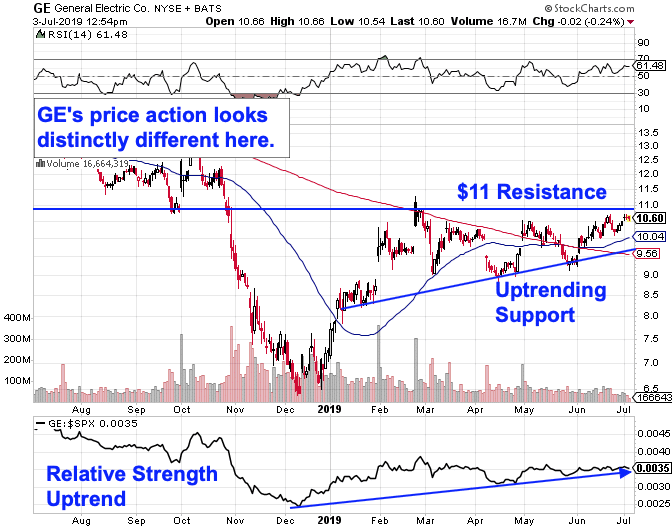
After systematically underperforming the rest of the market for more than two years now, GE’s price action is finally starting to show some signs of life.

Could GE become a buy this summer?

To figure that out, we’re turning to the charts for a technical look.

I haven’t been a fan of GE for a while now – the technical red flags started forming way back in early 2017, and they’ve only gotten worse in the intervening years.

Along the way, shares have been extremely technically obedient, selling off right on cue all the way down. But something important has changed more recently. Back in late April, GE was looking winded after bouncing higher at the start of 2019; with earnings on the horizon, I recommended selling a violation of $9 support.

Only that sell signal never happened. GE held $9, and shares have been building out a textbook bullish pattern ever since. With that context, it could finally be time to put GE back on your buy list this summer.

Shares are currently forming a long-term ascending triangle pattern, a bullish continuation pattern that’s formed by horizontal resistance up at the $11 level, with uptrending support to the downside. Simply put, a breakout above $11 is the signal that buyers have taken back control of shares.

A move through $11 clears the way to prior highs set in 2018.

For the first time in a long time, relative strength, the side-indicator down at the bottom of the GE chart above, is setting higher lows. That’s an indication that GE is starting to systematically outperform the S&P 500, quite a feat as the big index makes new all-time highs.

With shares hovering just below the $11 level right now, it might make sense to take a small starter position here with plans to scale into a full-sized trade once $11 gets taken out – that’s how I’m playing it. Doing that comes with a bit more risk than waiting until the $11 breakout happens, but it also comes with more reward.

From there, a logical place to park a protective stop is the 200-day moving average. If the 200-day gets violated, then GE’s bullish price setup has been invalidated, and you don’t want to own it anymore.

It’s a little too early to be outright bullish on GE this summer. But from a risk/reward standpoint, this blue chip is finally looking attractive for the first time in a long time.

Save 57% with our July 4th Sale. Join Jim Cramer’s Action Alerts PLUS investment club to become a smarter investor! Click here to sign up!

The True Art of Selling Stocks

The True Art of Selling Stocks

During my 16-year career as a Wall Street insider, I saw many fortunes made. Unfortunately, I also saw fortunes lost.

Among investors who lost money, the biggest reason was usually failure to protect profits and cut losses. Many investors are unaware that they can do just that by using a safe and effective strategy: the “trailing stop.”

A trailing stop is simply a stop-loss order set a certain percentage below the market – and then adjusted as the price rises.

So far this year, we’ve seen incredible volatility in the stock market.

Whenever a stock in our portfolio pulls back 25% from its closing high – or from our original entry point – we sell the stock at market.

Why do we depend on using trailing stops? Because they keep us from selling our stocks while they’re in a major uptrend – and prevent small losses from becoming unacceptable losses.

It’s true that many of these are great companies that will bounce back eventually. But “eventually” can be a long time. Our policy is not to argue with the market.

We buy based primarily on the near-term business prospects for our recommended companies. But we understand, too, that changes in fundamentals are immediately reflected in share prices. So that’s where we base our sell decisions.

Adhere To Your Trailing Stops, No Exceptions!

RECOMMENDED

World’s Shrewdest Shark: Invest with just $50″

Robert Herjavec: “This is a brand new way to make money. There’s never been anything like this”…

If we don’t adhere to our trailing stops and start making exceptions, our system will break down. And then – like so many investors – we’ll simply be flying by the seat of our pants, hoping our stocks will continue to rise… or stop falling.

I know some investors object, especially if they have faith in a company…

  • But you can’t bank on size and strength. Enron was the seventh-largest company in the United States.
  • You can’t always depend on quality, either. At one time, WorldCom had the most impressive array of telecom assets on the planet.
  • Nor will longevity protect you. Montgomery Ward was profitable for 100 years before declaring bankruptcy.
  • And I’m sure you’re familiar with the long and storied saga of General Motors.

However, if time passes and we recognize that we stopped out of a company due primarily to market volatility and not business fundamentals, we will often recommend the stock again.

Know When To Sell

But it’s important to have a sell discipline and stick with it. Using trailing stops and knowing when to sell a stock is the true art of investing… Anyone can buy a stock.


In a study published in The Journal of Portfolio Management, Christophe Faugere, Hany A. Shawky and David M. Smith – finance professors at the State University of New York at Albany – researched the performance of money managers who oversee pension funds, endowments and high-net-worth accounts.

Because most institutions work under strict investment guidelines, these academics were able to analyze performance based on differing approaches to selling stocks.

The result? Institutional managers who fared best were those with restrictive rules that did not allow leeway for hanging on to stocks for emotional reasons. The managers who relied on “flexible” sell strategies did far worse.

That’s unsurprising, really. When institutional investors see a stock moving against them, they are just as likely to rationalize as individual investors. And the culprit is always the same: pride, ego or emotion.

A Non-Emotional Sell Strategy

As Greg Forsythe, Director of the equity model development team at Charles Schwab, said, “Without any kind of sell strategy [e.g. trailing stops], emotions come into play. And emotions are almost always wrong.”

We recognize that our timing will never be perfect. (No investment system devised will ever beat the uncanny accuracy of hindsight.)

But, in our view, market prices generally reflect the prospects for a business better than “expert opinions.”

Using trailing stops protects both your profits and your principal. Not only by taking the emotion out of the investment process, but by basing your sell decisions on the realities of the market.

How A Trailing Stop Works

Let’s use a 25% trailing stop as an example.

After buying a stock at $20, you would immediately place a sell stop at $15, 25% below your purchase price. Under no circumstances should you lower your stop. It’s there to protect your principal.

However, you should adjust it upward as the stock begins to rise. When the stock hits $30, for instance, your 25% sell stop would be at $22.50, guaranteeing you a double-digit gain. When the stock hits $40, your sell stop would be at $30. And so on. This maximizes your gains – and ensures that your profits never slip through your fingers.

Traders, who are short-term oriented, will always want to run their sell stops closer than long-term investors. But even a short-term trader shouldn’t run his stops too close to the market. Why? Because no stock moves up in a straight line. And you don’t want to get knocked out of a winning stock while it’s just going through its normal fluctuations.

That can’t help but make you a more successful investor.

By adhering to a disciplined trailing stop strategy, you can mow down emotion-driven trading errors like a field full of dandelions. It cures greed. Eliminates fear. And does away with wishful thinking as in “I hope this stock turns around and starts going the right way.”

Trailing stops are a very effective way of managing risk. If you don’t have a sell discipline, you’re probably flying by the seat of your pants.

Why the Bluest of the Cannabis Blue-Chip Stocks Should Always Be in Your Portfolio

Why the Bluest of the Cannabis Blue-Chip Stocks Should Always Be in Your Portfolio

I first started following Constellation Brands Inc. (NYSE: STZ) over 30 years ago, long before it ballooned into the $40 billion giant we know today.

Back then, they were a much smaller and much different company.

In 1992, the company was called Canandaigua Wine Company, and it did a little less than $245 million in net sales per year.

At the time, Corona Beer’s growth story was just getting underway, and Canandaigua only had rights to it in about half of the United States.

Richard Sands was just taking over the business from his father, who founded the company. His brother Robert was rising through the ranks and would eventually join Richard in the executive suite.

Together, the Sands brothers envisioned a much larger company than the one their father built from scratch in 1945.

Fast forward to today, and this 70-year-old New York-based company has worldwide operations, roughly 40 facilities, and over 9,000 employees.

It’s a Fortune 500 company with a reported $7.33 billion in revenue, and more than $18.6 billion in assets, and is the industry giant behind brands like Robert Mondavi, Corona Beer, Svedka Vodka, and Black Velvet Whisky.

And today, I’m going to show you why I think this blue-chip stock is the one cannabis play every investor needs in their portfolio.

Editor’s Note: It’s Cannabis M&A Season!! And these 5 stocks are going to explode!

One of the Best Marijuana Stocks You Can Own

Over the years, Constellation has continued to impress me, and for a variety of reasons.

Along the way, the company told investors exactly what they were doing and why.

They set a level of debt relative to the company’s profitability and kept to it.

They shared industry information so that investors could see why their plans made sense.

And when they made a mistake, they quickly fixed the problem.

The Sands brothers are, in my opinion, the best corporate managers of any company in any industry in the world.

And the market agrees.

Since the end of Constellation’s 1992 fiscal year, its stock has outperformed the S&P 500 by over 20 times.

It has made investors more money over that time than Intel Corp. (NASDAQ: INTC) or Microsoft Corp. (NASDAQ: MSFT), and almost as much as Apple Inc. (NASDAQ: AAPL).

And it did it without the massive market growth those companies had to help them along the way.

So when the Sands brothers decided to get involved in the cannabis industry, that put to rest any doubts I might have had about the industry.

When they put an incredible $4 billion into the industry, that sealed it…

Constellation’s Game-Changing Cannabis Move

On August 15, Constellation Brands made the biggest splash in cannabis history after making a $4 billion investment in Canopy Growth Corp. (NYSE: CGC), a premier cannabis grower and distributor based in Ontario, Canada – claiming a 38% stake in the company in the process.


While that influx of capital instantly became the largest single- investment ever made in the cannabis market and equipped Canopy to be the “King of Cannabis” in Canada and around the world, it’s important to note that this wasn’t Constellation’s first stab at the cannabis market, or Canopy Growth, however.

In October 2017, Constellation decided it was time to get involved  in the legal cannabis market and bought a 9.9% stake in Canopy for roughly $191 million.

At the time, it was the first move by a Fortune 500 company or a major alcoholic beverage maker to own a stake in a cannabis business.

As part of the deal, Constellation can acquire as much as a 50% stake in Canopy over the next three years, should it exercise all available warrants. Constellation also has the opportunity to nominate four directors to Canopy’s board, which is comprised of just seven members, thereby having a controlling interest.

And yet, when people talk about investing in cannabis companies, they still tend to generally ignore Constellation’s stock.

Here’s why that is a mistake.

What’s Next for This Blue-Chip Cannabis Stock


Related: Pot is going mainstream… These HUGE companies are buying up little tiny pot stocks… These 5 are next


When it comes to this stock, I have no doubt of three things.

First, over time Constellation Brands will take full operational control of Canopy Growth and assume ownership of it.

Second, the Sands brothers have now once again gotten in front of a major trend and beat their competitors to the market.

Third, their competitors are going to follow suit.

That’s why I’m here to tell you that not only is Constellation Brands now a cannabis company, it’s now a cannabis company I think every investor needs in their portfolio, point blank.

Make no mistake, this is not a stock to trade.

It’s a stock to buy more and more of when your wealth increases, and when the inevitable share-price declines occur with an eye toward living off its dividends when you retire.

Constellation now has the assets and logistical wherewithal to become the biggest name in the marijuana market, one that will

continue to grow at high rates going forward regardless of whether or not the U.S. legalizes the product.

It’s a stable business, worth more than $7.5 billion in sales per year. It has a fixed infrastructure and multiple business relationships to leverage.

It’s true that Constellation shares fell a bit after the most recent earnings report. The major contributor to an earnings season some termed disappointing was a big jump in spending for marketing and for increasing production capacity in Mexico.

Well, marketing and growing capacity for popular brands is a good reason to spend cash, so it’s important to not fall in the mainstream gossip-chain surrounding this one.

There’s also one more thing…

Remember that, with its partnership with Canopy, Constellation now has the potential to add a new line of products to its current lineup.  It has the first-mover advantage in marijuana beverages just as the market takes off.

All of which proves to me that this stock has a big future in the next growing business: cannabis.