Home Blog Page 72

Procter & Gamble Is a ‘Buy the Dips’ Stock This Summer

Procter & Gamble Is a ‘Buy the Dips’ Stock This Summer

While it may lack the hype-factor of the latest tech IPO, shares of Procter & Gamble (PGGet Report) have been handing investors a banner year in 2019, surging more than 22.3% on a total returns basis since the calendar flipped to January.

No, a Beyond Meat  (BYND) it’s not.

But for a stock that’s as close to a prototypical defensive blue chip as they get, Procter’s market-stomping surge so far this year is worth paying attention to.

Better yet, there could be even more where that came from.

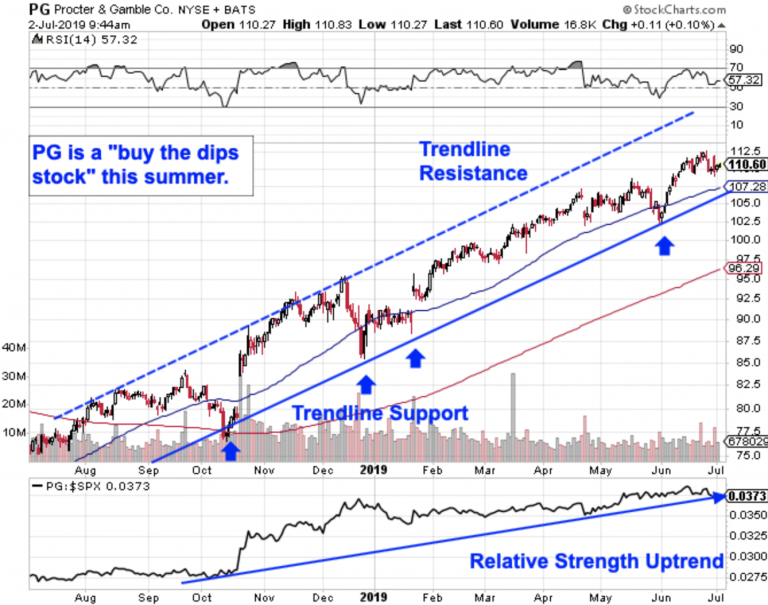
From a technical perspective, P&G is a “buy the dips” stock this summer. To figure out how to trade it, we’re turning to the charts:

You don’t need to be an expert technical trader to figure out what’s going on in shares of Procter & Gamble right now. Instead, the price action is about as straightforward as it gets.

Shares of P&G have been bouncing their way higher in a well-defined uptrend since the middle of last year. Put simply, ever test of trendline support on the way up has provided a low-risk, high-reward opportunity to add onto a position in shares.

In the very near term, shares look likely to correct lower. That’s not a contradiction of the longer-term trend, though. Instead, it means that Procter’s consistent pattern of rally from support followed by healthy correction looks likely to persist.

Currently, trendline support is just above the $105 level – a test of that price tag followed by buying pressure is the signal that buyers are still definitively in control of shares, so it makes sense to join them.

On the flip-side, it’s key to keep risk management in mind, at this point; all trends do eventually come to an end, after all. If that $105 level gets materially violated this summer, the uptrend has been violated, and you don’t want to own it anymore.

At this point, though, the rally is alive and well in shares of P&G. That’s confirmed by relative strength, the side-indicator down at the bottom of the chart above. Procter’s relative strength line has been in its own uptrend since last fall, signaling that shares continue to systematically outperform the rest of the broad market.

Shares have some correcting to do before they get back into “dip” territory. That said, Procter & Gamble looks more offensive than defensive this summer – and more touchdowns look likely for investors in 2019.

An Impressive Backend Play on the $23.4 Billion U.S. Cannabis Market

An Impressive Backend Play on the $23.4 Billion U.S. Cannabis Market

The list of conditions for which cannabis may prove highly effective at treating now totals 172 – everything from nausea and pain management to anxiety, blindness, epilepsy, and multiple sclerosis.

No other drug can make this claim.

Cannabis is so powerful medically because our bodies are wired to receive it. See, humans have an endocannabinoid system. It reaches into every major section of the body, allowing our cells to communicate with cannabis directly.

While the nation moves toward full legalization, it’s the biotech aspects that are the big driver here. It’s why more than twice as many states have made medical – instead of recreational – marijuana legal.

As savvy tech investors, we’re looking for a broad backend play. We want to avoid the risk inherent in a new drug while capturing the broad upside that medical marijuana holds.

Key Strategic Advantage


That’s what we’re getting with Innovative Industrial Properties Inc. (NYSE: IIPR). This firm sits at the nexus of cannabis and real estate.

It plays a crucial role in an industry lacking access to growth capital. While many cannabis operators acquire their own real estate up front, they have limited options for funding further expansions.

IIPR buys cannabis companies’ land and grow operations and leases the space back to clients on a long-term basis, snapping up the farmland that is best suited for the production of medical-grade, high-end cannabis. Those leases typically extend beyond 15 years, and IIPR builds in yearly rent hikes exceeding 3%.

IIPR’s strategic advantage is a strong balance sheet that helps it strike deals rapidly. That comes in handy at a time when competition in this area remains very limited due to cannabis’ ongoing federal prohibition.

In the states, this is already a major industry – 33 states and the District of Columbia having legalized medical cannabis, with 10 allowing recreational use.

Arcview Market Research says U.S. demand for legal cannabis will grow 20.8% annually to $23.4 billion in 2022. Medical cannabis accounts for around 40% of that market.

Growth and Income


IIPR has been growing its cannabis presence at a rapid clip. When it IPO’ed in December 2016, it had one property under contract to acquire – PharmaCann’s 127,000-square-foot facility in New York.

The firm has since bought another four properties in 2017 and another six in 2018. Through the end of last year, $167 million had been deployed in new deals. In 2019, the firm has spent another $87 million and says there is a brimming pipeline of new properties to acquire.

Real estate investors can typically expect a 5-7% annual cash-flow yield when buying industrial warehouses or other commercial properties.

Yet for IIPR, that figure is a whopping 14.7%, as the firm has very favorable terms in what it pays for land and then what it can secure in leases.

As just one example, IIPR bought a 266,000-square-foot industrial space in Saxton, Pennsylvania, in May for $13 million. The firm quickly lined up a tenant, Green Leaf Medical, for use of half of the space. Once another tenant is in, annual net rent on the property should be around $2 million and will rise from there thanks to rent increases.

IIPR is structured as a real estate investment trust (REIT), which means at least 90% of its earnings must be returned to investors each year in dividends.

And payouts are now rising at a rapid rate. IIPR’s dividend should rise around 75% this year and keep growing at a 30% clip in 2020 and again in 2021.

So this is a great combination of growth and income in a brand-new industry.

A Savvy Management Team


For cannabis investors, the importance of seasoned management can’t be underestimated. Gone are the days of the sector being dominated by artisanal growers and sellers.

These days, the field is attracting serious mainstream investments from sizable backers, like our very own Canopy Growth Corp. (NYSE:CGC) that received a $3.66 billion cash injection from beverage giant Constellation Brands Inc. (NYSE: STZ) last year.

Top-notch management teams are starting to become a key theme for the maturing cannabis industry, and I’m happy to report that IIPR has that in spades.

Chairman Alan Gold, for example, previously served as CEO of the life sciences REIT BioMed Realty, which was acquired by The Blackstone Group LP (NYSE:BX) in January 2016 for $8 billion.

CEO Paul Smithers previously founded Iso Nano International LLC, which designs and builds advanced materials for the aerospace and electronics industries.

And the leadership team has been in place since the firm was founded, a great sign of stability.

Crying All the Way to the Bank


When IIPR went public in 2016, the firm was met with derision from many quarters. One headline from CNN blared that “Marijuana Stock IPO Goes Up in Smoke.” The article noted that shares of the then-new IPO fell 4% on the first day of trading.

I’m glad Innovative Industrial Properties ignored the critics and built a great franchise. It helps explain why the stock has continued to rise despite snarky media attacks.

These days, the firm is focused on building its fast-growing real estate empire. It’s deployed $259 million to acquire 21 properties spanning 1.5 million square feet of grow space.

Thus far in 2019, it brought three new properties in California and two in Pennsylvania into the fold.

PharmaCann stands out as IIPR’s largest investment thus far. The $68.5 million purchase in May 2018 helps IIPR to profit from the strength of this multi-state, vertically built cannabis grower.

As of the end of the first quarter, IIPR had $59.2 million in the bank to snap up more properties. The firm has been able to raise capital on very favorable terms thanks to its remarkable cash-flow profile.

IIPR’s backers are also glad to invest in and lend to the firm because of its track record of snapping up primo real estate assets and leasing them to the most respected medical cannabis growers in the industry.

A Bright Future Ahead


That stellar reputation also helps when it comes to its clients. IIPR has built a great reputation from existing growers for the quality of the greenhouses it’s refurbished or built and for the ease of dealing with the firm to meet various capital needs.

Since IIPR sees such a high volume of appealing properties, it can afford to be selective. And this management team has a proven record of never overpaying for desired properties.

They nitpick every potential deal to ensure it will yield those very impressive cash-flow yields we discussed earlier.

IIPR is off to a terrific start in 2019. First-quarter rental revenue spiked 444% from a year ago, and adjusted earnings grew 275%.

The firm’s dividend is now rising at a very fast pace as a result. IIPR is serving a crucial role in the fast-growing cannabis industry – a proven buy-and-lease real estate strategy that’s a win-win for clients and investors. That makes this REIT a unique foundational play in a new and very lucrative industry.

Action to Take: Buy your first one-half position in Innovative Industrial Properties Inc. (NYSE: IIPR), and place a lowball limit for your next half-tranche at 20% below your entry price.

The Backend Biologics Play

Tearing up a $399.5 Billion Market

When it comes to building wealth, we at Wall Street Probe owe a lot to the 49ers.

No, I’m not referring to what was once my favorite football team.

I’m talking about all those miners who came from around the world back in 1849 to strike it rich in the golden hills of California.

Attracting an estimated 300,000 immigrants, the Gold Rush was the greatest migration at that time in U.S. history. It made San Francisco a boomtown and helped cement the state as a place where fortunes can be made overnight.

Here’s the thing. As a Silicon Valley veteran, I can’t help but think of one of the greatest – and most profitable – gold-rush ironies…

It was the merchants who really made it big – enterprising folks like Levi Strauss of the global jeans brand, John Studebaker (who made a fortune in the auto industry), and banking giant Wells Fargo.

12 Years and $2.5 Billion


Now you know why I’m always on the lookout for pick-and-shovel opportunities, which I often refer to as backend plays.

Just as it was back in the original Gold Rush, the idea is to make money on a broad sector filled with promise without risking too much capital on a single “mine.”

I believe it’s one of the best ways to invest in the many great breakthroughs in biotech today.

Biotech firms are often in a similar situation to the original 49ers. They take on huge risks with no promise they will ever make money.

But you can see what motivates them.

Global drug and biotech sales are worth more than $1.2 trillion a year. In other words, once a drug gets to market, the sales and profits are just off the charts.

And while many new drugs are lifesavers, this is a sector filled with heartache.

Consider that the Biotechnology Innovation Organization (BIO), a trade group, estimates that just 9.6% of drugs that scientists discover ever get approved for sale. The BIO study looked at 7,400 drug programs by 1,103 companies.

The costs and time spent in developing new compounds is even more daunting. A few years ago, the Tufts Center for the Study of Drug Development found that it costs $1 billion to get a new drug to market.

Tufts has since updated that study to reveal that the field is only getting tougher. It now forecasts that on average these days, it takes 12 years to go from discovery to commercial launch.

And the cost is a staggering $2.5 billion. Of course, that takes into account the costs of the many failed drugs as well.

A $400 Billion Market

That’s why I see a chance to score huge gains on a backend biotech supplier. Repligen Corp. (Nasdaq:RGEN) is great play in the fast-moving field of biologics.

Biologic drugs are produced from living organisms or contain components of living organisms. Such products include recombinant proteins, tissues, genes, allergens, cells, blood components, and vaccines.

Grand View Research says the biologics market will hit $399.5 billion by 2025, up from $276.6 billion in 2015.

The Quiet Biologics Leader


Don’t worry if you’ve never heard of Repligen. Most investors haven’t. It just may be the quietest firm in its sector.

But make no mistake: We have a real winner on our hands.

With a market cap of just $3 billion, the company is set to double its earnings per share in less than three years. Sales are also on pace to double by the end of 2021.

Based in the Boston suburb of Waltham, Massachusetts, the company makes and supplies the high-value ingredients other biopharma firms use for their own pharmaceuticals.

Because it’s a supplier rather than a drug maker, Repligen gives us the big upside potential of new drug development. But with this play, we simply don’t have the downside risks and long waiting times posed by the U.S. Food and Drug Administration (FDA) approval process.

Repligen is a major provider of a substance known as Protein A, which is used to produce many leading drugs. For instance, Protein A is used to separate and purify cancer fighters known as “monoclonal antibodies.”

And monoclonals are on the rise. To date, some 85 have hit the market, a roughly 50% increase since 2015. Plus, there are now roughly 400 more in various stages of the clinical pipeline.

The firm also supplies products that help with gene therapy, antibodies and vaccines, as well as the cutting-edge bioprocessing of nanoparticles.

The firm is literally targeting the global supply chain for biologics. Besides the Boston area, Repligen has operating plants in California, Germany, and Sweden.

And it boasts crackerjack leadership. CEO Tony J. Hunt joined in 2014 after the firm he was running got acquired by Thermo Fisher Scientific. He has a master’s in biotechnology as well as an MBA.

Four Pillars of Success


Repligen boils down its wide-ranging list of products and services into four main fields…

Bioprocessing of living cells or molecules, worth $9 billion a year.

Filtration of biomaterials, worth $900 million a year.

Proteins used in biotech products like monoclonal antibodies, worth $475 million.

Chromatography used to process and purify biotech compounds, worth $180 million a year.

No wonder Repligen is bucking the overall stock trends in biotech and Big Pharma today.

Wall Street is concerned that during the run up to the 2020 presidential election, candidates may propose price controls on health care.

And President Trump has said he wants to put the squeeze on drug prices as part of what he sees as a populist mandate.

These two factors explain why bellwether indices for biotech and Big Pharma are getting beaten by the S&P 500, which is up 9.8% so far this year. Biotech stocks are up just shy of 4%, while drug stocks as a group are down 8.4%.

By contrast, RGEN has gained nearly 32%, a little more than triple the S&P’s return this year. But there’s still plenty of upside remaining.

Over the past three years, the firm has grown its earnings by 25% and doubled to 60% in the most recent quarter.

Based on this strong track record, I believe we have a shot at making 75% over the next four years. It’s a conservative forecast.

The numbers show earnings should double in about 32 months. But I cut that back to account for any slowing economic growth over the next couple of years.

Actions to Take: Buy half your intended stake in Repligen Corp. (Nasdaq:RGEN) at market, and then put in a lowball limit order for the second half-stake at 20% below your entry price.
What Angel Investors Want Now

What Angel Investors Want Now

What’s hot with angel investors?

U.S. angel investment trends are shifting. The mobile sector is getting ever more attention and the health-care sector is losing dollars, according to the second annual Halo Report, released today from the advocacy organization Angel Resource Institute, entrepreneur-focused Silicon Valley Bank, and the National Science Foundation‐backed data research firm CB Insights. Data from 783 deals totaling $1.1 billion invested was collected both by survey and research of public data by the New York City-based CB Insights. Also, there is an increasing proliferation of angels in the Northwest and Southwest U.S., the report notes.

Internet-based and health-care startups often claim the lion’s share of the investment dollars from angels, but that’s changing. The percentage of dollars that went to health-care startups shrank in 2012 and the percentage of dollars that went to mobile-based startups grew. Here’s a look at the breakdown of sectors, by dollar volume, where angels invested in 2018:

  • Internet: 31.9 percent
  • Healthcare: 20.9 percent
  • Mobile and telecom: 13.3 percent
  • Industrial: 6 percent
  • Electronics: 3.8 percent
  • Consumer product and services: 5.3 percent
  • Services: 4.5 percent
  • All industries that don’t fit into the aforementioned categories: 14.2 percent

Here are some questions you might have about raising money from an angel investor with answers from the Halo Report.

How much money can I expect to get from an angel? The most common investment size in 2012 was $600,000, down slightly from the median investment of $625,000 in 2011. If you were hoping for a larger investment, however, there is indication that investment sizes are growing. In the final three months of 2012, the most common investment was $690,000.

How big should my company be to seek angel investment? For the past two years, the value of the companies receiving angel investments has held steady at $2.5 million.

Do I need to be making money already to pitch an angel? You don’t have to, but it helps: 63 percent of companies that received angel funding had revenue to point to.

Related: How You Can Invest in Private Companies just like “Shark Tank”– For as Little as $50

What if I have never received investment before? Don’t worry. Angel investors typically seek out early-stage startups that aren’t big enough for the venture-capital firms. Last year, 56 percent of angel investment deals were with new companies that had never before received funding from an angel investor.

Am I going to be working with a single person? It’s possible, but in recent years, the trend has been toward having more than one angel investor in a single fundraising. Almost 70 percent of angel investment deals were co-investments in 2012, up from 64 percent in 2011 and just 41 percent in 2010. When you have more than one angel backing your company, you get more money: the median investment size in a startup with multiple investors was $1.5 million. As co-investing becomes more common, however, the size of a co-investment has been falling, down from $1.63 million in 2011 and $1.92 million in 2010.

Where are these angels? The East and West coasts of the U.S. continue to be primary hubs for angel investing, but activity in the Northwest, and Southwest regions of the U.S. are seeing more activity. Ranked by number of deals completed, here is a look at the most active angel groups:

The best group we know of so far is The Angel and Entrepreneurs Network.You can watch their intro video here. Neil Patel, and Shark Tank‘s Robert Herjavec reveal an investing technique that has remained exclusive to the ultra-rich: “$50 with this could be life changing”…[Full Story]

How to Invest in Cannabis IPOs

How to Invest in Cannabis IPOs

Cannabis investing is being called the new gold rush for good reason.

Cannabis investing is being called the new gold rush for good reason.

It’s rare when investors have a chance to get in on a ground-floor opportunity that can lead to life-changing wealth.

Buying the right cannabis stocks now could be like buying Apple or Microsoft when they first went public. The only difference is the cannabis industry is going to be bigger and move faster than anything we’ve ever seen before.

That’s why inexperienced and experienced investors alike want to know how to get in on the booming marijuana market right now. They want to invest in the “Apple” and the “Microsoft” of cannabis.

To do that, it all starts with cannabis IPO (initial public offering) investments.

This is when a company decides to open its door to the public. Those who buy shares own a piece of the company and all the rewards and risks that come with being a shareholder. In turn, the company uses that money to hire staff, expand operations, build out its technology, and do a bunch of other things that will hopefully help the company make more money down the road.

The more money a company makes, the more investors want to own it, and those investors are generally willing to pay more to get a piece of it.

Of course, with cannabis investing in general being so new, we here at the National Institute for Cannabis Investors wanted to take some time and help answer some common questions potential cannabis investors typically have.

If you’re new to the investing world, everything can seem intimidating.

However, we’re going to break things down and cut out all the financial jargon.

Today, we’re going to show you exactly how to get up and running and ready to invest in your first cannabis IPO, and it’s easy to get started!

It doesn’t matter if you live in a state where cannabis is illegal. With the right large brokerage firm, you are going to be able to have the option to buy shares of cannabis companies that are listed on the NasdaqNew York Stock ExchangeCanadian Securities ExchangeToronto Stock Exchange, or through over-the-counter markets (OTCMKTs).

Now, before we get any further, we want to clear up one of the biggest misconceptions about cannabis IPOs and IPO investing in general.

Let’s jump right in…

Part 1: What to Know about Cannabis IPOs

One of the biggest misconceptions about cannabis IPOs is that there is a way to get in “early” before the company goes public. The only people who are normally able to buy shares of a private company are hedge funds, big banks, and well-connected investors.

There just isn’t a way for the average retail investor to own shares of a company like Facebook before everyone else can buy it.

However, you still can make a ton of money with cannabis IPO investing.

Just take a look…

Company IPO Date IPO Price (Close) Peak Price Gain from Peak
Aurora 12/16/2014 $0.73 $16.24 2,125%
Canopy 4/4/2014 $2.59 $76.68 2,861%
Cronos 2/4/2019 $0.80 $32.95 4,019%


Over the past few years, for those who have taken the risk, cannabis IPO investing has been extremely profitable.

Those won’t be the only big gains the industry will offer.

Of course, there are risks when it comes to investing, and that is especially true with cannabis stocks. You should never invest what you can’t afford to lose. That makes you emotionally attached to your investments, and when you are emotionally attached, it is hard to think logically.

That’s why it’s a good idea for many new investors to start small so they don’t get overwhelmed.

Now, if you already have a brokerage account, you can skip the next section. If you don’t, then you will need to check it out in order to start buying cannabis stocks. 

Part 2: Opening a Brokerage Account

Before getting into a cannabis IPO, you need to set up an account with a broker.

To make it easy, we have included a list of brokers to help you get started. It’s fairly simple to set up an account online and can take as little as 10 minutes. But if you find you need additional help, we have included the website for each company.

When your account is set up, you will be able to transfer money from your bank account into your brokerage account and buy a cannabis IPO.

The brokers listed below will allow you to trade stocks listed in the U.S. and Canada.


Charles Schwab Fidelity Interactive Brokers


There is no minimum balance for a Charles Schwab account, and the commission fee for stock trades is $4.95. Fidelity also has a $0 account minimum and charges $4.95 per trade. Interactive Brokers has a different price structure in place than most other brokers, and you can dive more into those details here.

Our members have also said they’ve had success with trading Canadian stocks on TD Ameritrade, but you will need to call in and talk to a live broker to make such a trade. TD Ameritrade does not have a minimum to open an account and charges $6.95 per trade.

You can’t buy Canadian stocks on E-Trade or TradeStation Group Inc., but you can buy stocks traded on major exchanges and on over-the-counter (OTC) markets. On E-Trade, you need a minimum of $500 to open an account, and it costs $6.95 per trade. TradeStation charges $5 per trade and has an account minimum of $5,000.

Now, let’s talk about how much money you need to get started with your cannabis investments.

Part 3: How Much Money Do I Need to Invest in Cannabis IPOs?

New investors ask this question a lot, but the only person who can answer it is you.

The National Institute for Cannabis Investors cannot offer personalized financial advice. On top of that, no one knows your risk tolerance better than you.

But a good rule of thumb for any type of investment is that you should never invest what you can’t afford to lose. When people become emotionally tied to their investments, they make rash decisions – and that can lead to a big loss.

We can’t stress that enough.

For example, you shouldn’t take the money you normally put towards a mortgage or a car payment and buy stocks with it. In any investment, there is always a chance that you could lose all of your investment, and then you would be in a very tough spot.

If you’re in this for the long haul, patience is going to be your friend.

You don’t have to place all of your money in one particular stock all at once. Over time, you can slowly build a position.

For a specific example, you will have to pay whatever the shares are trading for. If the shares of a company are trading for $10 per share and you want 10 shares, you will have to pay $100 (not including commission fees).

That’s why it’s important to determine how much money you want to dedicate to your cannabis investments each week, month, quarter, or year. You will want to do that well in advance of actually buying a stock, so take your time making a game plan!

Part 4: What to Do on the Day of the IPO

When a company begins trading on an exchange, that is when you will be able to buy shares. Of course, you must have your brokerage account set up before this.

You can do it all online, but if you need additional help, you can always call in to the customer service department at your brokerage firm. They should be more than able to help walk you through the process.

The stock may not begin trading right away, but you should be able to buy shares at some point during the day shortly after the market opens.

When investing in cannabis IPOs on your own, there are a few things you can do.

One is to put in a limit order on the maximum price you are willing to pay the first day a company goes public. That’s part of being a tough and patient trader and trying to get in at the best possible price.

However, if you believe in the company for the long haul and you can see yourself holding onto the stock for a decade or more, it really doesn’t matter if you pay for the stock while it’s trading at an intra-day high.

So if you really want a piece of the company, you can buy shares as soon as it starts trading.

Another option is to just wait to see how things play out.

As excited as we are about cannabis IPO investing, sometimes the market conditions aren’t favorable for a company going public, so we wait to pick our time to strike. Even though we see cannabis stocks as eventually having the potential to be recession-proof, overall bad market conditions can knock prices down.

No one can control trade wars, geopolitical tensions, slowing smartphone sales, or potential fallout from Brexit.

Remember that it’s okay to wait before purchasing a cannabis IPO. When it comes to investing, Warren Buffett compared it to baseball. He said he doesn’t have to swing at every pitch. He can wait for the one that is right for him, and that gives him a better chance of hitting it out of the park.

When it comes to cannabis investing, you only need a few big winners.

Conclusion

Investing in IPOs can be risky. If anyone tells you otherwise, they are lying.

In most cases, you are placing your trust in what a company could do instead of a proven track record of success.

That’s especially true with cannabis companies.

Not only are most cannabis companies new as businesses, they are also operating in an industry that still is illegal under federal law in the United States. While we believe full legalization is a matter of “when” and not “if,” there are still a lot of issues a cannabis company faces compared to a business from a more traditional industry that is going public.

Having said that, investing in the right IPOs can be extremely lucrative.

Not every company from the tech boom was a winner, but just talk to the folks who originally bought Apple or Amazon when they first went public.

There are going to be clear winners and losers, but make no mistake that the future winners will have the ability to create life-changing wealth.

At the Wall Street Probe, we wish you success on your investing journey, and we truly believe you have identified one of the biggest and best industries to invest in!

Stock to Buy: This Pot Stock Pays Its Shareholders

Stock to Buy: This Pot Stock Pays Its Shareholders

Reform to federal cannabis laws continues to move in a positive direction. It’s just about impossible to miss as the data – and the subsequent opportunities – stacking up.

There are 33 U.S. states and the District of Columbia offering some level of legalization.

Agencies like the U.S. Food and Drug Administration are fast-tracking cannabis-based pharmaceutical research and testing, even approving one product (Epidiolex by GW Pharmaceuticals) that has since been rescheduled by the U.S. Drug Enforcement Administration. It’s now a Schedule 5 drug, alongside of Robitussin AC, instead of on Schedule 1, which includes heroin.

And a majority of likely Republican voters support legalization in a host of polls.

Yet, there federal illegality continues to leave a number of obstacles in place for cannabis businesses… two of the biggest being access to capital and tax relief.

Cannabis companies find it difficult or even impossible to borrow money because of federal banking regulations. What that means is that they have to build their growing operations with equity capital, which can seriously damage the company’s return on equity, a key profitability measure.

On the tax side, provision of the tax code called 280E hold back any company that produces or sells a product on Schedule I of the Controlled Substances Act

Relief may be on the way from the U.S. Congress in time. Among the 70 active legislative proposals in the House and Senate during the current session, several would address these banking and tax codes. However, several of these efforts remain stalled and, even upon passage and a presidential signature, it will take time for the effects to make their way to companies that need it.

And there’s the beauty of an industry as creative as cannabis is: when a problem exists, someone with intelligence, an innovative spirit, and a little bravery crafts solutions to big problems.

One company does just that for the banking and tax issues. And for many reasons, it’s worth adding to any cannabis portfolio.

Innovative Industrial Properties, Inc. (NYSE: IIPR)

Innovative Industrial Properties (NYSE: IIPR) is a rarity in the cannabis business: It is profitable, pays a dividend, and has been traded on a major U.S. exchange for more than just a few months.

Innovative Industrial Properties is a real-estate investment trust (REIT) focusing on medical-cannabis growing facilities. A REIT is a special form of company which does not pay income taxes; in exchange for that privilege, it must distribute substantially all of its income as dividends.

Innovative Industrial buys growing operations from established cannabis companies and leases the spaces back to those proprietors.

These deals create a huge, and typically needed, influx of cash for the cannabis companies. They can then invest in various areas critical for growing its business – inventory, sales staff, marketing, even new facilities.

For Innovative Industrial’s part, the company gets an above-market return on real estate leasing.

Leasing a property instead of owning it also allows a cannabis company to create a string of tax-deductible payments instead of creating depreciation, which is more troublesome to deduct. It is particularly difficult for smaller companies that use cash accounting instead of Generally Accepted Accounting Principles (GAAP).

One Million Square Feet in Sight

Through fall 2018, the company owned nine properties in seven states… all leased to medical cannabis growers. Innovative Industrial had 875,000 rentable square feet.

IIPR minimizes operational risk by purchasing properties that are already in use or under construction. The company avoids building any growing operations “on spec,” which is to say they don’t build anything in hopes to lease it out later.

The company, however, has entered into deals where Innovative purchases a piece of property and custom-builds a facility to suit an intended customer. Our researchers expect this form of deal to increase for IIPR as industry growth demands larger and more complex construction projects.

The company’s properties are generating an average 15% yield. That’s more than 50% better than the average commercial real estate investment.

State Tenant Square Feet
Arizona The Pharm 358,000
Maryland Holistic Industries 72,000
Massachusetts PharmaCann 58,000
  Holistic Industries 55,000
Michigan Green Peak 56,000
Minnesota Vireo Health 20,000
New York PharmaCann 127,000
  Vireo Health 40,000
Pennsylvania Vireo Health 89,000

Currently, Innovative Industrial leases exclusively to customers in the medical cannabis industry.

However, Massachusetts recently legalized cannabis for recreational use. NICI believes that both of IIPR’s tenants there will sell to the recreational market.

Similarly, NICI expects New York to allow recreational use soon, as well… those tenants will surely seek permission to sell into the recreational market.

Finally, Innovative Industrial is currently in negotiations to acquire a property in Colorado. Colorado boats one of the most robust adult-use cannabis markets in the country. Accordingly, we expect IIPR to adjust its stated strategy of leasing only to medical cannabis growers.

That change would increase their total addressable market.

Cash is King in Cannabis and Real Estate

Following a recent equity issuance, IIPR has more than $200 million of cash and short-term investments on its balance sheet to make acquisitions. Those funds will go toward more properties with a similar return profile, more than doubling its invested capital. After that, the company’s options increase.

Innovative Industrial also carries no debt.

And because the company does not directly deal in cannabis, raising debt will be an option, going forward. Given the company’s high returns on leasing compared with the cost of debt, taking on some leverage would substantially increase the company’s return on equity.

Alternatively, the company could take a more conservative position, raising equity when the stock is high. This route would be less lucrative for new shareholders, but it would still be good for existing shareholders at the time of the capital raise. That’s because the new money would be coming in at a higher price than previous investors paid.

Because the company leases its properties on a “triple-net” basis -tenants pay for everything involved in operating the property – Innovative Industrial’s operating expenses grow slower than property rents, increasing profit margins.

The high returns and fast growth of Innovative Industrial will allow the company to increase its dividend over time. Unlike most cannabis companies, where revenue and eventually profit growth are the stories and dividends are not even issued, dividends are the main attraction of the REIT world.

So, an increasing dividend tends to indicate an increasing stock price.

As a company that will be producing profits and even dividends right from the beginning, more traditional value metrics apply to Innovative Industrial than to most cannabis businesses. And there’s good news on that front.

Despite the stock more than doubling over the past 12 months, Innovative Industrial remains an attractively priced stock compared with its growth trajectory.

Management seems well-suited to the task of growing the company. The executive chairman and much of the management team previously built a REIT dedicated to the biomedical industry, which has similar regulatory and zoning problems.

They sold that company for more than $8 billion.

An $8 billion deal is a tall order for Innovative Industrial. But the company has a highly profitable real estate niche in the cannabis industry, a huge pile of cash to put to work, a growing dividend, and a management team with proven REIT success.

All of that makes Innovative Industrial one of the lowest-risk ways to invest in the cannabis sector.

Thanks for being an important part of Wall Street Probe